



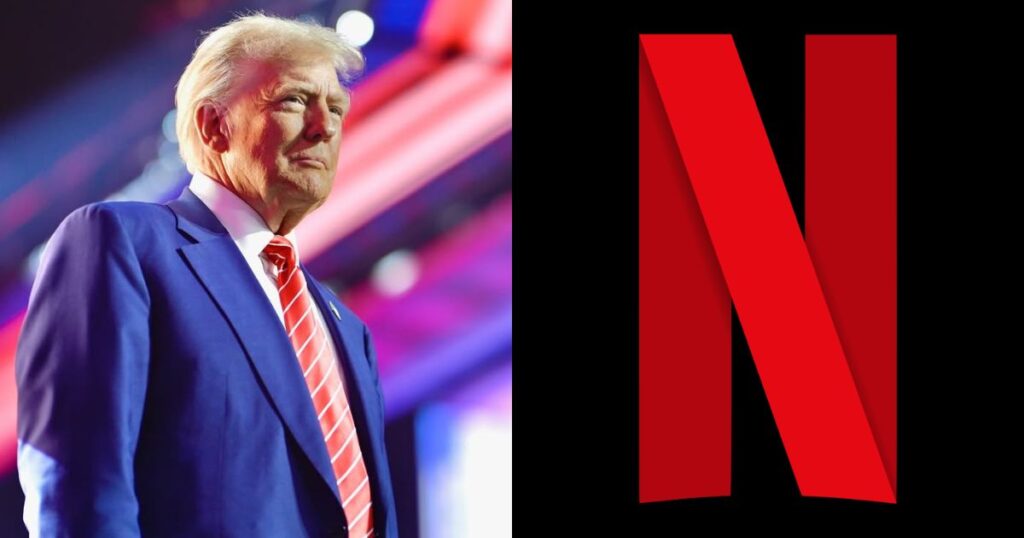
Donald Trump was the latest public figure to weigh in on the historic Netflix and Warner Bros. merger. According to the BBC, the U.S. President attended an event at the John F Kennedy Centre in Washington, DC, on Sunday, December 7, 2025.
During the event, Trump flagged concerns over Netflix’s proposed $72 billion deal to buy Warner Bros. film studio and HBO streaming platforms. He reportedly noted that Netflix already has a “very big market share,” which will likely “go up by a lot” if the deal with WB studios becomes a success.
The President also mentioned that the combined size of the firms “could be a problem.” Trump further revealed that he would be part of the final decision-making on whether the proposed deal would get the approval of the authorities and move forward in real time.
He also shared that Netflix co-CEO Ted Sarandos recently visited the Oval Office. While Donald Trump repeatedly drew attention to the streaming giant’s market share, he also praised Sarandos’ work at the company. “I have a lot of respect for him. He’s a great person,” the President noted, adding, “He’s done one of the greatest jobs in the history of movies.”
Donald Trump says he will be involved in the decision on whether Netflix should buy Warner Bros.
“Netflix have a very big market share and when they have WB, that share goes up a lot. I don’t know that’s gonna be for some economist to tell, I’ll be involved in that decision too” pic.twitter.com/zCjC28p3JF
— DiscussingFilm (@DiscussingFilm) December 7, 2025
Trump’s comments come days after Netflix and Warner Bros. announced that they have reached an agreement to merge the two media giants. Netflix edged past Paramount Skydance and Comcast, offering a massive $72 billion deal to take over WB studios.
In perhaps one of the most remarkable Hollywood deals, the agreement would move major global franchises under WB/HBO, like Harry Potter, Game of Thrones, The Lord of the Rings, Looney Tunes, and The Matrix, among others, to Netflix.
As reported by the BBC earlier, despite the merger, movies under Warner Bros. films will continue to have a theatrical release, while Warner Bros. TV studio will be allowed to produce for third parties. Meanwhile, Netflix will continue to make content for its own streaming platform.
The deal, which is eyeing completion after Warner Bros. completes its planned corporate split by the second half of 2026, is pending approval by competition authorities. Netflix, which is already considered one of the biggest entertainment entities in the world, may further establish its position if the deal becomes a success.
Netflix announces that it has acquired Warner Bros., including HBO Max and HBO, in a deal valued at $82.7 billion.
Franchises such as The Big Bang Theory, The Sopranos, Game of Thrones, The Wizard of Oz and the DC Universe are set to join Netflix as a result. pic.twitter.com/TS2W7EhRzy
— Pop Crave (@PopCrave) December 5, 2025
However, the US Justice Department’s competition division, which reviews large-scale mergers and acquisitions, could argue the deal violates antitrust law if the combined companies end up controlling too much of the streaming market.
Meanwhile, not just Donald Trump but several other experts have also shown concerns over the deal. The Writers Guild of America’s East and West divisions criticized the merger by defining the move as “the world’s largest streaming company swallowing one of its biggest competitors is what antitrust laws were designed to prevent.”
In a statement issued on Friday, December 5, 2025, WGA stated, “The outcome would eliminate jobs, push down wages, worsen conditions for all entertainment workers, raise prices for consumers and reduce the volume and diversity of content for all viewers.”
However, Ted Sarandos mentioned that Netflix remains “highly confident” that the deal would get the required approval. “Warner Bros have defined the last century of entertainment, and together we can define the next one,” he stated, adding that while surprising, the move would place Netflix in a position to achieve immense success in the “decades to come.”