

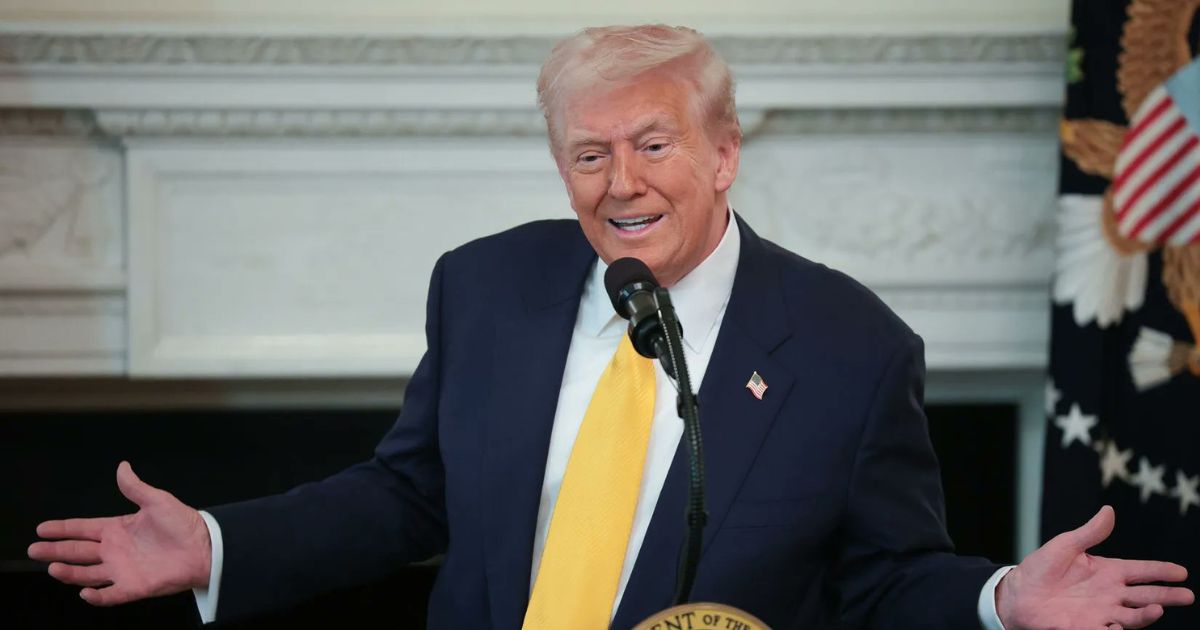
Donald Trump has decided to sign a “one-rule executive order” that would limit the ability of U.S. states to regulate artificial intelligence (AI). The U.S. President has instead proposed a centralized national approach, arguing that a singular and unified rulemaking process would help the U.S. maintain its dominance in the artificial intelligence market.
On Monday, Dec. 8, 2025, Trump took to his social media platform, Truth Social, to highlight the necessity of following “one rulebook” for regulating AI. He also mentioned that if “bad actors” continue to be part of the rulemaking and approval process, “AI will be destroyed in its infancy.”
“There must be only One Rulebook if we are going to continue to lead in AI. We are beating ALL COUNTRIES at this point in the race, but that won’t last long if we are going to have 50 States, many of them bad actors, involved in RULES and the APPROVAL PROCESS,” he wrote.
“THERE CAN BE NO DOUBT ABOUT THIS! AI WILL BE DESTROYED IN ITS INFANCY! I will be doing a ONE RULE Executive Order this week. You can’t expect a company to get 50 Approvals every time they want to do something. THAT WILL NEVER WORK!” Trump added.
Donald Trump’s announcement comes after Congress refused to rule in favor of overriding state-level approvals on AI. However, the industry has repeatedly stated the necessity of revoking distinct AI laws passed by the different U.S. states.
Donald Trump says he will sign an executive order this week that will limit the ability of states to regulate AI pic.twitter.com/q5JEoXKOgs
— Culture Crave 🍿 (@CultureCrave) December 8, 2025
If Trump’s attempt to centralize AI regulation becomes successful, it might largely benefit big tech companies that have established good relationships with the White House. However, the move might draw opposition from state leaders who have highlighted the importance of state-level AI regulation to protect the interests of the residents.
Florida Governor James Fishback has already mentioned that the state would hold its ground. “I respect President Trump, but as Florida Governor, I’ll take a full states-rights view of AI so our state—not the tech bros—decides what gets built on our soil,” he wrote on X (formerly Twitter).
“We will *block* any AI data centers that would drive up our electric bills, and we will push back against any AI scheme that tries to shape the minds of our children. Florida will stand its ground,” the Governor concluded.
I respect President Trump, but as Florida Governor, I’ll take a full states-rights view of AI so our state—not the tech bros—decides what gets built on our soil.
We will *block* any AI data centers that would drive up our electric bills, and we will push back against any AI… pic.twitter.com/wUp8NOJihB
— James Fishback (@j_fishback) December 8, 2025
The President’s latest action is another example of his efforts to remain competitive in the AI landscape, which has attracted trillions of dollars in corporate investment. According to The Mirror, a 2024 Stanford University AI Index Report revealed that companies have already invested $37 billion in private AI infrastructure across the globe.
Donald Trump has continued his efforts to place the US at the helm of the race to innovate, create, and control AI, a technological field that is on the verge of transforming the future of the world and how it functions.
Trump just confirmed he’ll sign an executive order banning states from regulating AI.
It’s a huge victory for Big Tech, which has spent millions lobbying to stop guardrails against AI. pic.twitter.com/85aj18KvVo
— Robert Reich (@RBReich) December 8, 2025
Nearly a month before announcing his decision to sign the executive order, Trump promised to establish “one Federal Standard” to rule AI and control what he dubbed “over-regulation” of the technology by some U.S. states. The president sparked immediate backlash, even from certain Republicans and MAGA supporters, earning accusations of giving in to Big Tech.