



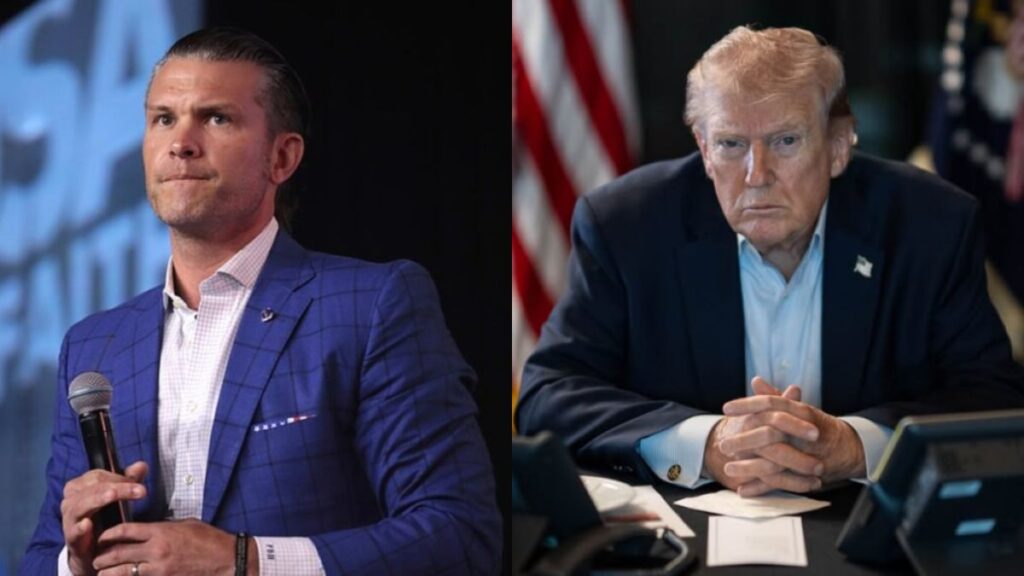
Three weeks into the conflict with Iran, Donald Trump has shifted the blame for the conflict to one of the key defence figures in his inner circle. Pete Hegseth was allegedly the first one to encourage Donald Trump to go ahead with an assault on Iran, specifically because the country was in the midst of acquiring nuclear weapons.
Speaking at a Memphis Safe Task Force, Trump singled out Hegseth as the first member of his team to steer the conversation towards conflict. He said, “Pete, I think you were the first one to speak up, and you said, ‘Let’s do it because you can’t let them have a nuclear weapon”
Trump blames Hegseth for the war: “Pete, I think you were the first one to speak up. You said, ‘Let’s do it.'” pic.twitter.com/QBGeFuhM1M
— Aaron Rupar (@atrupar) March 23, 2026
Pete Hegseth has been a key figure in the war, serving as an almost exclusive source of information about the conflict. The conflict seems to have taken significantly longer and has caused significant issues for global energy security. Frequent back-and-forth exchanges between Iran and Donald Trump have caused oil prices to fluctuate. Control over the Strait of Hormuz has been a key issue in the war since Iran chose to close it.
Donald Trump has stopped further strikes on Iran for five days, citing that productive conversations are being held with key Iranian figures. Allegedly, there has been a deal that Iran and the U.S. could control the Strait of Hormuz jointly. However, no confirmation of such a deal has been made so far. These talks, Trump revealed, would also result in a complete resolution of hostilities between the West Asian country and the United States and Israel.
FT Exclusive: Traders made bets worth half a billion dollars in the oil market about 15 minutes before Donald Trump’s post touting ‘productive’ talks with Iran sent the price of crude tumbling https://t.co/KVa0cZRLn0 pic.twitter.com/xgoNhudES0
— Financial Times (@FT) March 23, 2026
The Iranian Regime has called out these claims, saying that these talks are aimed at reducing oil prices and nothing else. Oil prices globally have taken a hit, soaring since the start of the war three weeks ago. Mohammad Bagher Ghalibaf has been looked at as a possible backchannel negotiator for the Iranian Regime, but analysts believe that there could not be a worse choice.
Given his hardline anti-United States stance and the hold that the Iranian military elite has on the political and diplomatic matters of the country, it is unlikely that Ghalibaf is going to be able to give the United States any benefit that it seeks from ending the conflict. Further, all eyes are trained on Israel as well, which has differed from the United States on multiple objectives during the conflict.


