

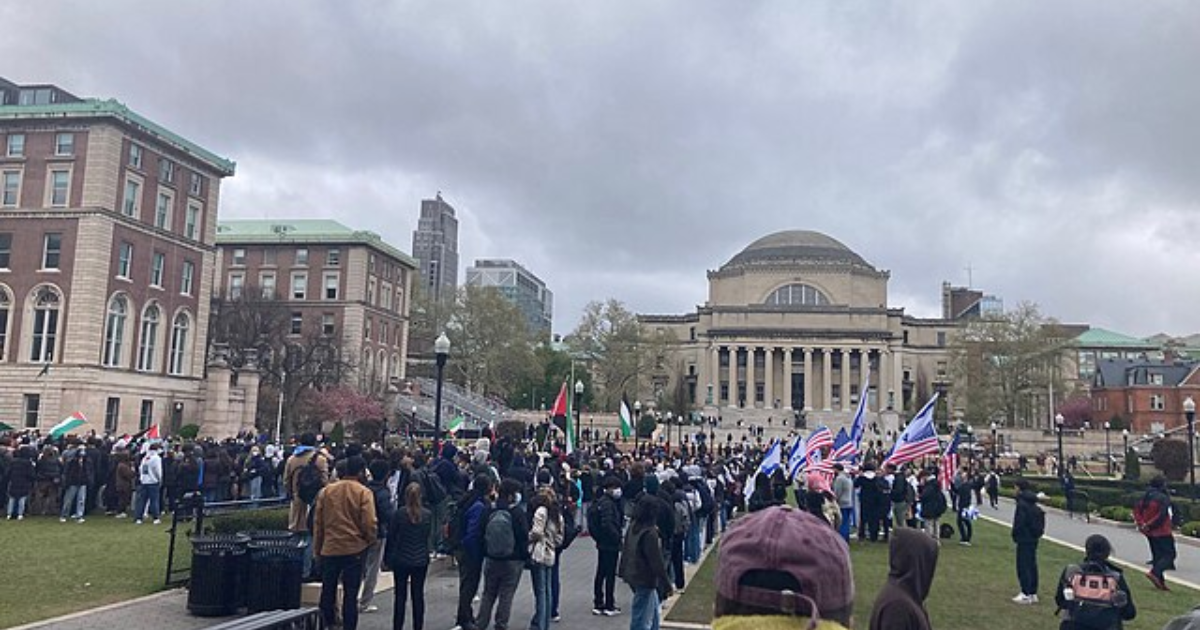
Tensions related to ICE recruitments arose this week at Columbia University after faculty members and students protested the promotion of a federal immigration recruitment event on the school’s website. This prompted administrators to remove the listing within hours.
According to The New York Post, the controversy began when Columbia’s School of Professional Studies posted an announcement for a Feb. 18 virtual career expo hosted by U.S. Customs and Border Protection (CBP). The event was described as a chance to “Help defend the homeland.” It was aimed to fill thousands of “mission-critical positions” across agencies within the Department of Homeland Security (DHS).
Tonight at Columbia University, a women’s basketball game was interrupted when student protesters targeted trustee Jonathan Lavine’s scheduled halftime remarks.
ICE is in the picture at Columbia because some students are facing real consequences. If their peers refuse to accept… pic.twitter.com/HSIdltFnCJ
— Stu Smith (@thestustustudio) February 14, 2026
The official description read, “This is a unique opportunity to learn more about our mission and how you could contribute to it, making a positive impact on yourself, your community and your country.”
Soon after, critics on campus voiced strong objections. Journalism professor Helen Benedict wrote on social media: “Capitulation. Columbia is recruiting for ICE. Alumni write in now. Cancel donations.” Meanwhile, fellow journalism professor Nina Berman wrote, “The depravity is bottomless.”
A coalition of faculty members circulated a letter demanding that the university remove the posting. “This event undermines campus trust, makes parts of our community feel targeted or unsafe, and further damages Columbia’s public standing by reinforcing the view that we are complicit in the turn towards authoritarianism,” the letter stated. “Silence will be read as consent.”
The university’s chapter of the Young Democratic Socialists of America also protested the listing. They argued that Columbia was “actively facilitating the recruitment” of federal agents. The group referenced the deaths of two individuals, including ICU nurse Alex Pretti, and named Border Patrol Agent Jesus Ochoa and CBP Officer Raymundo Guttierez in its statement.
The dispute comes as Colombia continues to navigate intense political scrutiny. In 2024, its Morningside Heights campus became a centre of attention for nationwide pro-Palestinian protests. The demonstrations led to federal civil-rights investigations over antisemitism concerns and threats from the Trump administration to withdraw $400 million in federal funding. After negotiations, the university agreed to a $200 million settlement and disciplined nearly 80 students.
Furthermore, it was made clear by a university spokesperson said that the event appeared on Columbia’s website through a third-party platform used to manage job postings. “The University do not control or select the employers available on the network,” the spokesperson said. “Job opportunities or career expo events made available on the platform should not be construed as a sponsorship or endorsement by the university.”
🚨 Well, well, well. I thought this genius looked familiar.
Professor Jennifer Hirsch, Columbia University.
The illustrious scholar was taken into custody during the Columbia anti-ICE protest, shrieking like a maniac because ‘fascist agents are arresting Americans.’ https://t.co/Mg8z6QvfP9 pic.twitter.com/Vrr6dtpnYF
— NizNellie3 (@NizNellie3) February 6, 2026
Columbia is not the only one facing pushback over federal agency recruitment. According to campus reports, the University of Maine recently removed CBP from its annual career fair after students threatened to boycott the event. In Missouri, University of Saint Louis officials said federal representatives withdrew from an upcoming job fair after administrators warned of potential disruptions.
As the spring recruiting season begins, universities are caught between offering broad employment access and responding to vocal campus opposition. This clearly reflects wider political divisions playing out beyond college grounds.