

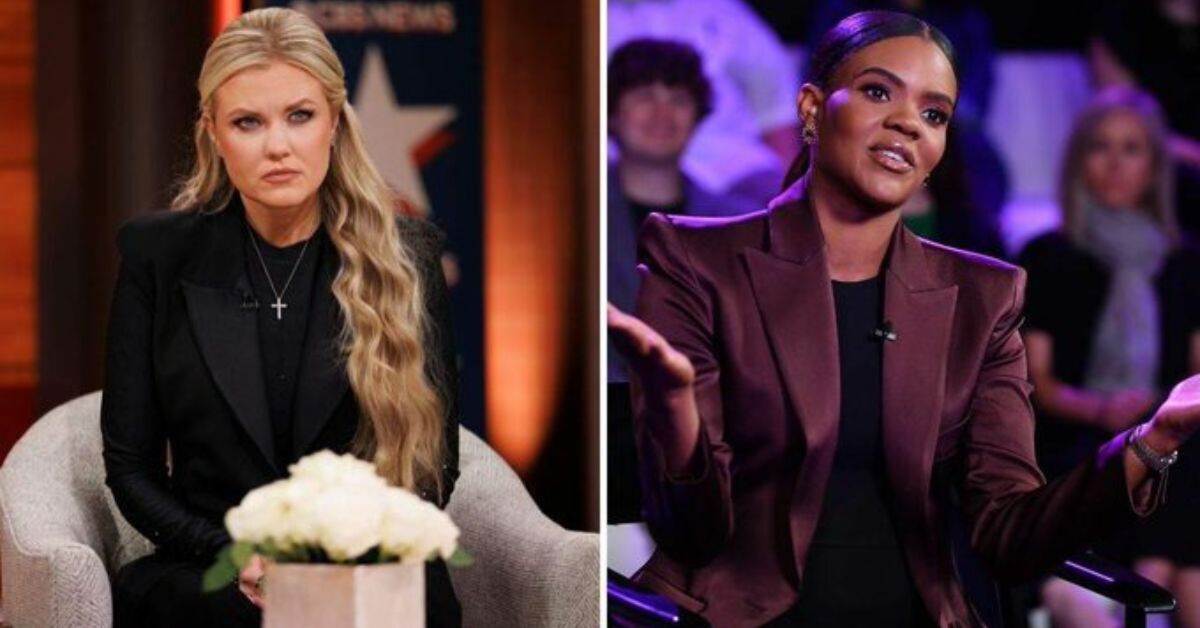
Candace Owens intensified her criticism of Turning Point USA’s alternative Super Bowl halftime show by accusing the organization of artificially inflating viewership numbers and misleading the public about the event’s success. Owens claimed the group relied on paid promotion and coordinated influencer activity to create the illusion of record-breaking audience engagement.
Turning Point USA staged its All-American Halftime Show as counterprogramming to the NFL’s official Super Bowl halftime performance, which was headlined by Bad Bunny. The alternative show featured Kid Rock as the headliner, with Brantley Gilbert, Lee Brice and Gabby Barrett also appearing. Erika Kirk, the widow of Charlie Kirk, and other organizers promoted the event as a patriotic option for viewers dissatisfied with the NFL’s entertainment choice, and supporters claimed that millions of fans tuned in instead of watching the official broadcast.
“‘I am sorry but I hate both options. On The one hand, we have a half-time show presented without a word of English spoken,” Candace Owens said on social media. “On the other hand we have an organization that scammed its views by paying platform advertisers, followed by influencers to pretend they broke records. The left vs. right grift is actually boring now. What exactly are we doing here, America?”
I am sorry but I hate both options.
On The one hand, we have a half-time show presented without a word of English spoken.
On the other hand we have an organization that scammed its views by paying platform advertisers, followed by influencers to pretend they broke records.…
— Candace Owens (@RealCandaceO) February 9, 2026
According to figures circulated by Turning Point USA affiliates, the show’s YouTube livestream surged past five million viewers midway through the performance, with total views later climbing to roughly 19 million – Candace Owens disputes those figures. Those numbers were promoted as evidence that the conservative-led event had shattered expectations and drawn massive interest during one of the most-watched television events of the year.
Despite having previously worked as a communications director for Turning Point USA and maintaining a personal friendship with its late founder, Charlie Kirk, Owens said the viewership figures did not reflect genuine audience behavior. She accused the organization now run by Erika Kirk, of manipulating perception by purchasing platform advertising and coordinating with influencers to falsely suggest that the show had broken records.
In her remarks, Candace Owens argued that the political left-versus-right spectacle surrounding the halftime shows had become stale and hollow. She criticized both options, saying that one side delivered a halftime performance without a single word of English spoken, while the other relied on inflated metrics and manufactured hype. Owens questioned the broader purpose of the spectacle, asking what Americans were actually gaining from the ongoing partisan grift.
Candace Owens also responded directly to early screenshots showing the YouTube livestream attracting fewer than 6,000 viewers at one point. She suggested that the discrepancy between those figures and the later claims of millions of viewers exposed a fundamental misunderstanding of how digital media works. Owens said that people with large budgets but little earned experience often misinterpret analytics and overstate success.
🚨Carrie Prejean Boller just asked Seth Dillon, while he was under oath, about the infamous Hamptons meeting with Charlie Kirk.
And now his story has shifted. He now admits that there was a “HEATED and at times spirited debate”.
But Seth denied that, categorically, when we… pic.twitter.com/k820LV9xbp
— Candace Owens (@RealCandaceO) February 9, 2026
“The problem with people who have a lot of money they didn’t earn, is that they tend to have no idea how stuff actually works. No, this is not a possible result if you truly had 5.2 million live viewers,” Candace Owens added. “Note: what they will do now is spend an offensive amount on YouTube ads over night to bring their viewership up while we sleep.”
She further stated that it was mathematically implausible for a livestream to jump from modest real-time engagement to more than 5.2 million concurrent viewers without extraordinary outside intervention. Candace Owens predicted that the organization would respond by pouring substantial money into YouTube advertising overnight to inflate total views after the fact, while most critics were offline.
The dispute reflects a broader rift between Owens and Turning Point USA leadership that has grown more pronounced in recent months. Owens has increasingly distanced herself from the organization, raising concerns about transparency, leadership decisions and what she views as performative politics replacing authentic grassroots engagement.
Turning Point USA’s halftime show was designed to challenge dissatisfaction among conservatives with the NFL’s official entertainment choices, particularly Bad Bunny’s performance, which some critics viewed as culturally exclusionary. The alternative event emphasized patriotism, traditional values and country-rock music as a counterbalance to the mainstream broadcast.
Reaction to the show was sharply divided. Supporters praised the lineup and applauded the attempt to create a conservative cultural alternative during a major national event. Critics echoed Candace Owens’s concerns, questioning whether the production truly reached the audience size being claimed and warning that exaggerated success narratives risk damaging credibility.
As debate continues, Owens’s accusations have reignited discussions about honesty, accountability and trust within conservative media and political organizations. Her challenge to the halftime show’s reported success highlights ongoing disagreements over how influence is measured and how achievements are communicated to supporters.
The controversy underscores deeper tensions over strategy and authenticity, between Erika Kirk and Candace Owens positioning herself as a critic of what she sees as hype-driven politics that prioritizes optics over substance.