



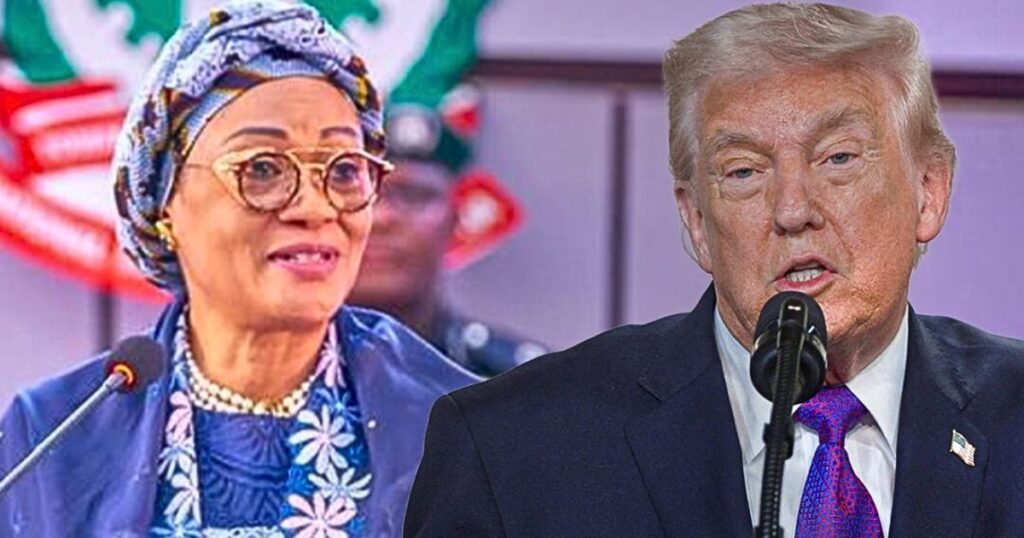
Nigeria’s first lady said U.S. military strikes against Islamist militants have been a “blessing” and signaled that her country wants expanded cooperation with the United States on security. Oluremi Tinubu made the comments during a visit to Washington as Nigeria and U.S. officials seek to address insurgency, banditry, and rising violence that have killed tens of thousands in Africa’s most populous nation. Her remarks come against a backdrop of heightened U.S. scrutiny of Nigeria’s human rights record and religious violence.
Tinubu spoke to Fox News Digital on Friday after meetings with senior U.S. government officials, where she discussed counterterrorism efforts, protection of religious communities, and broader security ties. She framed U.S. strikes in northwest Nigeria — conducted on Christmas Day against Islamist militants — as welcome support for her husband’s government.
“The intervention of the U.S. was quite a welcome development,” Tinubu said, via Fox News. “Nigeria is looking forward to collaboration” on security issues and “we are expecting that there will be more.”
PBAT Administration’s Soft Power on Display as Nigeria’s First Lady Earns U.S. Presidential Recognition
The public recognition of Nigeria’s First Lady, Senator Oluremi Tinubu, by United States President Donald Trump at the National Prayer Breakfast in Washington, D.C.,… pic.twitter.com/8ILnoa56n0
— PBAT SIGNAL (@PBATSignal27) February 6, 2026
The White House confirmed the U.S. conducted counterterrorism strikes against militants in northwest Nigeria, where groups such as Islamic State West Africa Province (ISWAP) and Boko Haram have carried out mass killings, kidnappings, and raids for years. The strikes formed part of a broader U.S. effort to counter terrorism in the Sahel region which Washington has called an “epicenter of terrorism.”
President Donald Trump, who designated Nigeria a “country of particular concern” over violations of religious freedom, has pushed for the United States to take a harder line on violence against Christians and other religious groups in Nigeria.
Tinubu and her husband, President Bola Ahmed Tinubu, say that while violence is severe, it affects communities across faith lines and cannot be reduced to attacks on Christians alone. Gunmen believed to be Islamist extremists killed at least 162 people in Nigeria’s Kwara state earlier this year. But the attacks have targeted both Muslim-majority and Christian-majority areas.
US President Donald Trump hailed Nigerian First Lady Oluremi Tinubu as “a very respected woman” at a national prayer gathering in Washington on Thursday.
This has drawn social media conversation, with some expressing surprise given Trump’s recent tough stance on the Nigerian… pic.twitter.com/FBOBmc0EJG
— TRT Afrika (@trtafrika) February 6, 2026
Nigeria’s population of more than 230 million includes a wide mix of faiths, ethnicities, and languages. Northern regions are predominantly Muslim, while many southern states have large Christian populations.
During her Washington visit, Tinubu explained the complexity of Nigeria’s security crisis to U.S. officials and underline that the government is taking steps to protect its people. “We live in Nigeria. We know the situation on the ground,” she said. She pointed to efforts that include a nationwide security emergency, plans to recruit tens of thousands of new police officers, and the redeployment of more than 11,000 officers from VIP protection roles to conflict-prone areas.
Tinubu’s own background reflects Nigeria’s religious diversity. She is an ordained pastor at the Redeemed Christian Church of God, one of the country’s largest Protestant denominations, while her husband is Muslim. She also hosts a Christian podcast and leads community outreach initiatives, placing a prominent Christian voice at the center of Nigeria’s response to U.S. scrutiny.
In addition to security cooperation, Nigeria hopes that closer ties with the United States will help attract foreign investment, particularly in emerging industries such as lithium and other critical minerals. Tinubu said both her security and economic outreach to Washington show that Nigeria is open for business and committed to addressing threats to stability. “We’re doing all we can to make sure that when investors come, they can feel comfortable,” she said, tying security progress to broader development goals.


