



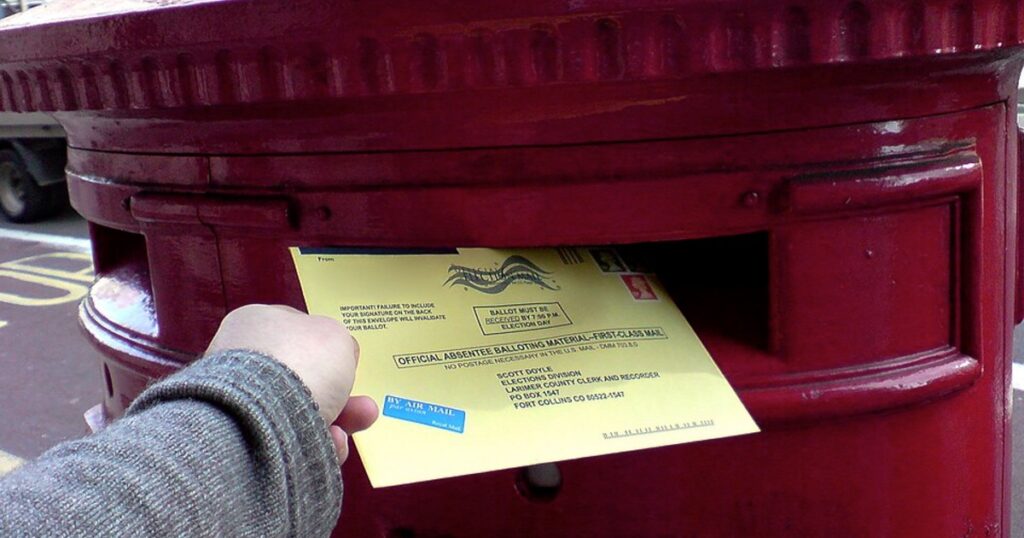
The Supreme Court on Wednesday ruled that federal candidates have the right to challenge state election laws on how ballots are counted, including rules allowing mail-in ballots to arrive after Election Day.
The decision came in a 7–2 ruling that revived a lawsuit brought by Illinois Republican Rep. Mike Bost, who is challenging his state’s policy of counting mail ballots received up to 14 days after Election Day, as long as they are postmarked on time.
Chief Justice John Roberts, who wrote on behalf of the majority, said that candidates are not outsiders to the elections they run in. “Candidates have a concrete and particularized interest in the rules that govern the counting of votes in their elections,” Roberts wrote. According to CNN, he added that the interest exists “regardless whether those rules harm their electoral prospects or increase the cost of their campaigns.”
🚨 BREAKING: In a HUGE win, the Supreme Court just ruled that Congressional candidates can legally challenge MAIL-IN VOTING LAWS – reviving a GOP challenge to the late-counting of mail-in ballots
Illinois allows late mail-in ballots to be counted late, after election day for up… pic.twitter.com/cwHBuk0R3D
— Eric Daugherty (@EricLDaugh) January 14, 2026
The ruling does not decide whqether Illinois’ mail-in ballot law is legal, per Fox News. It only says Bost has standing to bring the case in federal court, reversing lower court decisions that had thrown the lawsuit out.
At issue is a long-standing rule in Illinois that allows ballots to be counted if they arrive up to two weeks after Election Day. Bost sued in 2022, arguing the policy conflicts with federal law requiring a uniform day for congressional elections.
Lower courts ruled against him, noting that Bost had won his election comfortably and failed to show he was personally harmed. The Supreme Court disagreed. “Candidates, in short, are not ‘mere bystanders’ in their own elections,” Roberts wrote. “Win or lose, candidates suffer when the process departs from the law.”
Bost argued that extended ballot counting forces campaigns to stay operational longer, keeping staff and legal teams in place while results remain unresolved. During oral arguments, his lawyer Paul Clement said a longer count directly raises campaign costs. “If the campaign is going to be two weeks longer, you’ve got to keep the campaign staff together for two weeks longer,” Clement told the court.
BREAKING: In a win for election integrity, the U.S. Supreme Court rules in FAVOR of Congressman Mike Bost (R), finding he has a legal RIGHT to sue the State of Illinois’s procedure for counting mail-in ballots received AFTER election day. pic.twitter.com/CpDac00s7M
— Election Wizard (@ElectionWiz) January 14, 2026
Two justices did not agree with the decision. Justice Ketanji Brown Jackson and Justice Sonia Sotomayor warned the ruling could destabilize elections by encouraging waves of litigation. “By carving out a bespoke rule for candidate-plaintiffs,” Jackson wrote, the court “complicates and destabilizes both our standing law and America’s electoral processes.”
Roberts pushed back on fears of runaway lawsuits. He wrote that it was unclear why candidates would waste resources on frivolous claims or how such cases would succeed without a valid federal basis.
The decision, which was ahead of the 2026 midterm elections, and as the court prepares to hear another case later this year that directly targets mail-in ballot deadlines. That case, Watson v. Republican National Committee, focuses on whether states can count ballots received several days after an election.
More than a dozen states and Washington, D.C., currently allow some form of post-Election Day ballot counting, provided ballots are postmarked or certified by the time polls close. For now, the ruling ensures one thing: disputes over how and when votes are counted are far more likely to end up in court as the next election cycle approaches.