



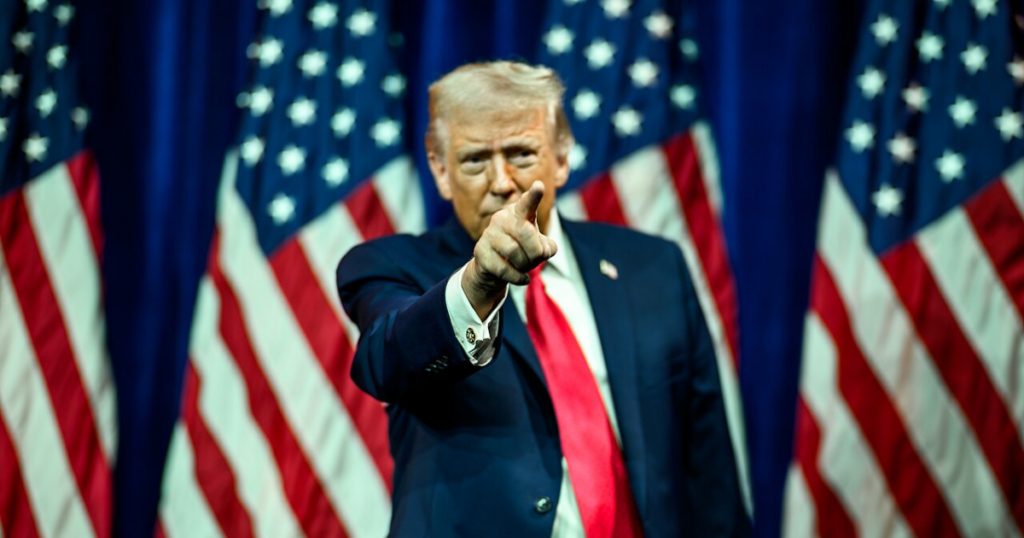
During his second term in office, Donald Trump has made it clear that the only check on presidential power is his own judgment. Speaking with The New York Times, the POTUS, when asked if there were any limits on his global authority, said that his own morality and his own mind are the only things that could stop him.
Trump’s comment encapsulates his worldview—one in which international law, institutional constraints, and diplomatic norms are secondary considerations to his own conviction. Asked if his administration must comply with international law, the 79-year-old commander-in-chief said: “I do. It depends on what your definition of international law is.”
That philosophical stance has taken on concrete consequences in the first few weeks of his presidency. Trump’s remarks came shortly after Venezuelan President Nicolas Maduro and his controversial wife, first lady Cilia Flores, were caught and flown to the United States on January 3.
Asked in an interview with The New York Times whether there were any limits on his global powers, Donald Trump said: “Yeah, there is one thing. My own morality. My own mind. It’s the only thing that can stop me.”
“I don’t need international law,” he added. pic.twitter.com/xU9rNWzojK
— Republicans against Trump (@RpsAgainstTrump) January 8, 2026
Maduro and Flores—being held at the Metropolitan Detention Center in Brooklyn—were indicted on drug trafficking charges, and on Monday, January 5, the couple pleaded not guilty in federal court.
Though Trump claimed the U.S. is now “in charge” of Venezuela, Delcy Rodriguez, the country’s Vice President and a member of Maduro’s government, was sworn in as acting president on the same day.
Supporters and critics alike had a lot of questions about the operation, especially about the legal and diplomatic framework that made it possible. Experts suggest that the apprehension of an incumbent foreign leader from his own country represents an extraordinary assertion of American power, as it usually requires thorough coordination with international partners and legal justification.
Trump framed it as a straightforward matter of American strength and resolve. However, it seems that the POTUS’s ambition goes beyond Venezuela after he openly discussed taking over Greenland from Denmark, which is a known NATO ally and longtime American partner.
During an interview with The New York Times, Donald Trump said that obtaining Greenland “may be a choice” between that and preserving America’s membership in NATO.
Donald Trump 🗣
“If we dont take Greenland, you’re going to have Russia or China as your next door neighbor. Thats not going to happen.” pic.twitter.com/yO2sRkfkSw
— MDN NEWS (@MDNnewss) January 10, 2026
“Ownership is very important,” Trump explained. “Because that’s what I feel is psychologically needed for success. I think that ownership gives you a thing that you can’t do, whether you’re talking about a lease or a treaty. Ownership gives you things and elements that you can’t get from just signing a document.”
Prime Minister Mette Frederiksen responded sharply to Trump’s stunning statement, saying that “everything stops” should the United States attack another NATO country militarily. “That is, including our NATO and thus the security that has been provided since the end of the Second World War,” she added.
For context, NATO, which was established after World War II, has provided the security architecture that kept the Western alliance intact through the Cold War and beyond. For Trump to casually suggest that membership might be conditional on territorial acquisitions from allied nations represents a fundamental challenge to the post-WWII international order.
Trump has explicitly stated that his own moral compass is the only guardrail on his power, and, for friends and foes alike, that declaration raises uncomfortable questions about what comes next.


