



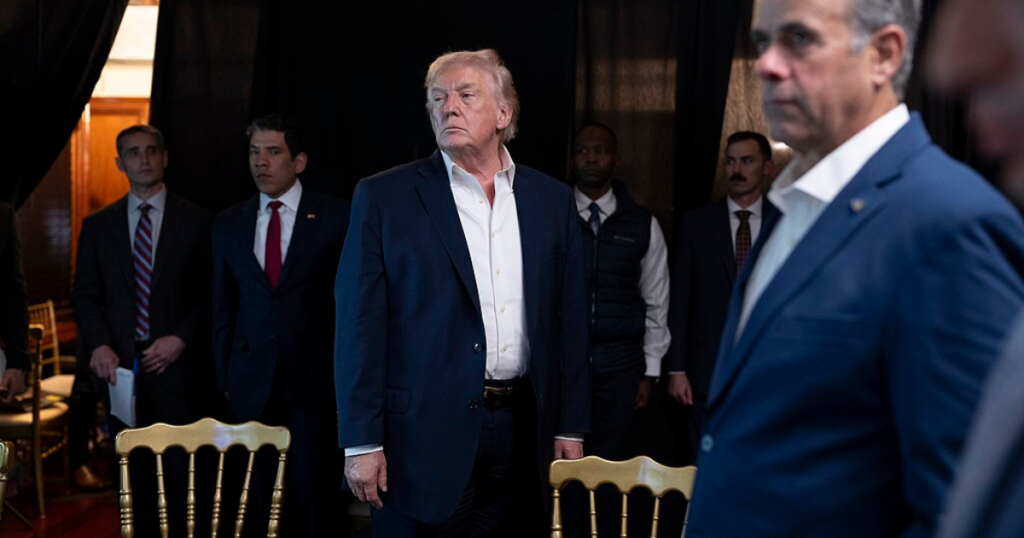
Just one day after American military forces captured Venezuelan President Nicolás Maduro and Trump declared that the U.S. would effectively “run” the Latin American country, the president turned his attention northward to another prize: Greenland.
In an interview with The Atlantic, Donald Trump doubled down on his long-standing desire to acquire the Arctic island, declaring bluntly, “We do need Greenland, absolutely. We need it for defense.”
The timing couldn’t have been more provocative. Denmark’s Prime Minister Mette Frederiksen was already on edge, watching how quickly Trump moved to consolidate control over Venezuela. Now, with the president openly stating America’s need for Greenland, she understood exactly what message he was sending.
On Sunday, Frederiksen issued a sharp rebuke, warning Trump in an official statement: “I would therefore strongly urge the U.S. stop the threats against a historically close ally and against another country and another people, who have very clearly said that they are not for sale.”
But Trump wasn’t listening.
Trump is saying that the US needs Greenland for national security, not for resources.
Denmark PM urges him to stop the threats. pic.twitter.com/cV4oSykI3K
— Mukhtar (@I_amMukhtar) January 4, 2026
Greenland isn’t just another territory on Donald Trump’s wish list. The Danish-controlled island occupies a critical position in geopolitical strategy. Nestled between Europe and North America, it serves as a linchpin for America’s ballistic missile defense system.
Beyond its defensive value, Greenland sits atop vast mineral wealth—rare-earth elements, oil, and other resources that Washington desperately wants to secure as it seeks to reduce its dependence on Chinese exports. For a president focused on American dominance and self-sufficiency, Greenland represents both strategic necessity and economic opportunity.
The Trump administration has made its intentions crystal clear. In December, Trump named Louisiana Governor Jeff Landry as special envoy to Greenland, a move that drew immediate criticism from both Denmark and Greenland itself.
Landry publicly supports the POTUS’s vision of annexing Greenland. The message was unmistakable: this wasn’t idle speculation—it was a deliberate policy initiative backed by official government personnel.
Watch | Denmark PM Rejects U.S. Threats Over Greenland: “Not for Sale”
Danish Prime Minister Mette Frederiksen issued a firm statement in response to remarks by U.S. President Donald Trump, calling on Washington to halt its threats against a “close ally” and respect the will of… pic.twitter.com/34bL6E9LtE
— Quds News Network (@QudsNen) January 4, 2026
Donald Trump’s argument revolves around national defense. “We need it for defense,” he told The Atlantic, framing Greenland’s acquisition as a matter of American security rather than imperial expansion.
It’s a familiar rhetorical move from this administration: wrapping territorial ambitions in the language of necessity and protection. For Trump’s base, it’s a compelling narrative. For Denmark, it’s an outright threat to one of America’s “historically close allies,” as Frederiksen pointed out in her statement.
We desperately need Greenland, – Trump.
EXCLUSIVE: In an interview with Michael Scherer, Donald Trump threatened Venezuela’s interim leader, Delcy Rodríguez, with a fate worse than Maduro’s; defended the regime change in the country; and expressed renewed interest in the US… pic.twitter.com/UU3GN0URJV
— Jürgen Nauditt 🇩🇪🇺🇦 (@jurgen_nauditt) January 4, 2026
The situation is more nuanced than a simple land grab. Greenland is a self-governing territory within the Kingdom of Denmark, granted extensive autonomy under a 2009 agreement that theoretically gives it the right to declare independence. However, Greenland remains heavily dependent on Danish subsidies to maintain its economy and infrastructure.
Independence sounds appealing in theory, but the financial reality is far more complicated. This financial dependence makes Greenland vulnerable to pressure from wealthier powers offering investment and security guarantees.
Denmark has spent the past year trying to strengthen its relationship with Greenland while simultaneously attempting to ease tensions with the Trump administration by investing in Arctic defense capabilities. It’s a delicate balancing act that becomes increasingly precarious as Trump signals American intent with ever-greater clarity.
The Venezuela operation demonstrated the POTUS’s willingness to take unilateral military action against foreign governments. Now, with Greenland on his radar and a special envoy already in place, observers are wondering whether the Arctic island could be next on his agenda.
Denmark is rightfully nervous, and Greenland finds itself caught between a longtime ally and a superpower with both military strength and economic leverage.
The real question isn’t whether Trump wants Greenland. It’s whether he’ll actually attempt to acquire it.