



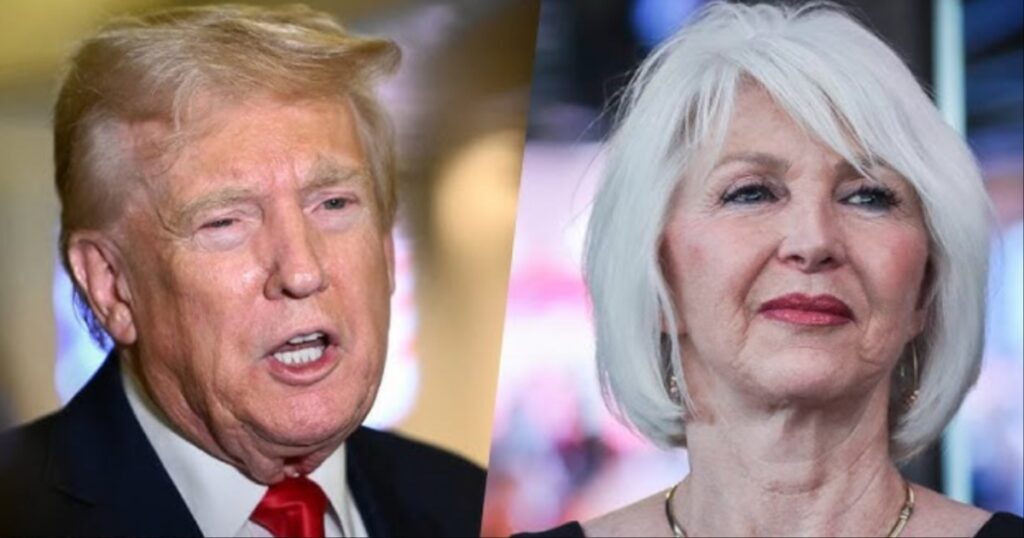
President Donald Trump spent New Year’s Eve once again urging the release of Tina Peters, the 73-year-old former Colorado elections clerk now two years into a nine-year state prison sentence — a plea that legal experts say cannot, under current law, get her out of jail.
On Truth Social Wednesday, Trump wrote, “God Bless Tina Peters, who is now, for two years out of nine, sitting in a Colorado Maximum Security Prison… for the ‘crime’ of trying to stop the massive voter fraud… FREE TINA PETTERS [sic]!” The post echoed familiar rhetoric but also ratcheted up personal invective against Colorado officials.
Peters’ story has become one of the most contentious legal and political dramas of the post-2020 era.
Why is it that NOBODY is covering the Tina Peters story? She is 100% the key to the 2020 election, yet podcasters and journalists are focused on covering different topics. Why? pic.twitter.com/4aBttce49X
— David Nino Rodriguez (@ninoboxer) December 31, 2025
In October 2024, a jury in Mesa County convicted her on multiple state charges — including conspiracy, official misconduct, and conspiracy to impersonate — in connection with a 2021 election-system data breach. Authorities found she allowed unauthorized access to voting machines and then helped misrepresent that access as evidence of fraud, actions that prosecutors said undermined public trust. The judge who sentenced her called her a “charlatan” who abused her oath, per AP News.
The nine-year sentence reflected not only the seriousness of the crimes but also repeated defiance in court and refusal to acknowledge responsibility.
Trump’s involvement escalated in 2025. On Dec. 5, he publicly announced he had granted Peters a “full pardon,” a declaration widely described by legal experts and state officials as symbolic at best and unconstitutional at worst because presidential pardon power does not extend to state convictions.
🚨 JUST IN: President Trump tells the Colorado District Attorney persecuting Tina Peters to “ROT IN HELL”
“I wish them only the WORST. May they rot in hell. FREE TINA PETERS!”
Tina Peters is a POLITICAL PRISONER being held by the Democrats simply for exposing voter fraud.… pic.twitter.com/8sYWVlFp1o
— Nick Sortor (@nicksortor) December 31, 2025
In defending his action, via Time, Trump echoed long-debunked claims of election fraud and cast Peters as a martyr, asserting without evidence that she was jailed for challenging 2020 results. He did this even though courts and multiple audits found no proof of systemic fraud that would have changed the outcome.
According to Newsweek, Colorado officials, including Governor Jared Polis and Attorney General Phil Weiser, have repeatedly rejected Trump’s premise, saying that federal clemency doesn’t have legal effect over state court verdicts and that Peters must remain in state custody.
Last week, Peters’ lawyers took a new legal tack by asking the Colorado Court of Appeals to recognize Trump’s pardon and release her from prison. In that filing, they argue historical precedence, citing an 18th-century pardon by George Washington in the Whiskey Rebellion, in support of broader presidential clemency powers.
The state is expected to respond by early January, with oral arguments scheduled ahead of the appellate calendar.
Expectedly, the clash has drawn attention far beyond Colorado. Supporters of Peters — many aligned with the same election denial movement that backed Trump’s 2020 challenges — have amplified calls for her release. Some fringe figures have even suggested violence or extralegal “rescues,” though Peters herself has publicly denounced any call for force against prison facilities.
Tina Peters was convicted by a jury of her peers, prosecuted by a Republican District Attorney, and found guilty of violating Colorado state laws, including criminal impersonation. No President has jurisdiction over state law nor the power to pardon a person for state… pic.twitter.com/3szIgywLAf
— Governor Jared Polis (@GovofCO) December 12, 2025
For now, the legal reality remains that a presidential pardon, even one announced from the White House, does not, by itself, undo convictions handed down in a state court. The appellate fight will focus squarely on a question that constitutional scholars call unprecedented: whether a federal pardon can alter state judgments, a notion most legal experts reject under current constitutional interpretation.
As the appellate clock ticks into 2026, Peters stays in La Vista Correctional Facility in Colorado, the legal arguments ahead — and her fate — uncertain.