



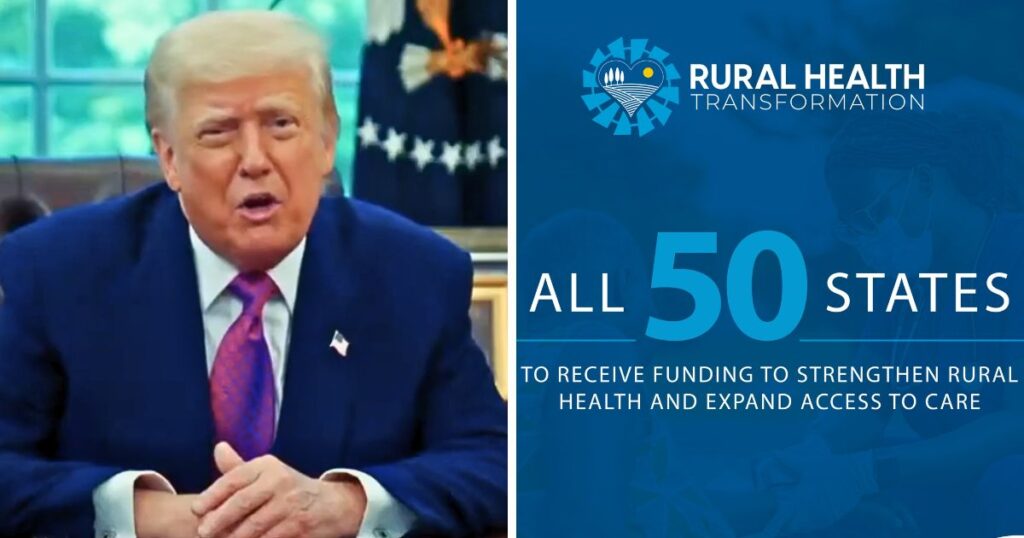
For once, the Donald Trump administration is wiring money directly to rural America. They’ve now launched a $50 billion Rural Health Transformation Program, which is going to be a five-year effort to funnel funding to all 50 states, starting in 2026. Except that states won’t just get the cash and walk away; they’ll be audited, ranked, and rewarded (or penalized) every year.
The announcement came in a White House YouTube video and was confirmed by an HHS release on December 29, 2025, which frames the program as somewhat of a competition. The administration argues that if states want to keep their funding and maybe even grow it, they’ll need to prove the money is actually improving rural health outcomes. The funding is coming from the Rural Health Transformation Program established under President Trump’s Working Families Tax Cuts legislation (Public Law 119-21).
The said money will be distributed from 2026 through 2030, with $10 billion each year.
.@DrOzCMS on the $50B in CMS awards to strengthen rural healthcare in all 50 states: “This money is not there to pay bills… We want the money to be used to change the way we envision healthcare in rural America.” pic.twitter.com/lWFYlbwUo8
— Rapid Response 47 (@RapidResponse47) December 29, 2025
Half of Trump’s funding is going to be split among all approved states. The remaining 50 percent will be allocated based on population needs, the strength of a state’s rural health system, policy initiatives, and how ambitious its plans are.
In the first year, states will get an average $200 million, which will range from $147 million to $281 million. Texas tops the list at more than $281 million, while smaller or less rural states will be getting lower amounts.
The White House says that innovation is the heart of the program, be it drones delivering medications to remote communities, to robotic ultrasound systems allowing prenatal care. There’s also a push to let healthcare workers operate at the “top of their license,” so that will expand what nurses, pharmacists, and other providers can do in underserved regions. Telehealth, remote patient monitoring, and AI-powered tools to reduce administrative burdens are all part of it.
According to HHS, states will also invest in preventive care, maternal health, behavioral health services, emergency medical systems, and chronic disease prevention, including nutrition and fitness programs designed to address root causes.
Alaska, population 740,000 (less than the city of Charlotte), got 22% more from the “rural health fund” in Trump’s OBBB than did North Carolina, population 11 million.
They cut roughly a trillion dollars from Medicaid, and are promoting the $50 billion fund as an accomplishment. https://t.co/x8JZPWhSO2
— Carolina Forward (@ForwardCarolina) December 29, 2025
Through this program, funding will only be awarded with the expectation that states will deliver on their promises, and the CMS under Trump will check by auditing performance. With measurable progress, some states can also receive additional funds. But if a state falls short, it can lose a portion of its allocation, which can be redistributed to higher-performing states.
CMS Administrator Dr. Mehmet Oz described that federal project officers will work directly with states, track progress, and provide technical assistance. Annual Rural Health Summits will allow states to share what’s working and what isn’t. The administration’s framing leans heavily on accountability, as geography can still determine how long and how well Americans live.
So yes, the money is coming, but excuses won’t be accepted.