



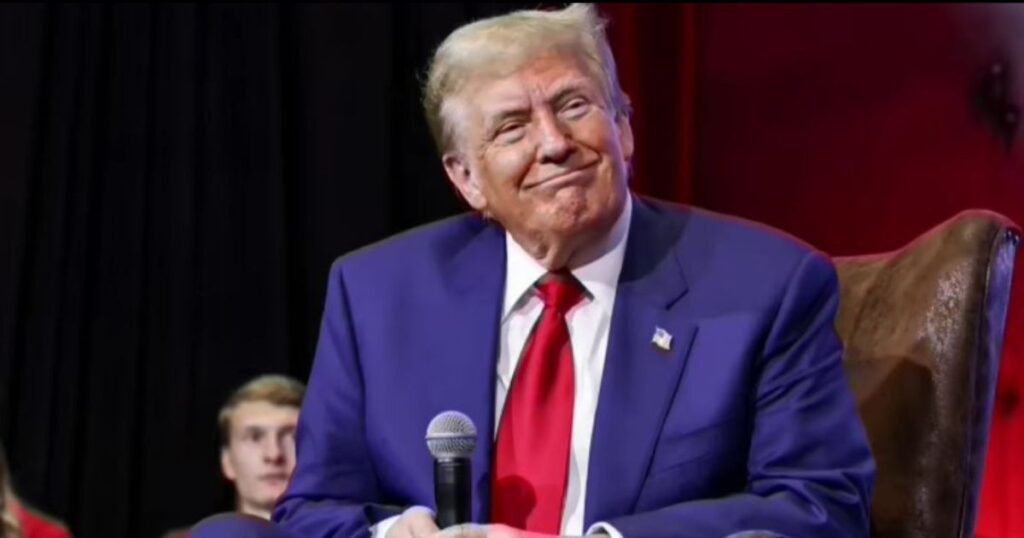
US President Donald Trump is grabbing attention and facing criticism for something he said during a Newsmax interview on Friday. He made a confusing comment describing wars he claims he “settled” as being “very beautiful.” His most notable claim during this interview was that he brought peace between India and Pakistan, which has been proven false many times before.
To the interviewer, Rob Finnerty, Donald Trump said, “You take a look at what’s happened just over the last little while, we’ve settled a lot of (…) very beautiful wars.” He then specifically mentioned, “You know, one of the wars: India-Pakistan, nuclear.”
If that sounds strange, you’re not the only one thinking that!
Indian officials were quick to dismiss the idea once more. Indian Defense Minister Rajnath Singh addressed the Lok Sabha, stating that it was “completely incorrect and baseless” to claim the military action had been halted due to outside pressure, the Irish Star reports.
Indian Prime Minister Narendra Modi was even more blunt about it. He revealed that he hadn’t answered a call from the U.S. Vice President on May 9 because he was busy meeting with military leaders during Operation Sindoor, India’s response to a deadly terror attack. Modi also mentioned telling the U.S. afterward that if Pakistan were to launch any strike, “we will respond by launching a big attack.”
In simple terms, India clarified that American mediation was neither needed nor welcomed.
Trump: “I stopped the war between India and Pakistan with a trade deal.” 💀
Modi: 0 rebuttal. 0 response. 0 self-respect. 😭
Opposition MPs rightly tore into BJP in Lok Sabha yesterday 🔥
Truth hits hard when it’s backed by facts. pic.twitter.com/t8hKGGWKZX
— Chikku (@imChikku_) July 29, 2025
This isn’t the first time Trump has called himself the “Peace President.” Speaking from his sons’ new golf course in Scotland earlier this week, he claimed, “We did one yesterday. You know, we stopped the war, but we stopped about five wars.”
Among the supposed peace successes being mentioned? There’s that ’12-day war’ between Israel and Iran, which has now become a conflict that seems to have faded from most memories, though The Economic Times did report that Trump allegedly ordered strikes on Iran’s nuclear sites back in June. Donald Trump claims this action quickly brought the fighting to a halt.
Then, of course, there’s the ongoing war in Ukraine. Trump has consistently promised that if he were reelected, he could wrap up the Russia-Ukraine conflict in just ’24 hours.’ That quick fix hasn’t materialized yet. Just this week, Russia launched missile and drone attacks on Ukraine, showing absolutely no indication that it even recognizes Trump’s recent 10-day ‘peace deadline’ he announced.
Still, White House Press Secretary Karoline Leavitt announced on Thursday that Donald Trump should receive a Nobel Peace Prize for his work in “global conflict resolution.” Let the worldwide eye-rolls begin!
🚨BREAKING: Karoline Leavitt, the official spokeswoman for the White House, has just made the bizarre demand from the podium that Donald Trump should receive the Nobel Peace Prize.
Is she out of her mind? 🤡 pic.twitter.com/PKeHCdreA7
— CALL TO ACTIVISM (@CalltoActivism) July 31, 2025
Online commentators and international observers quickly criticize the idea that describing wars as “beautiful” is a wise diplomatic move. Former national security experts, journalists, and social media users all jumped on the statement, calling it incredibly insensitive, particularly when talking about nuclear standoffs and deadly conflicts.
The phrase “very beautiful wars” is starting to catch on as a kind of joke on various online platforms.
Trump: “We’re settled — a lot of very beautiful wars have been settled.” pic.twitter.com/p9veunPQ96
— Aaron Rupar (@atrupar) August 2, 2025
People call it a strange medley of Orwellian doubletalk and the usual bold claims you’d expect from Donald Trump. Some wonder if he just misspoke or is making up foreign policy successes to drum up excitement for his second term in office.
Meanwhile, India and Pakistan (the two nations that have really felt the heat of those tensions) are saying that no outside pressure had anything to do with their recent temporary ceasefire.