



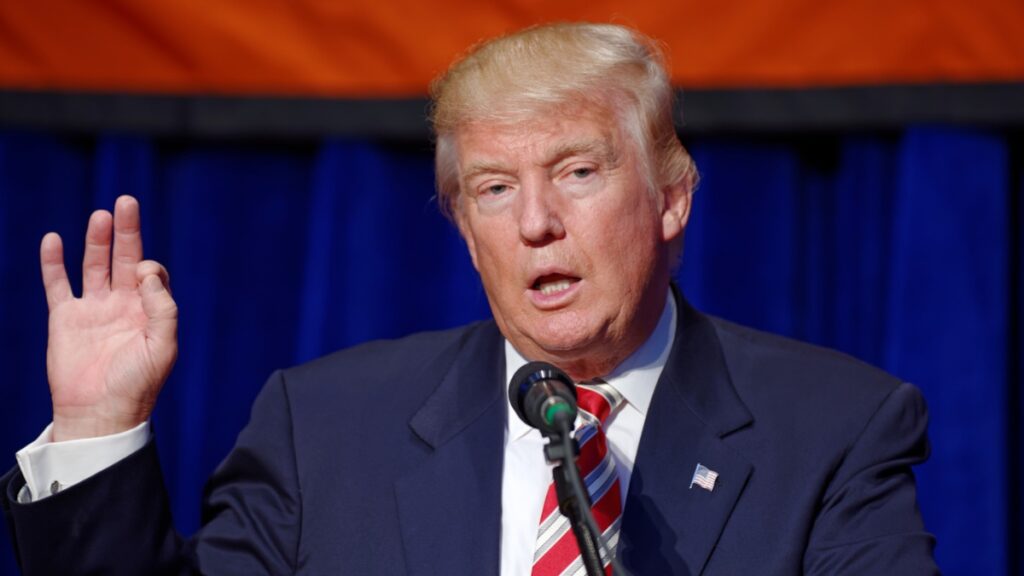
President Donald Trump’s military campaign against Iran could lead to a significant financial opportunity for Tehran.
A Reuters analysis estimates that Iran could gain as much as $500 billion over several years if it maintains control of the Strait of Hormuz and the United States withdraws from the conflict without restoring normal shipping.
The analysis suggests that Iran could create a formal toll system on the narrow waterway. Before the war, about one-fifth of the world’s oil and liquefied natural gas passed through Hormuz.
Reuters reports that Iran could collect large sums by charging ships for passage or by negotiating revenue-sharing deals with Gulf energy exporters who need the route reopened.
The analysis estimates Iran could earn approximately $110 billion a year at a flat rate of $2 million per ship, and potentially around $490 billion in total before alternative pipeline infrastructure diminishes its leverage.
Absolute bombshell. A top US maritime expert completely destroys Trump’s narrative on live TV. He confirms Iran has turned the Strait of Hormuz into a toll booth, charging ships up to 2 million dollars to pass. The US military has completely failed. Iran has total control. pic.twitter.com/AQ02PDBneZ
— Furkan Gözükara (@FurkanGozukara) March 29, 2026
The figures in the analysis are based on the volume of energy flows disrupted by the war. Reuters noted that about 20 million barrels of oil a day traveled through Hormuz before the conflict.
It estimated that Saudi Arabia can redirect 7 million barrels a day through a pipeline to the Red Sea, while the United Arab Emirates can transport 1.5 million barrels a day through a line to the Gulf of Oman.
With another 1.5 million barrels still coming from Iran, this leaves roughly 10 million barrels a day trapped in the Persian Gulf. The analysis indicated that Gulf producers could be losing about $200 billion in annual profit due to blocked oil flows, with Qatar’s gas revenues increasing the pressure to reach some kind of deal.
Trump has sent mixed messages regarding the duration of the war and whether reopening Hormuz is a firm requirement for a U.S. exit. In an interview with Reuters on April 1, he stated that the United States would leave Iran “pretty quickly” and could return for “spot hits” if necessary.
He also mentioned the day before that the U.S. could conclude its military campaign within two to three weeks. However, in a prime-time speech on April 1, Trump said operations would continue “extremely hard” for the next two to three weeks and did not specify an end date.
Reuters later reported that his comments left uncertainty about whether U.S. operations could finish before the strait is completely reopened.
The US is completely powerless. Kudlow admits Iranian tankers are freely moving through the Strait of Hormuz and selling oil to China and India. Iran is completely bypassing US sanctions and making billions, while Washington can only helplessly watch and plot to steal it. pic.twitter.com/AEq1Ta4O6W
— Furkan Gözükara (@FurkanGozukara) March 24, 2026
Developments on the ground have amplified that analysis. Reuters reported on April 2 that many countries were seeking ways to resume energy shipments through Hormuz after Trump threatened more severe actions against Iran.
Iran mentioned it was discussing a protocol with Oman to monitor ship traffic. An Iranian official said vessels would require permits and licenses in agreement with both Iran and Oman.
Furthermore, Reuters reported that Iran’s Parliament was examining a bill to formalize the blocking of vessels from hostile nations and to impose tolls on other ships seeking passage.
The economic repercussions are already emerging. Reuters reported that U.S. exports of refined fuel set a record high in March, as buyers in Europe, Asia, and Africa rushed to replace supplies lost from the near-total closure of Hormuz. U.S. gasoline prices surged above $4 a gallon, according to Reuters, while Brent crude rose about 7% to around $108 a barrel on April 2.
In this context, the Reuters analysis argues that if Washington departs before restoring free transit, Tehran may emerge from a war that severely impacted the region with a powerful new source of income.


