

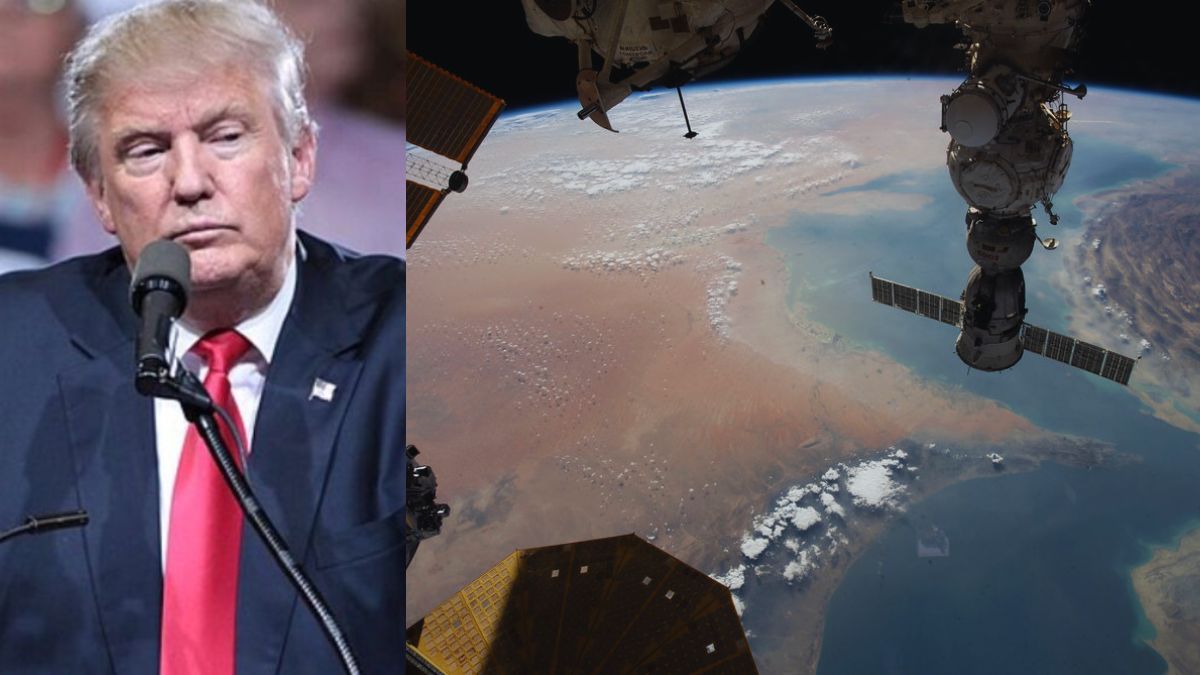
Donald Trump said over the weekend that other nations should help the United States secure the important Strait of Hormuz, arguing that the major shipping route benefits them more than it does the US.
Talking to reporters aboard Air Force One on Sunday, Trump said that countries like China, which rely on the choke point for oil shipments, should take greater responsibility for protecting it. “I’m demanding that these countries step in and defend their own interests, because this is the route from which they get their energy,” Trump said.
“They should be helping us protect it.”
Trump questioned why the United States continues to protect the waterway, arguing that it mainly serves the energy needs of other nations. “Why are we maintaining the Hormuz Strait when it’s really there for China and many other countries? Why aren’t they doing it?”
The Strait of Hormuz, located between Oman and Iran, connects the Persian Gulf to the Gulf of Oman and the Arabian Sea. The waterway is deep and wide enough for the world’s largest crude oil tankers to move swiftly. The Strait is considered one of the most important points in the global energy system. Trump said that about 90% of China’s crude oil imports pass through the passageway
However, according to CNBC, the U.S. depends on the strait for only 1 to 2% of its oil supply. Experts claim that Beijing has spent years diversifying its energy sources and building reserves to reduce the chances of disruptions.
View this post on Instagram
Trump also said the administration is urging seven countries to offer support as the situation remains tense. He criticized the NATO alliance, arguing that the United States often comes to the aid of its allies.
These comments come amid the ongoing U.S.-Israeli military campaign against Iran, as the waterway that carries a fifth of global oil and liquefied natural gas has remained shut for 15 days. Under Operation Epic Fury, strikes escalated following joint U.S. and Israeli airstrikes on Feb. 28, during which Iran’s Supreme Leader Ayatollah Ali Khamenei and several family members were reportedly killed.
On March 1, Iran responded with drone and missile strikes across the Gulf region, targeting several countries, including the United Arab Emirates (UAE), Saudi Arabia, Bahrain, Oman and Qatar, among others.
The strikes have rattled oil markets, with prices rising to the $100-per-barrel mark on Monday, with U.S. West Texas Intermediate (WTI) futures trading at $99.32 per barrel and global benchmark Brent crude at $104.84 per barrel.
Trump also said on Truth Social that several countries would send warships alongside the U.S. Navy to keep the Strait of Hormuz open and secure against Iranian threats to shipping.
View this post on Instagram
However, no country has publicly confirmed plans to deploy naval vessels to the area. Reports also indicate that several US commercial ships attempting to pass through the Strait of Hormuz have been damaged.
According to Reuters, the Navy has denied ”near-daily” requests from shipping companies to escort commercial vessels through the strait due to the high risk of further attacks.
Apart from the US, other countries like France and the United Kingdom have also discussed possible measures to help commercial shipping resume in the region. According to Al Jazeera, the gas shortage has affected 33 million LPG-dependent people in the region.
View this post on Instagram
Trump said on March 16 that British Prime Minister Keir Starmer had offered to deploy aircraft carriers to the strait, and noted that solutions to the crisis should have come sooner. “Whether we get support or not (…) we will remember.”