



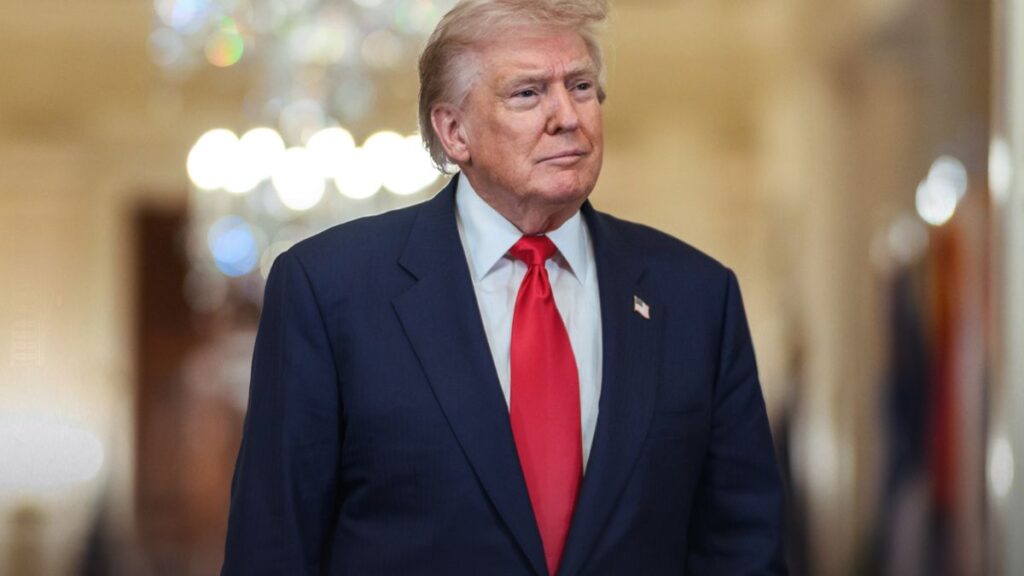
President Donald Trump on Thursday finally revealed the “present” he claimed Iran had given the United States. During a Cabinet meeting on March 26, Trump stated that Iranian officials had allowed a group of large oil tankers to pass through the economic shipping lane.
He called this a goodwill signal in discussions that Iranian officials continue to deny is taking place. According to Reuters, Trump first mentioned eight tankers and then increased that number to ten, noting that the vessels were flying Pakistani flags.
Earlier in the week, Trump teased the idea without saying exactly what he meant. Speaking to reporters, he said Iran had given the United States a “very big present worth a tremendous amount of money,” but stopped short of explaining it.
He only suggested it had something to do with energy and traffic moving through the Strait of Hormuz, a key route for global oil shipments.
TRUMP: I told you about a present. Steve, can I reveal the present?
WITKOFF: You can do anything you want, sir
TRUMP: They said to show you the fact that we’re real and solid and we’re there, we’re gonna let you have eight boats of oil. Eight big boats of oil. I think they… pic.twitter.com/v9XF1UCtGQ
— Aaron Rupar (@atrupar) March 26, 2026
Trump has claimed the tanker passage proves Iran desperately wants a deal to end the fighting. He stated that the action showed Iranian officials were serious about finding a way out of the situation, even as Iranian public statements and local media mock the White House’s description of events.
Reuters reported that Trump again urged Iran to accept an agreement, and threatened that the U.S. would continue its bombing campaign if Tehran refused.
This disclosure came as the administration maintained its stance that diplomacy is still possible despite nearly four weeks of fighting. U.S. envoy Steve Witkoff stated during the same Cabinet meeting that Washington had given Iran a 15-point framework to open negotiations, while Pakistan has assisted in mediating communication between both sides.
However, Iran has not publicly accepted Trump’s portrayal of the talks. A senior Iranian official told Reuters that the U.S. proposal was “one-sided and unfair.” Nonetheless, the official mentioned that diplomacy could still happen if Washington took a more realistic approach. They added that there are currently no specific plans for negotiations.
Iranian officials have firmly denied any negotiations with the US. Foreign Ministry spokesperson Esmaeil Baghaei rejected claims of talks, while Parliament Speaker Mohammad Bagher Ghalibaf called it “fake news” aimed at influencing oil markets.
Al Jazeera’s @Alihashem reports. pic.twitter.com/mVsZVi7e9Q
— Al Jazeera English (@AJEnglish) March 23, 2026
The Strait of Hormuz has become a key point in the economic fight which the Iranians are using as leverage. Iran has partially blocked the waterway during the war, causing oil prices to rise and increasing anxiety in global markets. The Associated Press reported Thursday that Trump has claimed Iran is “begging to make a deal,” while Tehran has publicly rejected the U.S. ceasefire plan being discussed through intermediaries.
Trump mentioned that the tanker passage was significant because it indicated some cooperation from Tehran regarding energy flows at a time when global markets are closely monitoring any disruptions in the Gulf.
The Wall Street Journal reported that Trump viewed the gesture as proof that “we’re dealing with the right people,” even though he admitted he had hesitated to share this detail while talks were still delicate.
The White House has not provided independent evidence identifying the ships or outlining any formal agreement related to their passage. Still, Trump’s remarks clarified the nature of the “present” and gave the administration a new talking point as it argues that pressure on Iran is leading to concessions, even as fighting continues and no final deal has been reached.


