SS United States begins sinking to form world's largest artificial reef
Okaloosa County hopes the former ocean liner, which holds a 1952 transatlantic speed record, will attract divers.
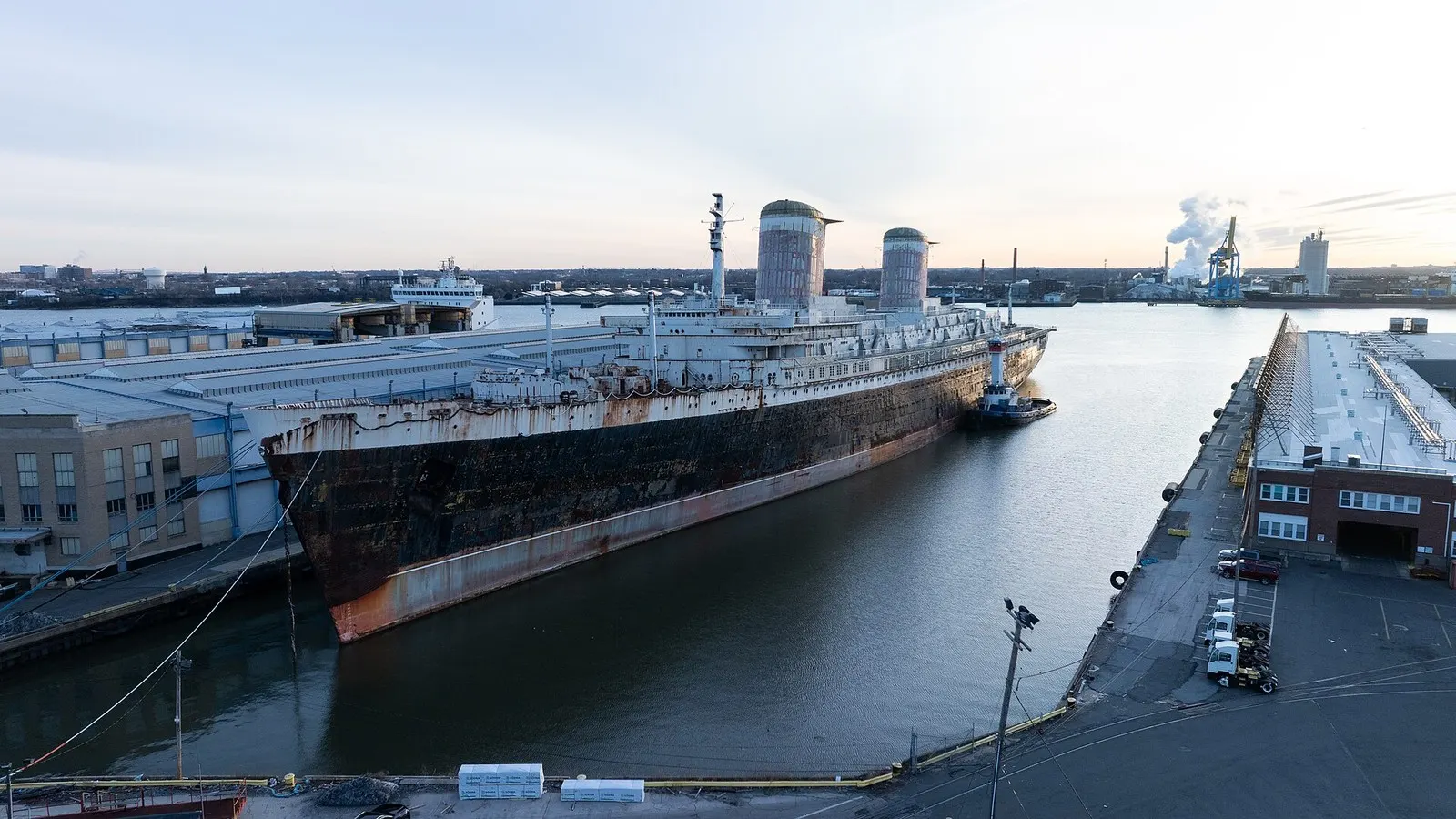
The SS United States began sinking Wednesday off the Florida Panhandle, where the ocean liner that set a still-standing 1952 transatlantic speed record will form an artificial reef larger than any other worldwide.
Okaloosa County hopes the vessel will bring divers to the Panhandle throughout the year and help its economy. CBS News.
"We're trying to be the best diving destination in the world," county spokesperson Nick Tomecek said.
Hundreds of spectators traveled off Destin on private boats, including sailboats and yachts, to see the operation, The New York Times reported. A livestream carried it online.
A preservationist group had sought to stop the sinking in a last-minute lawsuit, but a judge dismissed it. It was not immediately known which group sued or what grounds were given for the suit and its dismissal. Officials moved the operation forward by a day over concerns about bad weather.
Crews began the sinking at about 2:40 p.m. Eastern time, USA Today reported. County officials said at 5:47 p.m. that the vessel was fully flooded and had begun to sink.
Small boats remained around the liner, with some drawing alongside as it slowly descended, The Associated Press reported. Even after its hull was flooded, most of the ship remained above the surface at dusk.
The operation continued throughout the afternoon and into the evening, although predictions had put the time after flooding at less than an hour.
Without its red-white-and-blue smokestacks, the ship appeared lower and leaner than before. The Times called the operation one of the most unusual intentional sinkings ever, saying vessels of that size are rarely sunk this way.
"We're not destroying anything," said Tim Mullane, chief operating officer of Coleen Marine, the company conducting the sinking, in a video aired by local officials. Mullane, a Navy veteran, said the ship was "going to serve a second life."
"She really embodies and expresses this country's best," said Susan Gibbs, granddaughter of the vessel's designer, William Francis Gibbs. Gibbs said she was "just so happy that we are able to save parts of her."
"It was our goal to make sure that she wasn't lost forever," said David Lawrence, a board member of the SS United States Conservancy.
From record crossing to reef
The liner averaged almost 41 mph on its maiden voyage in 1952, surpassing the 1938 mark held by Britain's RMS Queen Mary by 4.5 mph. The crossing ended in a gale strong enough to blow a ping pong table off the deck.
The vessel made more than 800 Atlantic crossings during its career, with Grace Kelly and Elizabeth Taylor among its Hollywood passengers. Presidents Harry Truman, Dwight Eisenhower and John F. Kennedy also traveled aboard, as did Britain's former King Edward VIII. A young Bill Clinton sailed on it to attend Oxford University in 1968.
The ship was decommissioned in 1969. A hotel magnate and Norwegian Cruise Lines made unsuccessful attempts to use it, and it remained docked in Philadelphia from 1996 until recently.
The aircraft carrier USS Oriskany became the largest artificial reef when it was scuttled in 2006 in the Gulf off Pensacola. Launched in 1950, the carrier measured 911 feet long.
Okaloosa County bought the SS United States for about $1 million in 2024, intending to turn it into an artificial reef. The county sent it to Mobile, Alabama, for a one-year preparation that removed environmentally unsafe materials, including wiring and fuel. The work was coordinated with the Environmental Protection Agency and the Florida Department of Environmental Protection.
Federal environmental and explosives rules prohibited explosives, Tomecek said. Workers instead took tanks out of the boiler-cooling system, allowing seawater to enter the hull when valves opened, he said. They removed more than 400 portholes and made deck openings measuring 10-foot by 10-foot, positioned to keep the vessel upright underwater.
Tomecek said about 500 artificial reefs are already in waters near the new site. The Oriskany lies roughly 13 nautical miles from the liner, close enough for an experienced diver to see the two wrecks on the same day, Tomecek said.
Some of the liner will remain ashore. Organizers removed its 65-foot smokestacks ahead of the operation; the funnels are intended as anchors for a new museum about the ship. Mullane called them "works of art."
Diving plans
The liner is expected to come to rest roughly 25 miles southwest of Destin, between Panama City and Pensacola, in about 180 feet of water. It was not immediately known whether the ship had reached the bottom or settled upright.
Alex Fogg, who leads natural resources for the county, said the top should lie at a depth of roughly 55 to 60 feet, within reach of inexperienced divers. "A lot of those top decks are going to be easily accessible to the beginner diver and novice diver," Fogg said.
Fogg said he expects more experienced divers to venture farther inside. "There's probably going to be plenty of cave divers and other penetration divers who are going to be exploring the inside of the ship, going down to the engine room, going to the pool, and other places like that," Fogg told USA Today.
Savanna Christy, owner and instructor at the Destin dive center ScubaTech, said the first visitors are interested in the wreck before marine growth develops. "Those who are eager to dive immediately are there for the historical factor," Christy told USA Today.
Christy said fish will follow, including snapper and grouper, both important to commercial fishing. "Marine life will quickly start to gravitate to the wreck and start living there," Christy told USA Today.
Jocelyn Collins, general manager for Emerald Coast Scuba, said she expects the wreck to attract divers.
Jennifer Adams, the county's tourism director, said the county has spent five years expanding its reef program.
The AP put the project's cost at $13.5 million and said it is intended to attract people who dive and fish, as well as provide habitat for tuna and marlin. CBS News put the cost at about $13 million and said county tourist tax revenue paid for it.
Sources
- The New York Times: The S.S. United States, a Historic Supership, Heads to the Ocean Floor
- CBS News: SS United States is being sunk off Florida's Gulf Coast to become world's largest artificial reef
- AP News: The SS United States begins a final journey to the bottom of the Gulf of Mexico
- USA Today: The SS United States is about to sink. Many scuba divers will follow
- ABC News: Ocean liner being sunk to make largest artificial reef