

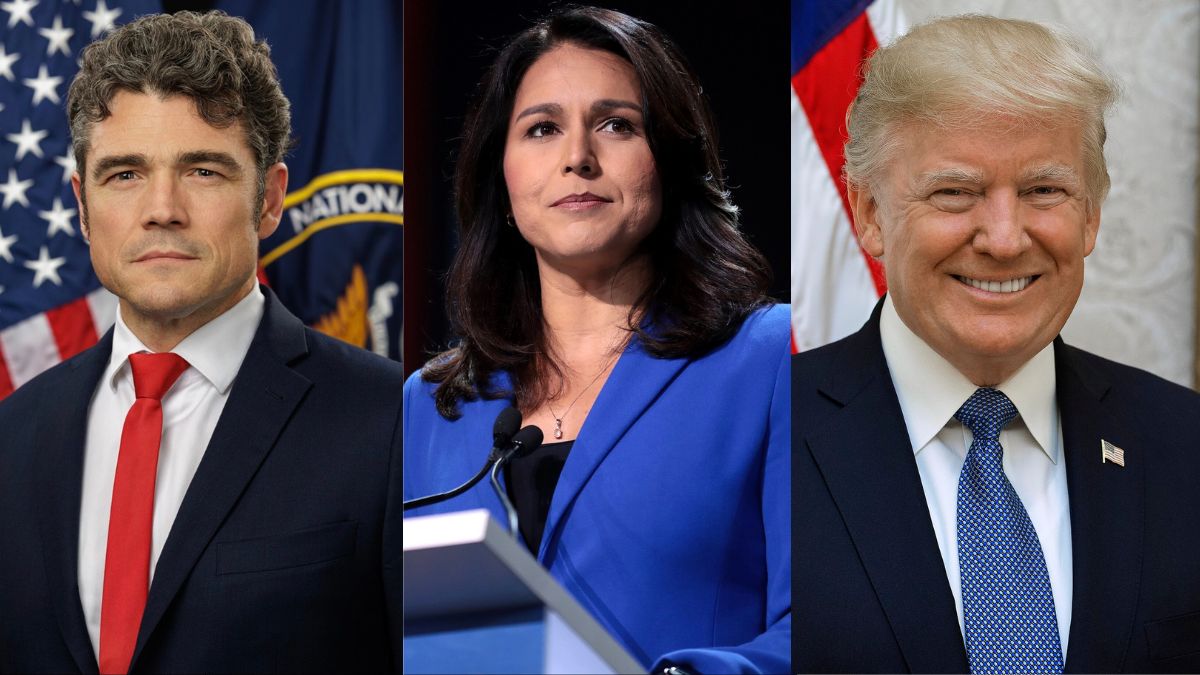
The director of the National Counterterrorism Center, Joe Kent, has submitted his resignation, putting his boss, Tulsi Gabbard, in a difficult position. Kent announced his departure on Tuesday, saying he could not support the war “in good conscience.”
“I cannot in good conscience support the ongoing war in Iran,” Kent wrote in a resignation letter, via X.
Here’s the whole post from Kent:
After much reflection, I have decided to resign from my position as Director of the National Counterterrorism Center, effective today.
I cannot in good conscience support the ongoing war in Iran. Iran posed no imminent threat to our nation, and it is clear that we started this… pic.twitter.com/prtu86DpEr
— Joe Kent (@joekent16jan19) March 17, 2026
Now, his exit has put a spotlight on the director of national intelligence, Tulsi Gabbard, who is set to face tough questions from lawmakers. She will testify on March 18 before the Senate Intelligence Committee.
So far, despite building her political career by standing against long and costly wars, Gabbard has mostly stayed silent about the U.S.-Israeli airstrikes on Iran. However, after Kent’s resignation, she released a cryptic statement.
While the statement did not address her deputy’s departure, it clarified that it’s up to the president to decide whether a threat is serious enough to go to war. According to Gabbard’s tweet, Donald Trump reviewed the intelligence and concluded that Iran was a real and immediate danger.
“Donald Trump was overwhelmingly elected by the American people to be our President and Commander in Chief. As our Commander in Chief, he is responsible for determining what is and is not an imminent threat, and whether or not to take action he deems necessary to protect the safety and security of our troops, the American people, and our country,” Gabbard wrote.
“After carefully reviewing all the information before him, President Trump concluded that the terrorist Islamist regime in Iran posed an imminent threat and he took action based on that conclusion,” she concluded.
Donald Trump was overwhelmingly elected by the American people to be our President and Commander in Chief. As our Commander in Chief, he is responsible for determining what is and is not an imminent threat, and whether or not to take action he deems necessary to protect the…
— DNI Tulsi Gabbard (@DNIGabbard) March 17, 2026
Despite the lengthy post, Gabbard did not confirm whether intelligence agencies had actually determined that Iran posed an imminent threat, as Trump suggested. As the country’s top intelligence official, people expected her to give a clearer answer.
Instead, she issued a statement that sounded neutral and careful in the wake of Joe Kent’s resignation and the dire situation in the world caused by the war. The White House has strongly pushed back against Kent’s claims.
Officials have defended the decision to go to war and insisted that the president had solid evidence. White House Press Secretary Karoline Leavitt said, “As President Trump has clearly and explicitly stated, he had strong and compelling evidence that Iran was going to attack the United States first.”
There are many false claims in this letter but let me address one specifically: that “Iran posed no imminent threat to our nation.”
This is the same false claim that Democrats and some in the liberal media have been repeating over and over.
As President Trump has clearly and… https://t.co/AC8M5L8lye
— Karoline Leavitt (@PressSec) March 17, 2026
As Leavitt rejected the idea that the war was based on misleading information, Donald Trump addressed Joe Kent’s resignation. During a meeting at the White House with Irish Prime Minister Micheal Martin on St. Patrick’s Day, while the U.S. President described Kent as a “nice guy,” he also went on to call Kent weak on security.
“I read his statement,” Trump said. “I always thought he was a nice guy, but I always thought he was weak on security, very weak on security.”
“I didn’t know him well, but I thought he seemed like a pretty nice guy. (…) When I read his statement, I realized that it’s a good thing that he’s out. Because he said that Iran was not a threat.” Trump mentioned. “Iran was a threat. Every country realized what a threat Iran was. The question is whether or not they wanted to do something about it,” he said.