

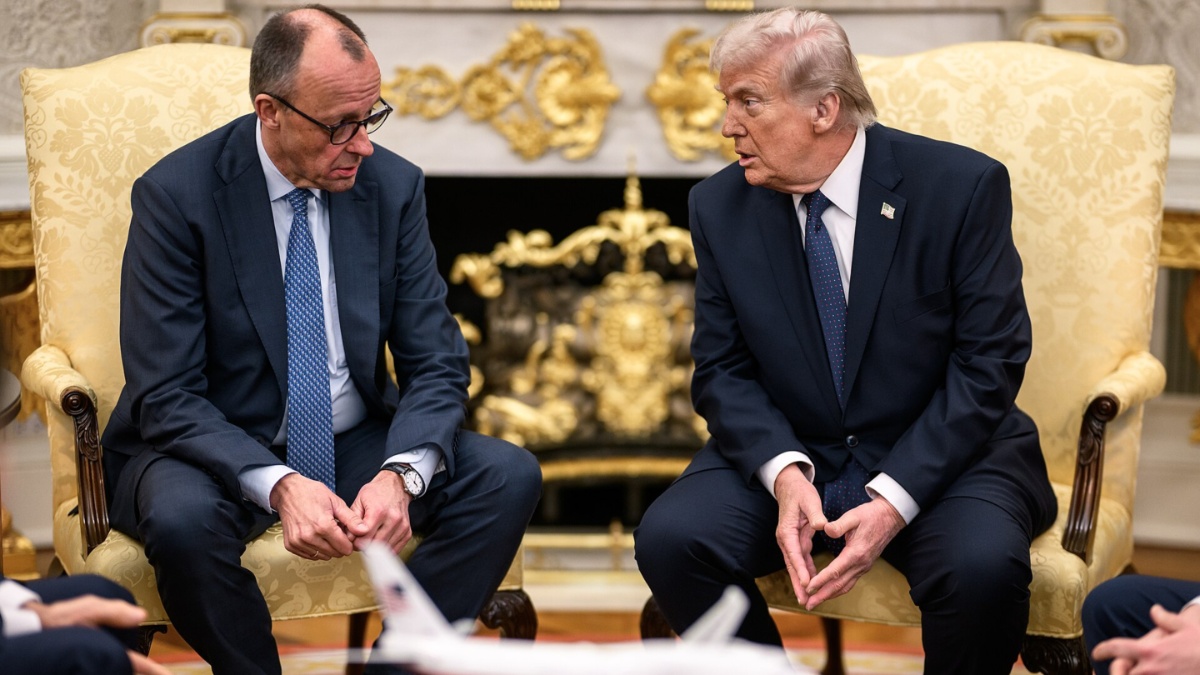
President Donald Trump’s request for military assistance from allies to reopen the Strait of Hormuz faced pushback on Monday. Germany, among several U.S. partners, stated it had no plans to send ships into the Gulf after a war that it claimed Washington and Israel initiated without consulting them.
Berlin was among the strongest reactions, according to Reuters. German Defence Minister Boris Pistorius asked, “What does Donald Trump expect a handful or two handfuls of European frigates to do in the Strait of Hormuz that the powerful U.S. Navy cannot do?” He added, “This is not our war; we have not started it.”
Government spokesperson Stefan Kornelius emphasized that the conflict “has nothing to do with NATO” and pointed out that neither the United States nor Israel consulted Germany before the fighting began.
Over the weekend, Trump urged allies to join a maritime effort after Iran responded to U.S.-Israeli attacks by using drones, missiles, and mines to effectively block this crucial shipping route for tankers.
He mentioned that Washington was in talks with around seven countries and listed China, France, Japan, South Korea, and Britain as potential contributors. In an interview with the Financial Times, Trump also cautioned that a refusal to assist could be “very bad” for NATO’s future.
Q: Trump says other countries should step up to safeguard ships in the Strait of Hormuz. Why should other countries that were not consulted about this war now put their troops in harm’s way?
LEAVITT: Because these other countries are benefitting greatly from the US military… pic.twitter.com/oJ7oO8WMYd
— Aaron Rupar (@atrupar) March 16, 2026
The Strait of Hormuz carries about one-fifth of the world’s oil supply, making the standoff a significant economic concern globally. Reuters reported that crude oil prices remained above $100 a barrel on Monday as traders looked for signs of a naval coalition or further escalation of conflict in the region.
The conflict, which AP noted began with U.S. and Israeli strikes on February 28, has already disrupted cargo traffic and raised fears about shortages and rising prices for goods linked to Gulf energy exports.
Other European governments also expressed hesitance. Spain stated it would not participate in any mission that could intensify the conflict. Italian Deputy Prime Minister Matteo Salvini remarked that sending naval vessels into a war zone would mean entering the war. Greece, which leads the EU’s Aspides naval mission in the Red Sea, asserted its role would stay focused on that area.
Britain kept the possibility of a limited role open, but ruled out direct involvement in the war. Prime Minister Keir Starmer mentioned that the U.K. would collaborate with allies on a shared plan to protect freedom of navigation while making it clear that Britain would “not be drawn into a wider war.”
He noted that British mine-hunting systems already in the region could be used if necessary. France also indicated that it was considering options for escorting shipping, but only under more favorable conditions and once fighting subsides.
The closure of the Strait of Hormuz hurts the global economy and helps Russia fund its war.
It is affecting our partners in the region and is dangerous for global energy supplies.
Today, EU Foreign Ministers will discuss how to better protect shipping in the region, including… pic.twitter.com/iJSVdT7FqA
— Kaja Kallas (@kajakallas) March 16, 2026
At the European Union level, foreign policy chief Kaja Kallas stated that ministers were discussing whether the bloc could reshape Operation Aspides, which currently protects ships in the Red Sea, to help secure the Gulf.
However, she and other European officials also asked Washington to clarify its goals and explain when it expects the military campaign against Iran to conclude. German Foreign Minister Johann Wadephul remarked, “We need more clarity here.”
For now, Trump’s call for a quick coalition seems to have led to more caution than commitments, leaving the United States still looking for partners as the world’s most critical oil chokepoint continues to face danger.