



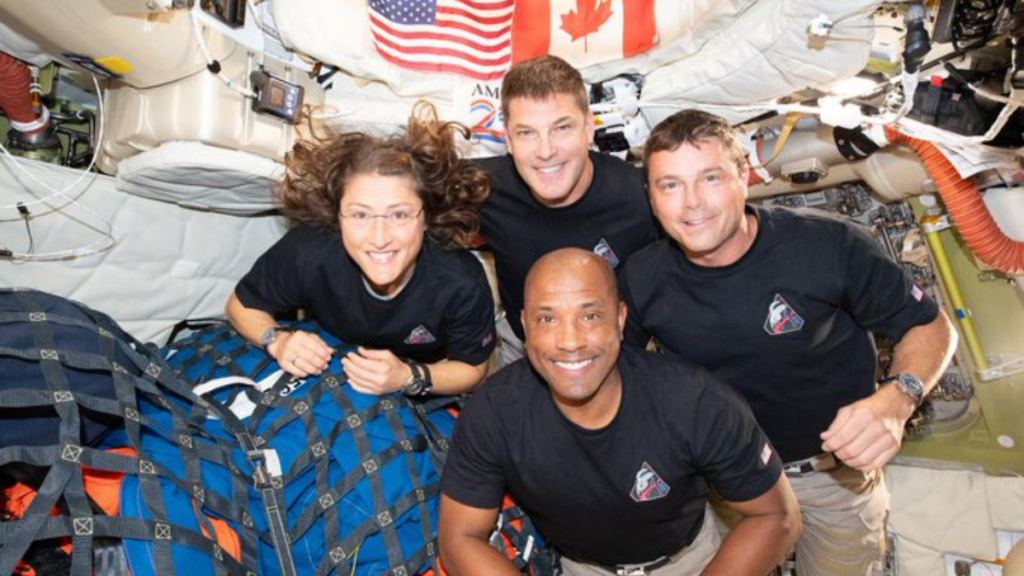
In addition to blasting past the Moon, NASA’s Artemis II mission blasted tunes beyond Earth’s orbit as well. WKYC reported that astronauts Reid Wiseman, Victor Glover, Christina Koch and Jeremy Hansen each enjoyed “listen after listen” to specially curated songs after waking up in space every day aboard Artemis II. The wake-up song has long been a tradition at NASA to spread positivity and let astronauts hear from friends and family back home.
NASA just released this closest image of Moon ever taken by Artemis II .
The clarity in insane in this view. pic.twitter.com/vBomri7fu1
— Nigerian Trump🇳🇬🇱🇷 (@Amblojiggy) April 8, 2026
Featuring classics about space travel and other “feel-good” songs, Artemis II astronauts listened to tunes including “Here Comes the Sun” and “Good Day Sunshine” by The Beatles, “Fly Me to the Moon” by Frank Sinatra, “Rocket Man” by Elton John, “A Sky Full of Stars” by Coldplay, “Walking on Sunshine” by Katrina and the Waves, “Beautiful Day” by U2, “Don’t Stop Me Now” by Queen and “Happy” by Pharrell Williams. The official Instagram handle of NASA Artemis also shared the list of tracks.
In addition to those songs, Artemis II astronauts listened to “Mr. Blue Sky” by Electric Light Orchestra, “Higher Ground” by Stevie Wonder, “On Top of the World” by Imagine Dragons, “Best Day of My Life” by American Authors, “Shut Up and Dance” by Walk the Moon, “Celebration” by Kool & the Gang and “Good Vibrations” by The Beach Boys.
The carefully selected songs served as a welcome dose of nostalgia and energy as Artemis II flew farther from Earth than any astronauts have in decades. The astronauts also felt the weight of the mission — and enjoyed special attention from former President Donald Trump — as they orbited behind the Moon and lost communications with NASA for a time similar to astronauts did during Apollo missions more than 50 years ago.
The astronauts on the Artemis II mission wake up each day to songs they picked for the voyage. Here’s their wakeup playlist so far. https://t.co/xd4RnwDdtg
— WTOL 11 (@WTOL11Toledo) April 8, 2026
In addition to blasting tunes into space, Artemis II included a special gift from a child who designed his own zero-gravity indicator. Zero-gravity indicators are stuffed mascots astronauts unfurl to indicate they’ve reached weightlessness aboard spacecraft.
Eight-year-old Lucas Ye of California designed his zero-gravity indicator, which features a smiling character with its arms outstretched, to be blasted aboard Artemis II. Once Artemis II reached microgravity, the spacecraft quickly unfurled and Ye’s mascot began floating freely inside the capsule.
Ye, who goes to second grade at a school in the San Francisco Bay Area, entered a NASA and Freelancer contest to design a “moon mascot” and was chosen out of more than 2,600 applicants from around the world. “I like rockets, I like NASA, I like the solar system, I like studying about space,” Ye said of his interest in spaceflight.
“I was really surprised and very happy,” he added after winning the contest and learning his zero-gravity indicator was heading to space. “This little mascot is going to space!”
During Artemis II, Trump also called into the mission to offer his congratulations to the crew and praised them for continuing America’s legacy of space travel. He noted it had been decades since astronauts last traveled to the Moon during the Apollo program and spoke to Artemis II astronauts while they orbited behind the Moon and lost contact with mission control.
Trump asked the astronauts how it felt to lose communications during that phase of the mission — one of the most important junctures of Artemis II. “The world is behind you. Everything you touch turns into a success,” Trump told the astronauts.