



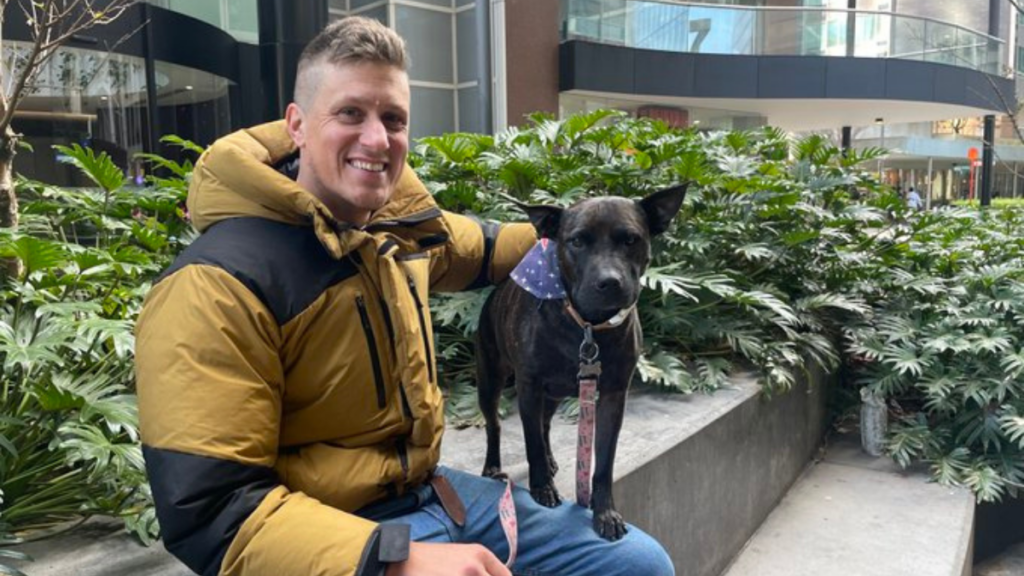
Australian tech entrepreneur Paul Conyngham may have created a bespoke AI cancer vaccine for his dog Rosie—with a little help from AI tools such as ChatGPT along the way.
It sounds complicated—the sequencing of DNA, mRNA vaccines, “neoantigens”—but in essence the AI technology allows us to read instructions cells use to grow inside tumors, then create new instructions that help the body destroy them, The Conversation reports.
Vid from yesterday of Rose being looked after at my parents house. Cant wait to see her again pic.twitter.com/VECq1JCtTG
— Paul S. Conyngham (@paul_conyngham) April 1, 2026
“The fatal prognosis left me with a choice: accept it, or throw everything I had at it. I used ChatGPT and devoured everything I could to understand cancer and what I could do about it. All the while continuing a full-time job: running an AI consulting business,” Paul Conyngham detailed in a report on the AI dog cancer “cure” he posted in article format in X.
Rosie, an eight-year-old rescue dog who’s part Staffordshire bull terrier, had surgery and chemotherapy after being diagnosed with mast cell cancer, a particularly aggressive skin cancer common in dogs. While treatment initially worked, the cancer came back—many times.
It eventually developed into large tumors on Rosie’s leg, at which point vets informed Conyngham that Rosie likely only had a few months to live. Conyngham took matters into his own hands: using his professional skills in data analysis, coding, and familiarity with AI technology, he researched another route.
DNA was sequenced from inside Rosie’s tumor, mapping out the genetic code inside and comparing it to healthy cells. Conyngham worked with a university lab to generate a detailed dataset outlining the mutations—the “spelling errors” in the cancer’s instruction manual that made it distinct.
Met one of the heroes of Rosie’s story – Dr Mari Maeda of the Canine Cancer Alliance in Seattle!
She is doing amazing work for doggos:https://t.co/lvBxmUG79n pic.twitter.com/mVG8ckinDG
— Paul S. Conyngham (@paul_conyngham) April 3, 2026
On its own, that data is just information. The challenge is determining how to use it. That’s where the AI came in. Conyngham typed questions into a chatbot: How do scientists create personalized cancer vaccines? How do you go from a list of mutations to potential targets for vaccines?
“Dr. Ghaly is one of the unsung heroes of this story. He was the only vet that was truly receptive to me – a “citizen scientist.” This new vet was critical in facilitating much of what was to come. About this time my journey in understanding cancer drug development had just begun. I knew that AlphaFold had been touted for its ability to accelerate the discovery of targeted cancer therapies and I wanted to see if that was applicable to Rosie’s case. I queried ChatGPT deeper on this, and the first step it suggested was to get genomic sequencing of Rosie’s DNA and her cancer cells’ DNA,” the Australian man continued.
GPT-Rosie: https://t.co/pTMTLRxLgE
— Paul S. Conyngham (@paul_conyngham) April 16, 2026
Cancer vaccines aren’t like preventative vaccines you take before disease strikes. They’re usually used after someone has cancer, and are meant to teach your immune system to attack tumors it had been ignoring.
This works with mRNA. Think of DNA as the master blueprint. mRNA is more like a photocopy of one tiny page in that blueprint. It’s a snippet of code that translates into instructions for your cells to make one protein. Some COVID vaccines work this way — they send mRNA into your body with instructions to build one of the proteins that makes up the virus. That way your body can learn to recognize that protein.
With personalized cancer vaccines, researchers pick pieces of proteins unique to your tumor, called neoantigens. They then string that pattern of mutations together into mRNA code. When introduced into the body, cells briefly produce these tumor-linked markers, giving the immune system a kind of “most wanted” poster to identify and attack cancer cells.
Conyngham ran Rosie’s tumor mutations through AI software to prioritize potential neoantigens. He also used protein modeling software to predict what mutated proteins would look like — giving him clues as to which antigens would be recognizable to Rosie’s immune system.
But Conyngham didn’t make the vaccine himself. After identifying targets, he worked with researchers at UNSW, who had experts in RNA tech. Together, they analyzed the data before designing an mRNA construct. They manufactured it in a lab.
The result was a one-of-a-kind vaccine tailored specifically to Rosie’s cancer, encoding several of the tumor’s unique mutations. She received the experimental treatment at a veterinary research center, followed by booster doses over several months.
In interviews, her veterinarians and owner have reported positive results. Multiple tumors decreased in size, her overall tumor load lessened, and she became more energetic and behaved more like her old self. In one case, an intransigent tumor prompted additional testing and vaccine iteration.
It’s also worth underscoring what this case isn’t. Doctors and experts have been quick to point out that this is only one case. Cancer responds inconsistently, and it’s impossible to know how much of this dog’s recovery was attributable to the vaccine or how long it will last. Nor will this approach necessarily work in other dogs, let alone people.
AI didn’t “discover a cure for cancer.” It’s simply a tool: In this case, a user-friendly manual that helped synthesize information. Humans — experienced researchers — were needed to confirm results and do the physical lab work.
Nevertheless, the story does showcase how effective these technologies can be when paired together. We can now sequence DNA quickly to identify where tumors are mutating. mRNA technology can now be used to rapidly produce personalized treatments. And AI can help humans more easily understand those processes, even if the technology still needs human oversight.
All of that adds up to a future where ultra-personalized medicine is easier to produce. Rather than requiring billion-dollar pharmaceutical companies with fleets of researchers, it could one day be made by committed individuals. A person like Paul Conyngham, who sequenced a tumor, used AI to analyze the information, and collaborated with scientists to create a personalized treatment, at least on an experimental basis.
There are obviously a lot of scientific and ethical hurdles to work through. Safety and efficacy will need to be tested, for example. And standards will need to be put in place to help ensure desperate pet owners don’t jump to conclusions or engage in risky DIY experiments.
At the most fundamental level, it starts with knowing what makes your tumor different. Each of our cells contains DNA, which serves as a blueprint for our bodies. It’s made up of molecules called bases that are arranged in a sequence, sort of like the letters that make up words. When enough of those bases mutate — and start reading as something other than A, T, C, or G — cells begin to grow out of control, leading to cancer. By sequencing those mutations, researchers can work backwards to find ways to attack them.