



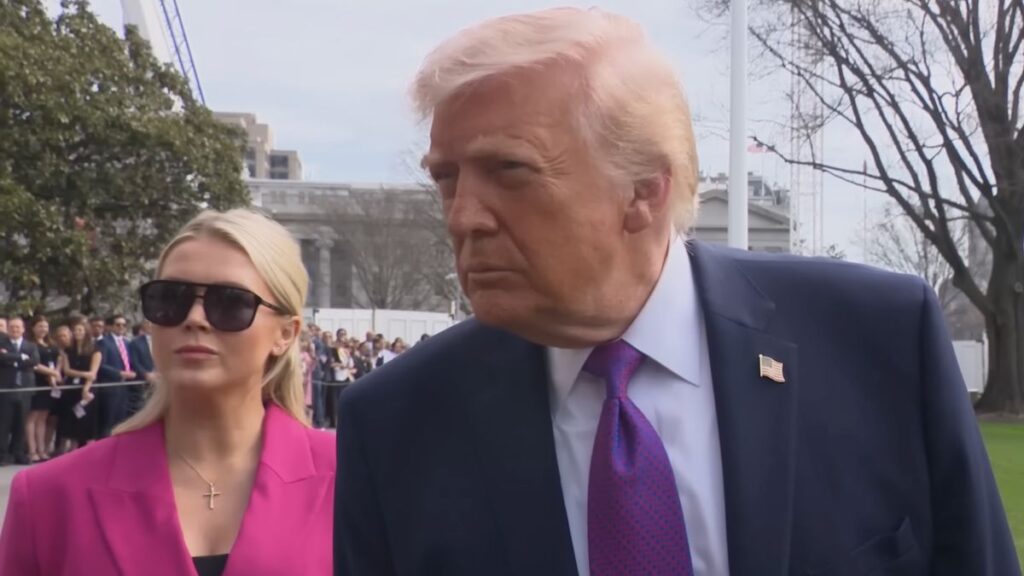
White House officials are reportedly struggling to keep up with Donald Trump as his messaging around the Iran conflict continues to shift, leaving even senior aides — including press secretary Karoline Leavitt — in the dark about key decisions. In fact, the president seems to intentionally be keeping everyone on their toes.
According to The Mirror US, Trump has been taking calls directly from journalists on his personal phone. As if this is not enough, he is apparently also sometimes offering conflicting statements about the U.S. position in the war in Iran. By having direct access to the president, these journalists are seemingly able to bypass the traditional channels, raising concerns about consistency and control over the stories which are being reported. Since Trump is speaking to them on a personal level, the White House has no control about what is being said.
Officials told reporters that Trump has, at times, teased Leavitt by suggesting he had shared information with journalists without clarifying what was said or to whom. As the Press Secretary she is impacted directly when the president makes statements to the press without her knowing what was said. Instead, she was told she would have to “wait and see.” This approach has left those within the administration with feelings of uncertainty and unease because they do not necessarily know what has been communicated.
‘Blindsided’ Karoline Leavitt told to ‘wait and see’ as Trump makes shocking decisionhttps://t.co/QAbdC7CTjC
— MirrorUSNews (@MirrorUSNews) April 20, 2026
The confusion comes as the conflict in Iran is still ongoing, which began with the U.S. and Israeli joining forces to strike Iran at the end of February. Since then, Trump has repeatedly told Americans different things. At one time, he said the U.S. was “ahead of schedule” in its military campaign. Days later, he stated there was “no time limit.”
Yet another time, Trump told one outlet there was “practically nothing left to target in Iran,” before later warning he could wipe out a “whole civilization” if demands were not met. The contrasting statements have added to what aides privately describe as a difficult communication environment.
Even though there has reportedly been many internal challenges, Leavitt has continued to publicly defend the administration’s position. During internal discussions before the strikes, she reportedly told Trump that the decision ultimately rested with him, adding that the communications team would handle the public’s response as best as they could.
The country’s youngest press secretary may also be its most stressed.https://t.co/mWPl1YKYYw
— The Daily Beast (@thedailybeast) April 19, 2026
Recently, the spotlight has been on Leavitt, not only for her position as one of the youngest press secretaries ever, but also how she and the president interact. Earlier this year, Trump joked about her performance, telling her, “You’re doing a terrible job,” before adding, “Shall we keep her? I think we’ll keep her.”
Trump has also acknowledged the impact of his communication style, at one point suggesting he intentionally adopts a more unpredictable tone. The president has apparently even told an adviser that projecting an “unstable” image could serve as a negotiating tactic.
The result is a White House dynamic where messaging continues to evolve in real time. While aides may attempt to maintain a consistent public image and messaging, the president’s direct engagement with media and shifting message have made that task very challenging. For now, officials appear to be adapting as the situation changes, with key decisions and key communications made by the president at any given time.