



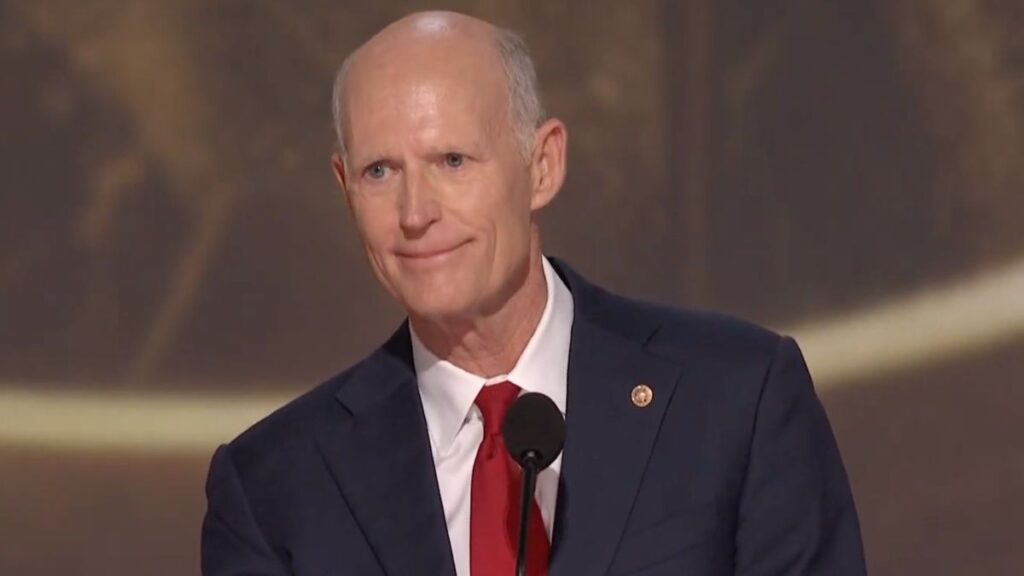
Florida Senator Rick Scott recently suggested a savings plan that has drawn scrutiny online. Many netizens wondered whether he was out of touch with reality and considered the current economic conditions when suggesting a savings plan for 18-year-olds.
Recently, Sen. Scott shared a post on X that has now generated a buzz online. He suggested a savings plan that would generate substantial returns by the retirement age.
He wrote, “If you put $500 in a bank account every month from your 18th birthday until you turn 65, how much money would you have on your 65th birthday if your average return was the average S&P over the last fifty years?”
If you put $500 in a bank account every month from your 18th birthday until you turn 65, about how much money would you have on your 65th birthday if your average return was the average of the S&P over the last fifty years?
— Rick Scott (@ScottforFlorida) March 15, 2026
Scott’s post also contained a poll of different possible answers to his question. About 39.2% of respondents believe they would generate $500,000. And 32.5% said $10,000,000.
Lastly, about 17.4% and 10.2% believe they could generate $1,000,000 and $500,000, respectively. The internet appeared surprised by his assumption of an average young adult having that amount of money, and responded to his question and suggestion on X.
One netizen prompted a series of responses by highlighting, “If you think 18-year-olds in America have an expendable $500 per month, you are not tethered to the reality you helped to create for younger generations.”
Similarly, another user on X asked, “Where do us NON-billionaires get this disposable $500 a month?” A third netizen also asked, “Which middle-class American can afford to put away $500 a month for 47 years?”
Rick Scott’s answer to living life! pic.twitter.com/fnKaKVk0Cz
— JamesLee (@jimmy0726) March 16, 2026
The user explained, “A middle-class family with both (parents) working and one child in daycare isn’t saving $500 a month.” A fourth one suggested a reality check, saying, “You do realize most people are living paycheck to paycheck? I saw a guy counting pennies for gas.”
Another user stated, “Unrealistic expectation, Rick. Bad majority of GenZ’ers and those struggling now.” A final one pointed out, “Leave it to a millionaire to think the average American can set aside $500 every month. These people live in an alternate reality.”
Similarly, many others scrutinized Scott for his post on X. Neither Sen. Scott nor his representatives have responded to the backlash. Some political figures did respond.
Jennifer Jenkins, a Democrat and former Brevard County School Board Member, responded with a separate post on X, prompting another series of responses from her supporters.
If @ScottforFlorida took the $1.7 billion he stole from taxpayers and used it to give people the $500 a month he says they should be saving…
How many months would it last?
ANSWER: About 3.4 million months.
Maybe the problem isn’t that working people aren’t saving enough.
— Jennifer Jenkins (@Jenkins4Florida) March 16, 2026
Jenkins accused the Florida Senator of allegedly “stealing $1.4 billion from taxpayers” and stated, “Maybe the problem isn’t that working people aren’t saving enough…” Jenkins’ post referred to the time he was accused of being involved in a Medicare and Medicaid fraud of $1.7 billion.
The incident took place in the 1990s and led to a legal altercation when he was the CEO of Columbia/HCA. As a result of being investigated by the federal authorities, he resigned from his role at the chain of hospitals.
Rick Scott’s Hospital Company ColumbiaHCA defrauded Medicare and was fined $2 billion— the biggest ever.
He invoked the 5th 75 times to avoid prison & received $300 million retirement package which he used to buy FL governorship + Senate Seat.
He’s doubled his net worth since.
— Maine (@TheMaineWonk) December 16, 2025
And although the company faced penalties, he denied any responsibility for the crime and was not legally implicated in committing fraud either.
As for the lawsuit, it was settled for a hefty fine and penalty amounting to $1.7 billion. According to the Department of Justice, it was the largest healthcare fraud in US history.


