



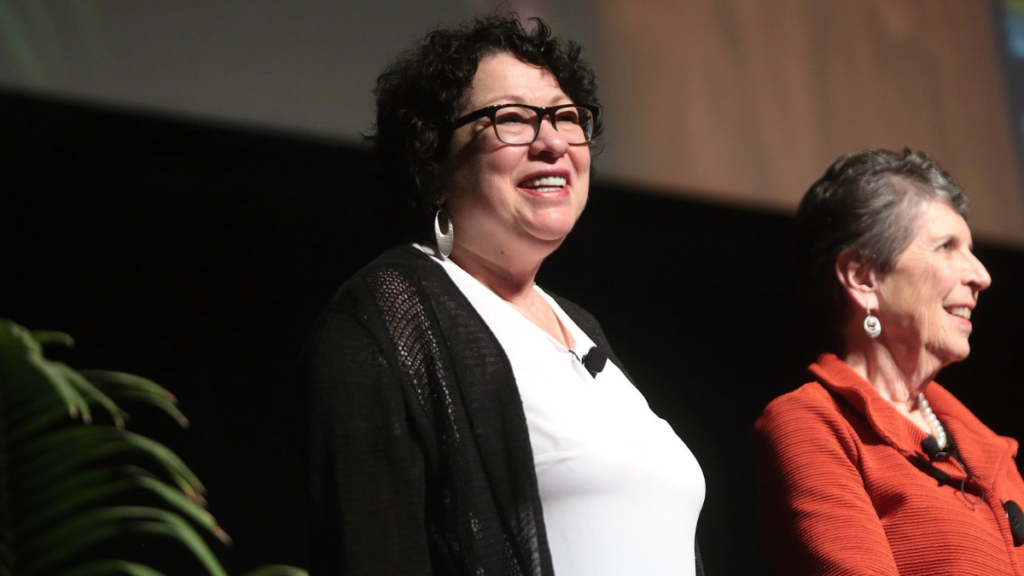
Sonia Sotomayor came into the public eye when then-President Barack Obama nominated her to the Supreme Court of the United States in 2009. However, it was not routine, and it became a big deal since it marked a historic moment in American law. Sonia Sotomayor became the first Hispanic justice and only the third woman to serve on the nation’s highest court. Yet her path to the position began far from the halls of power.
Born in the Bronx, a borough of New York City, to parents who had moved from Puerto Rico during World War II, her family lived in a public housing project. Undoubtedly, her childhood was filled with hardship. Moreover, her father struggled with alcoholism and died when she was just nine years old.
According to Nicki Swift, while reflecting on her upbringing during a 2013 interview on the “Today” show, Sonia Sotomayor spoke about the emotional challenges she faced. “Neglect was the right word,” she said while discussing her early relationship with her mother. “The mother I grew up with is not the mother I know now… and that’s been the greatest prize of my life.”
Sonia Sotomayor, the first Latina Associate Justice of the Supreme Court. #InternationalWomensDay pic.twitter.com/Y4zcstD1AR
— Affinity Magazine (@TheAffinityMag) March 8, 2016
However, this wasn’t the only struggle she faced early in life. At age eight, she was diagnosed with Type 1 diabetes, a condition that was poorly understood at the time. In her memoir My Beloved World, she wrote that the illness allowed her to gain a different outlook on life. “When you have anything that threatens life… it prods you into stepping back and really appreciating the value of life.”
It is reported that the condition still affects her daily routine. During an interview with NPR, she talked about an incident where she gave herself an insulin shot in a restaurant bathroom, though a stranger misunderstood what she was doing. “Madam, I am not a drug addict. I am diabetic,” she remembered saying. “That injection you saw me give to myself is insulin. It’s the medicine that keeps me alive.”
Sonia Sotomayor’s interest in law began unlikely way, through television. As a child, she admired fictional detective Nancy Drew, but doctors weren’t sure if she could become a police officer. Hence, she found comfort in the courtroom drama Perry Mason, starring Raymond Burr. It was then that she thought that becoming a lawyer would allow her to pursue justice in another way.
Her academic journey began at Princeton University, where she enrolled in the early 1970s, not fully aware of the culture of Ivy League schools. Back then, Princeton had only recently begun admitting women, making her presence as a Hispanic student a crucial chapter of her life.
After graduating, she joined public service as an assistant district attorney in New York in 1979. Reportedly, the city was experiencing high levels of crime at the time. One of the cases that helped establish her reputation was the prosecution of Richard Maddicks, known as the “Tarzan Burglar.”
A fellow prosecutor, Hugh Mo, later praised her courtroom presence. “She had that uncanny ability of putting together a complicated set of facts and distilling them into a very simple story that would resonate with the jury,” he told NPR.
Justice Sonia Sotomayor on the far right rulings of the Supreme Court: “I live in frustration. Every loss truly traumatizes me in my stomach and in my heart. But I have to get up the next morning and keep on fighting.” pic.twitter.com/6AUcPqb1ka
— Mike Sington (@MikeSington) January 30, 2024
Years later, Sonia Sotomayor left the district attorney’s office, saying the work had begun to change her outlook. However, her judicial career started to scale up when George H. W. Bush nominated her to the federal bench in 1991. Nearly two decades later, Obama selected her for the Supreme Court, which left her overwhelmed. “At that moment, my heart started to thump,” she said.
Since joining the court, Sonia Sotomayor has often spoken out through unconventional opinions, including policies introduced during the administration of Donald Trump. This includes the travel ban targeting several Muslim-majority countries.
Beyond the courtroom, she has also become a successful author, writing books like Just Ask! Be Different, Be Brave, Be You to inspire children with diverse backgrounds and abilities. She says the goal is to encourage young people to see themselves as agents of change.


