



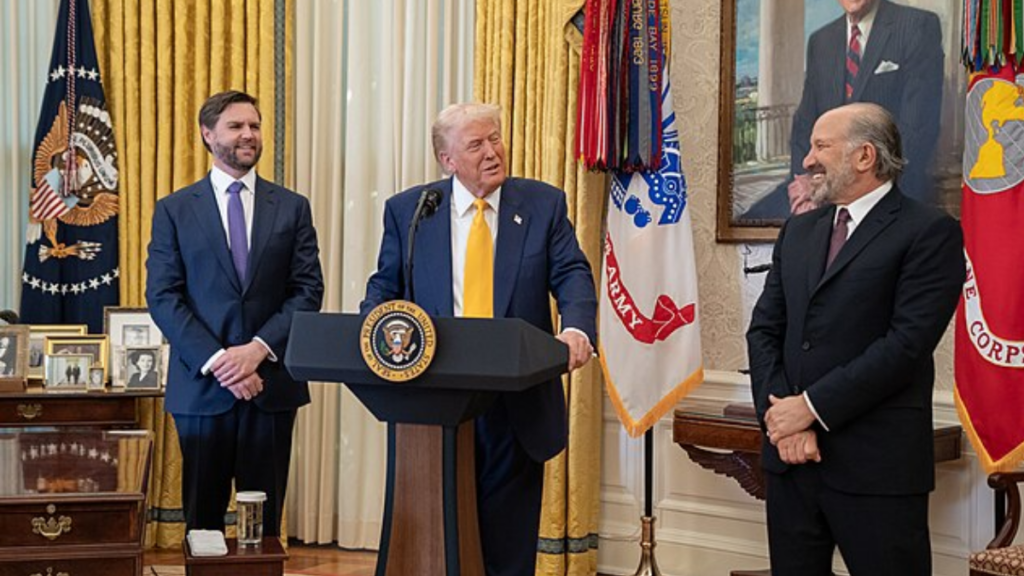
In a surprising turn of events, President Donald Trump allegedly sidelined Vice President JD Vance while moving ahead with his military campaign against Iran. This has raised comments from insiders, who describe it as a growing divide between the two over U.S. involvement in foreign conflicts.
As per The Daily Beast, the split became more evident over the weekend as American and Israeli forces launched coordinated strikes on multiple Iranian locations and targets on Saturday.
Senior officials, including Défense Secretary Pete Hegseth and Secretary of State Marco Rubio, were at Trump’s Mar-a-Lago residence during the operation.
Rubio was tasked with briefing lawmakers ahead of the strikes, while White House Press Secretary Karoline Leavitt led the administration’s public communication.
Shockingly, Vance was not prominently featured in the entire process. According to officials familiar with the situation, he was seated in the White House Situation Room alongside Treasury Secretary Scott Bessent, Director of National Intelligence Tulsi Gabbard, and Energy Secretary Chris Wright.
Yeah it says that Trump and Vance shouldn’t be in the same room together right now.
— Benny (@amrcn_benny) March 1, 2026
It was reported that he was receiving updates via a secure line rather than taking part in the strategic planning. Hence, the vice president did not make any public statement immediately after the airstrikes.
The absence stood in contrast to Rubio’s high-profile role. In the days leading up to the operation, Rubio publicly warned Americans to leave Iran. He also contacted seven of the eight members of the so-called “Gang of Eight” congressional leaders to inform them that military action was in the process.
Now, if compared to Vance, he was seen having a far more cautious tone. Just one day before the attacks in Tehran, he told reporters there was “no chance” the United States would become entangled in a prolonged Middle Eastern war.
“The idea that we’re going to be in a Middle Eastern war for years with no end in sight — there is no chance that will happen,” Vance said Friday.
In an interview with The Washington Post, Vance shared that both he and Trump had long been “skeptics of foreign military interventions,” though the VP acknowledged he did not know precisely what the president was planning.
Meanwhile, Trump’s rhetoric changed drastically after the strikes began. On Saturday, he openly circulated the idea of regime change in Iran and signalled that the operation would not be limited in scope.
They lied. Trump and Vance lied
It’s simple.
You can try to justify and twist yourself into a pretzel with talking points. “Oh this is a good idea”. But it’s the opposite of what they said they would do when they ran.
You can’t be for the old Trump message and support this. https://t.co/dW6rcrQfse
— Bruce Fenton (@brucefenton) March 1, 2026
It is reported that the tough actions did not sit well with Vance, who built much of his political brand on opposing so-called “forever wars.” Sources close to the administration say Trump viewed the vice president’s hesitation as a lack of enthusiasm during the critical time.
Instead of playing a leading role in national security matters, Vance has recently been looking after the administration’s domestic priorities. This includes energy policy and affordability initiatives.
This week, he was also assigned to oversee a push to uncover fraud in federal programs. This proves that he is definitely looking over responsibilities that are significant, but far removed from the centre of the Iran crisis.


