



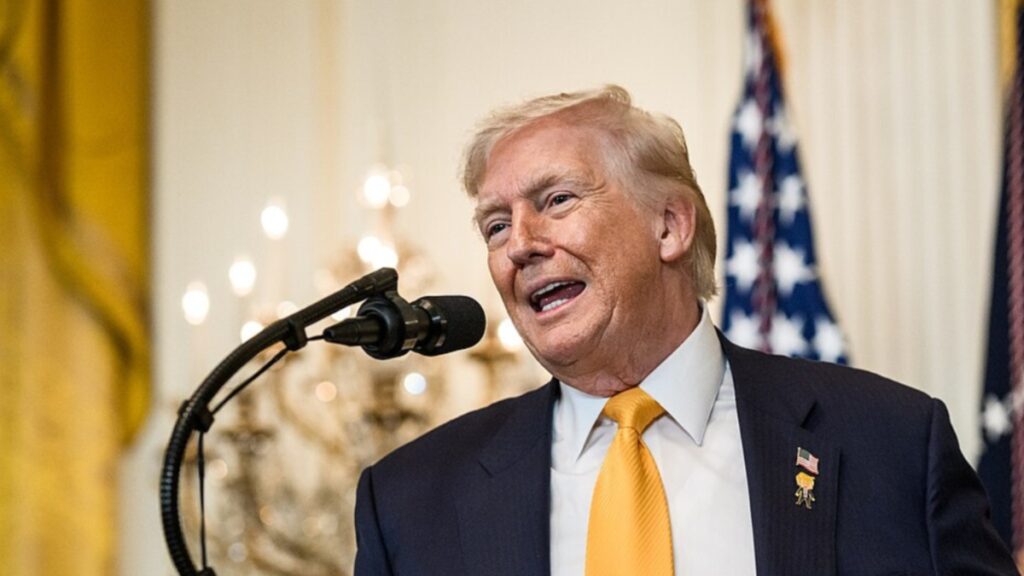
President Donald Trump faced challenges on three fronts as the Supreme Court rejected his global tariffs, new government data showed a sharp slowdown in the economy at the end of 2025, and a key measure of inflation increased. This made it harder for the White House to present a strong economy ahead of next week’s State of the Union address.
The Supreme Court ruled 6-3 that Trump exceeded his authority by imposing broad tariffs under a law meant for national emergencies. This was a significant blow to a policy that Trump has relied on for his trade agenda.
In response, Trump launched a personal attack on the court and several justices during a White House event. “The Supreme Court’s ruling on tariffs is deeply disappointing. I’m ashamed of certain members of the court, absolutely ashamed, for not having the courage to do what’s right for our country,” Trump said via Reuters.
He also criticized two justices he appointed, Neil Gorsuch and Amy Coney Barrett, for siding with Chief Justice John Roberts and the court’s three liberal justices in the majority. “I think it’s an embarrassment to their families, if you want to know the truth, the two of them,” Trump commented about Gorsuch and Barrett.
Earlier in the day, the Commerce Department’s Bureau of Economic Analysis reported that gross domestic product grew at a 1.4% annual rate in the fourth quarter, down from 4.4% in the third quarter. Economists surveyed by Reuters had predicted a growth rate of 3.0%.
NEW: Illinois Gov. JB Pritzker sent Trump a letter and an invoice demanding the return of $8.6 billion taken from Illinois families after the Supreme Court ruled Trump’s tariffs are illegal. pic.twitter.com/C4t1N0t0PG
— MeidasTouch (@MeidasTouch) February 20, 2026
The report attributed much of the slowdown to a steep decline in federal government spending tied to last year’s 43-day shutdown. Federal spending fell at a rate of 16.6% in the fourth quarter, marking the largest decline since 1972, and it reduced GDP growth by 1.15 percentage points, according to Reuters.
Trump pointed to the shutdown as a major factor behind the weak GDP results in a social media post before the data was released. He wrote, “Shutdown cost the U.S.A. at least two points in GDP. That’s why they are doing it, in mini form, again. No Shutdowns! Also, LOWER INTEREST RATES.”
At the same time, inflation readings went in the opposite direction of what would support near-term interest rate cuts. A separate BEA report showed that core personal consumption expenditures prices, the Federal Reserve’s preferred inflation measure excluding food and energy, increased by 0.4% in December after a 0.2% rise in November. Core PCE inflation rose 3.0% over the 12 months ending in December, up from 2.8% in November.
Economists in the Reuters report mentioned that core inflation could stay steady into early 2026, and they did not expect the Fed to reduce rates before its meeting on June 16-17.
The White House now has a narrower path to reaffirm its trade policy after the court ruling, while also managing an economy that displayed slower growth late last year and inflation that has not returned to the Fed’s 2% target. Trump is set to deliver his State of the Union address on Tuesday, February 24, and some Democrats are boycotting the speech.


