



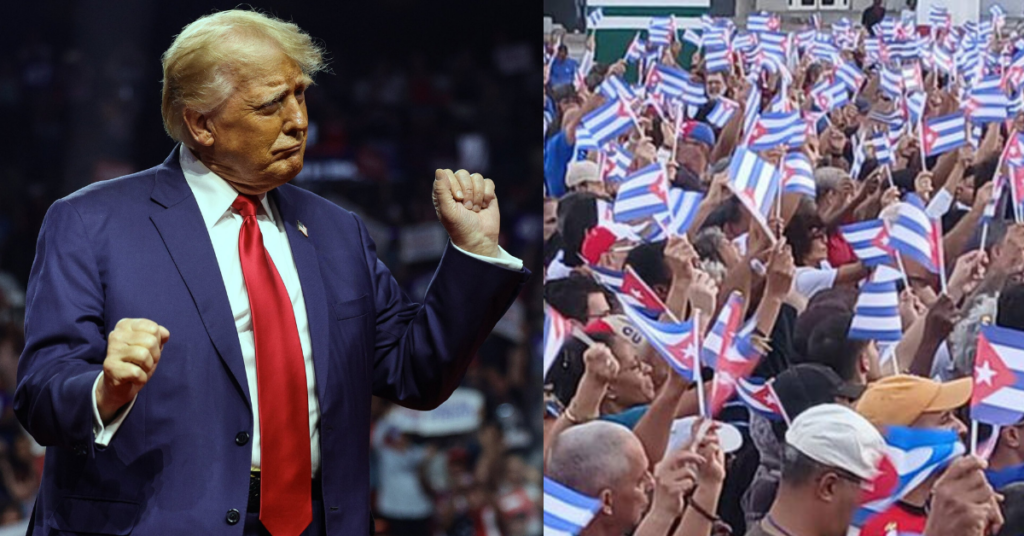
President Donald Trump is facing renewed calls from foreign policy experts and Cuban-American leaders to impose a strict zero-tolerance policy toward Cuba, as warnings mount that the island’s communist regime is nearing collapse and will attempt to manipulate Washington into easing pressure. Advocates argue that the current moment presents a rare opportunity for decisive U.S. action after decades of failed engagement and broken promises from Havana.
“No están recibiendo dinero alguno de Venezuela y no están recibiendo dinero de ningún lado. (Cuba) Es una nación fallida. México va a dejar de enviarles petróleo”: Trump
pic.twitter.com/dFpQ52ziZD
— Carlos Loret de Mola (@CarlosLoret) February 2, 2026
According to experts cited by the New York Post, Cuba’s leadership is in a weakened position due to a combination of economic collapse, fuel shortages, and the loss of financial backing from allies such as Venezuela. Cuban President Miguel Díaz-Canel has publicly acknowledged severe energy shortages and disruptions to daily life, while insisting that the regime will not yield on political control. Analysts have warned the Donald Trump administration that these admissions signal desperation rather than reform, and that the regime may attempt to lure the United States into negotiations in order to buy time and secure economic relief without making substantive changes.
⚠️⚠️Trump vuelve a referirse a Cuba:
“Está en muy ma estado… dependió de Venezuela por petróleo y por dinero” pic.twitter.com/w4h2kCGWnW
— Mag Jorge Castro🇨🇺 (@MagJorgeCastro) January 9, 2026
Trump has previously described Cuba as a failed state and has made clear that his administration views the communist government as illegitimate and oppressive. Lawmakers urging a zero-tolerance policy have called on the administration to apply total economic and diplomatic pressure, including sanctions against foreign governments and companies that supply oil or financial lifelines to the regime. Some advisers have also raised the possibility of aggressive enforcement measures aimed at preventing Cuba from circumventing U.S. sanctions through third-party nations.
Experts quoted in the report cautioned that the Cuban regime has a long history of deception in dealings with foreign governments. One analyst warned that Havana would likely promise reforms, humanitarian cooperation, or political openings that never materialize, a tactic used repeatedly over the past several decades to ease pressure while maintaining strict one-party rule. Supporters of Trump’s approach argue that only sustained pressure, without concessions, can force genuine change.
Cuba has been ruled by a communist dictatorship since the 1959 revolution led by Fidel Castro, who aligned the island with the Soviet Union and transformed it into a one-party state. Under Castro and his successors, private property was seized, political dissent was criminalized, and tens of thousands of Cubans were imprisoned or executed. Millions more fled the island, creating one of the largest exile communities in the Western Hemisphere, particularly in the United States.
COMUNICADO. “Gobierno de México envía ayuda humanitaria al pueblo de Cuba, a través de dos buques de la Armada de México”.https://t.co/Kg0zN8cMLB pic.twitter.com/E73CB7xiB1
— Relaciones Exteriores (@SRE_mx) February 8, 2026
Relations between Washington and Havana remained hostile for decades, shaped by Cold War tensions, the Cuban Missile Crisis, and the ongoing U.S. embargo. That posture shifted dramatically under President Barack Obama, who pursued a policy of normalizing relations with Cuba beginning in 2014. Obama restored diplomatic ties, reopened embassies, eased travel and trade restrictions, and removed Cuba from the list of state sponsors of terrorism. He argued that engagement would encourage reform and improve conditions for the Cuban people.
Critics of Obama’s approach, including Trump, contended that normalization delivered economic benefits to the Cuban government and military while failing to secure meaningful political freedoms or human rights improvements. During his first term, Trump reversed many of those policies, reinstating sanctions and tightening enforcement, arguing that engagement had only strengthened the regime’s grip on power.
Now, as Cuba faces one of its worst crises in decades, Trump allies argue that easing pressure would repeat past mistakes. They point to mass protests on the island, widespread shortages of food and electricity, and growing unrest among the population as evidence that the regime is vulnerable. In their view, this moment demands firmness rather than negotiation.
The push for a zero-tolerance policy reflects a broader Trump-era foreign policy doctrine that prioritizes leverage, deterrence, and accountability over diplomatic accommodation with authoritarian governments. Supporters argue that sustained pressure on Cuba would not only advance U.S. interests but also offer the Cuban people their best chance in generations for real political change.
As the administration weighs its next steps, the debate underscores a sharp contrast between past efforts to engage Havana and the current push to confront it head-on, with Trump urged to maintain unwavering pressure on one of the hemisphere’s longest-standing communist regimes.