



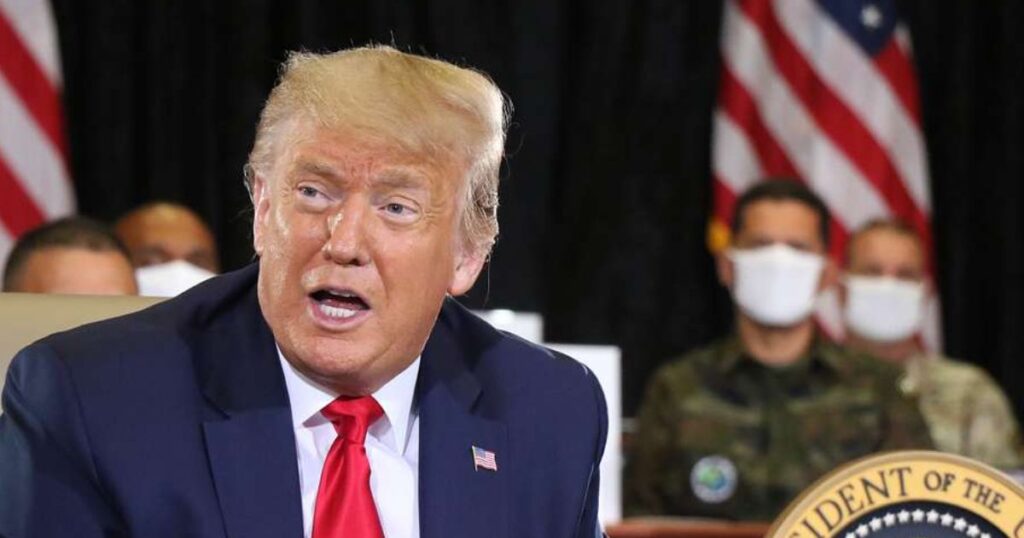
President Donald Trump and public criticism have long gone hand in hand.
From backlash over his blunt rants on Truth Social to multiple lawsuits filed by private citizens and media organizations over ICE raids and alleged misconduct, followed by repeated incidents of publicly shaming female reporters, the list of controversies surrounding him appears endless.
For instance, Trump called the New York Times a “TRUE ENEMY OF THE PEOPLE!” in a lengthy online rant after the outlet published a story claiming the president was showing signs of cognitive and physical decline. His feud with the publication has a long history.
Recently, Trump has faced renewed criticism after claiming he has effectively “won” at least one lawsuit against the U.S. government and could receive a large payout funded by taxpayers.
I hope it’s clear to everyone by now that Trump’s play over and over again is to yell “National Security!” and pretend as though that gives him the right to act like a dictator pic.twitter.com/uNATJ6Zazm
— Aaron Rupar (@atrupar) December 23, 2025
During an interview on February 5 with NBC’s Tom Llamas, Trump discussed a $10 billion lawsuit he filed last week against the IRS and the Treasury Department. The lawsuit stems from the leak of his tax returns by a former IRS contractor during Trump’s first term, a breach of federal confidentiality laws.
According to sources, the leaked records, later published by The New York Times and ProPublica, showed that Trump paid little to no federal income tax over several years, despite his vast accumulation of wealth. According to Forbes, his net worth is estimated to be between $6.5 billion and more than $7 billion as of February 2026.
Much of that wealth is driven by the valuation of the Trump Media Technology Group, cryptocurrency investments, overseas real estate partnerships, and other ventures during his second term, which began in January 2025.
“You can’t leak documents,” Trump said, adding that any money he receives would be donated entirely to charity. “Any money that I win, I’ll give it to charity—100%—charities that will be approved by the government or whatever.”
Trump also discussed another lawsuit in which he is seeking $230 million from taxpayers, tied in part to the FBI’s 2022 search of his Mar-a-Lago estate, where classified documents were recovered.
“Essentially, the lawsuit’s been won,” Trump told Llamas. “I guess I won a lot of money.”
Trump: Essentially, the lawsuit has been won. I guess I won a lot of money. I’ll give 100% to charity.
Reporter: You’re taking it out of the system.
Trump: No, I’m putting it back into the system. I’m giving it to charity.
Reporter: 38 trillion in debt and we’re taking 10… pic.twitter.com/ylhbRG4Vg1
— Acyn (@Acyn) February 5, 2026
While it remains unclear which lawsuit Trump was referring to, neither case has been formally resolved. Both lawsuits target executive branch agencies, which are now under the president’s authority.
Donald Trump has previously suggested that this power allows him to “work out a settlement with myself,” a comment that sparked criticism and raised questions about his ethics.
Although Trump said he would donate any proceeds to organizations such as the American Cancer Society, critics have questioned his stance on charities. In 2018, the Trump Foundation was shut down under court supervision following allegations of self-dealing.
The 79-year-old later agreed to pay $2 million to settle a civil lawsuit brought by New York state. The organization, officially known as the “Donald J. Trump Foundation,” was a private entity established to distribute funds to charitable causes.
Donald Trump’s misused his charitable foundation for personal and political gain led to its closure and a $2 million restitution agreement, exposing the deep corruption that undermines public trust in political figures. https://t.co/3O5AiX3bJC
— Michael D. Baker (@mikebakerlaw) November 23, 2024
In September and October 2016, multiple legal actions and complaints were filed against the Trump Foundation over alleged legal violations. These included using foundation funds to settle business debts, purchase personal items, and support Trump’s 2016 presidential campaign.
On December 18, 2018, the Trump Foundation was formally dissolved. Trump was required to wind down the organization in accordance with court rules, a development that drew national attention.
Consequently, former New York Attorney General Barbara Underwood described the foundation’s conduct as a “shocking pattern” of “repeated and willful self-dealing,” including the purchase of a $10,000 portrait of Trump for display at one of his golf courses.