



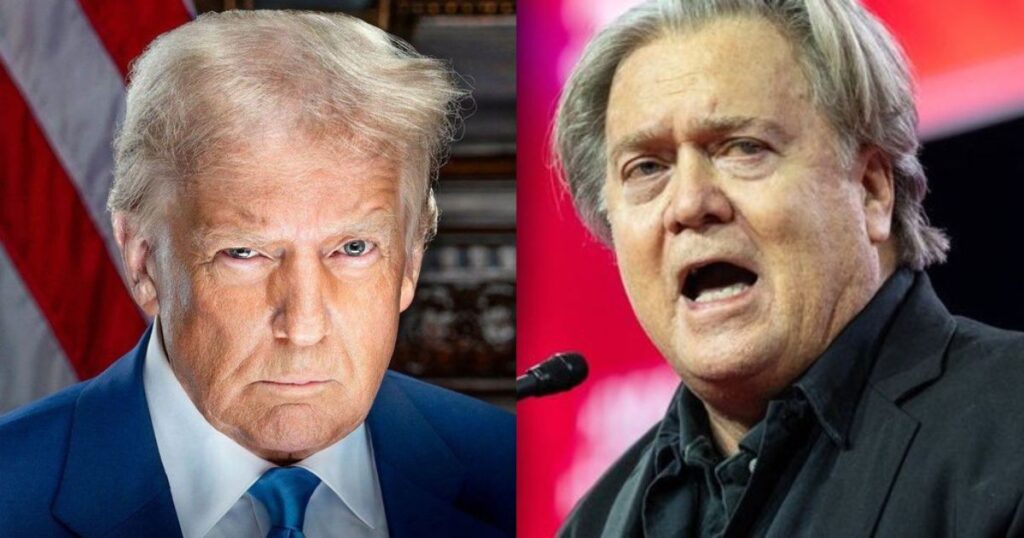
Steve Bannon, a close ally of President Donald Trump, stated this week that ICE agents should “surround the polls” during the November 2026 midterm elections. His remark raised concerns among some election officials and voting-rights groups about intimidation at polling places.
“You’re damn right we’re gonna have ICE surround the polls come November,” Bannon said Tuesday on his “War Room” podcast. He added, “We’re not going to sit here and let you steal the country again.”
Bannon did not explain how ICE would be deployed, what authority the agency would use to operate at voting sites, or if federal officials had approved any such plan. ICE, which is part of the Department of Homeland Security, usually focuses on immigration enforcement and detention rather than election administration.
These comments came as Trump and his allies promoted claims that elections can be “stolen.” Trump has used such language repeatedly since his 2020 loss. Recently, Trump urged Republican officials to “take over” and “nationalize” elections in different states, according to a conservative podcast.
Democratic election officials have been updating crisis plans ahead of the midterms due to a charged political climate and increased tensions over federal law enforcement actions. The Associated Press reported last week that secretaries of state and other officials discussed preparing for disruptions that could range from bomb threats to the potential presence of immigration agents at polling sites. This comes after aggressive immigration operations and a federal search linked to election records in Georgia.
Steve Bannon: “We‘re gonna have ICE surround the polls…We’ll never again allow an election to be stolen.” pic.twitter.com/9R9tZdolHx
— Republicans against Trump (@RpsAgainstTrump) February 4, 2026
Federal law prohibits intimidation aimed at interfering with voting rights in federal elections. Title 18, Section 594 of the U.S. Code makes it a crime to “intimidate, threaten, [or] coerce” someone to interfere with their right to vote. Additionally, the Justice Department notes that the Voting Rights Act allows federal observers, recruited through the Office of Personnel Management, to monitor specific polling places and ballot-counting sites when authorized.
Bannon’s remarks surfaced as immigration enforcement has become a key issue in the lead-up to the midterms, especially after high-profile shootings involving federal immigration agents in Minnesota. Reuters reported in January that Trump’s immigration crackdown has turned into a complex campaign issue, with public unease rising over aggressive tactics.
Two U.S. citizens were shot dead by federal immigration agents in Minnesota. These events intensified political fallout and influenced some election officials’ planning for November.
Voting-rights advocates have long argued that having armed or uniformed personnel near polling sites can lower turnout, especially among communities that already distrust government authorities. The Brennan Center for Justice has documented how intimidation can arise through aggressive “poll watching,” confrontations at drop boxes, and organized efforts that challenge voters en masse. They noted that multiple federal and state laws might apply based on the conduct involved.
Bannon described his proposal as a response to unproven claims of election fraud, but he did not present evidence of widespread illegal voting. Courts, audits, and state election officials have dismissed Trump’s fraud claims from 2020. Election experts have repeatedly stated that noncitizen voting in federal elections is rare and illegal.
Neither ICE nor DHS has publicly stated any policy to place immigration agents at polling places for the 2026 midterms. Election administration in the U.S. is mainly the responsibility of state and local officials, with federal agencies typically supporting roles related to civil rights enforcement, cybersecurity coordination, and criminal investigations when needed.
Bannon’s comments will likely heighten partisan conflicts over election rules and enforcement in the coming months as campaigns work to mobilize voters and parties explore legal boundaries regarding who can be present at polling sites and under what conditions.