



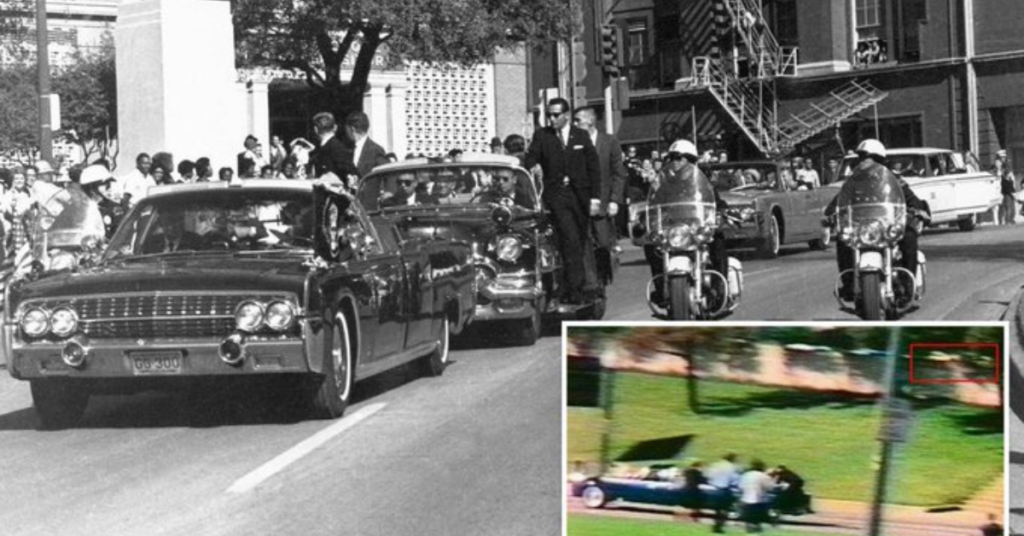
A long-buried piece of American history may soon force the government to confront one of the most explosive questions ever tied to the assassination of President John F. Kennedy: was there a second shooter on the grassy knoll?
According to attorneys representing the family of the late Orville Nix, a Dallas man who filmed the assassination from a unique angle in Dealey Plaza, a never-released 8mm home movie has been quietly held by the federal government for decades and could now be worth as much as $900 million. More importantly, they say, the film could visually contradict the official claim that Lee Harvey Oswald acted alone.
Unlike the famous Zapruder film, the Nix footage was shot from the opposite side of the motorcade and directly captures the grassy knoll area at the moment Kennedy was struck. Legal experts argue it is the only known film that shows that vantage point clearly during the shooting. In a twist that further underscores its importance, Abraham Zapruder himself can be seen standing in the Nix footage as he films his now-famous reel.
JFK’s body was flown back to Washington in a bronze casket — but that casket was never used for his funeral. Damaged beyond repair and feared to become a morbid collectible, it was weighted down and sunk by the U.S. Air Force in the Atlantic. #JFK https://t.co/LBaOylV0zj pic.twitter.com/KhuVRwIMzx
— We Are The Mighty (@WeAreTheMighty) January 27, 2026
“It’s really the only one that is known to have captured the grassy knoll area of Dealey Plaza right as the assassination occurs,” said attorney Scott Watnik, who represents Nix’s granddaughter, Linda Gayle Nix Jackson.
The footage also shows Jackie Kennedy climbing onto the back of the presidential limousine moments after the fatal shot, a movement some experts believe could help determine the direction of the gunfire if analyzed with modern technology.
Watnik said advances in optics, image enhancement and artificial intelligence could reveal details that were impossible to extract when Congress last reviewed the film in 1978. “If we subjected the camera-original film to optics technology of 2026, we can certainly capture details that could not be seen decades ago,” he said.
The mystery surrounding the JFK assassination film deepened in 1988, when the National Archives acknowledged it did not possess the original footage — only a copy — raising fresh questions about where the camera-original film actually ended up. That admission now sits at the center of a renewed legal fight. A January 15 order issued by Court of Federal Claims Judge Stephen Schwartz laid out a formal discovery process that gives attorneys the ability to press the federal government on how it handled, stored, and potentially withheld the historic film.
Complicating matters further is the 1992 JFK Records Act, which granted the federal government ownership rights over assassination-related evidence while establishing a system intended to eventually make records public. Lawyers for Nix Jackson argue that the law has instead been used to shield critical materials from scrutiny. They say the lawsuit — and a potential trial if no settlement is reached — is aimed at forcing new disclosures about how and where the government has stored evidence, including fragments of Kennedy’s brain and recordings of internal communications by Dallas police on the day of the shooting.
Orville Nix filmed the JFK assassination on November 22, 1963, but died in 1972. His family has spent decades trying to recover the original footage, which passed through the hands of the FBI, United Press International, congressional investigators and private analysts before effectively vanishing into federal custody.
JFK getting animated during a press conference when questioned on Cuba after the missile crisis: pic.twitter.com/j39DQ8FxcU
— Monika Wiesak (@MonikaWiesak) January 26, 2026
The Nix family’s attorneys say they are not willing to simply accept official explanations. Among the JFK assassination records they contend have become “unlocated” over time are the original copy of the president’s supplementary autopsy report, as many as three photographs taken during the autopsy, and Kennedy’s brain itself.
Under the Fifth Amendment, the government is prohibited from taking private property without just compensation. Watnik argues that if the Nix film is valued similarly to the Zapruder film, which was appraised at $16 million in 1999, decades of interest and inflation could drive its current value into staggering territory.
“One preliminary estimate placed the value at approximately $930 million,” Watnik said.
But the lawsuit is not just about money. “This is evidence of a murder of our nation’s president,” Watnik said. “It’s even more important that we know where these records are.”
For more than 60 years, the Warren Commission’s conclusion that Oswald acted alone has been challenged by witnesses, experts and historians who point to conflicting testimony and unexplained physical evidence pointing toward the grassy knoll.
If the Nix film is finally released and analyzed with modern tools, it could become the most consequential piece of JFK evidence ever made public — and one that permanently alters how Americans understand one of the darkest days in U.S. history.


