



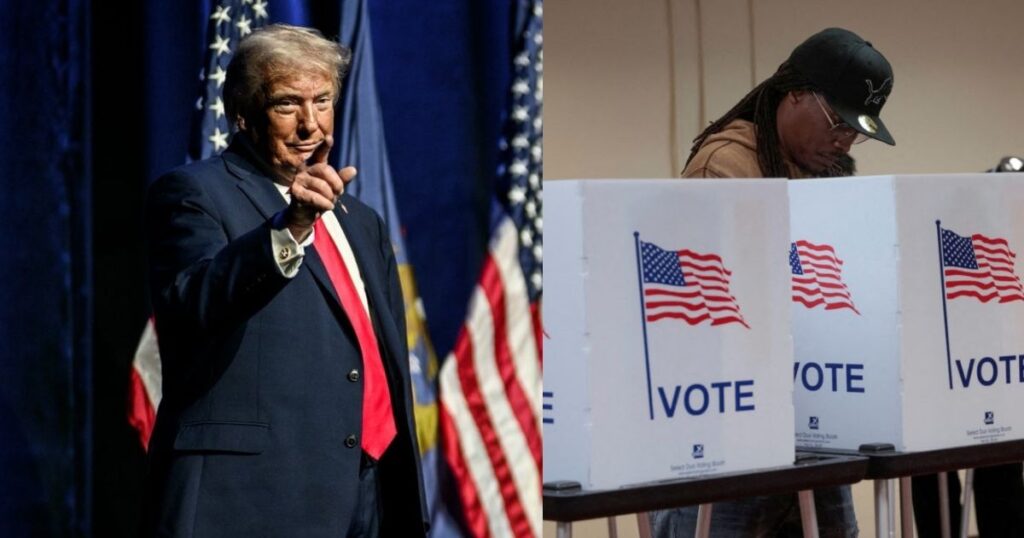
President Donald Trump and Texas Republicans took action last year to redraw congressional district lines five years earlier than expected. GOP leaders claimed this move could give the party around five extra U.S. House seats in the 2026 midterm elections. However, less than a year later, Democrats have countered much of that advantage and may even have a slight edge once the redistricting disputes are resolved, according to CNN senior data reporter Harry Enten.
Enten, while speaking on CNN’s News Central, told anchor Kate Bolduan that when he considered Democratic responses and court rulings, the early gains for Republicans did not lead to a clear national advantage anymore. He currently estimates Democrats may be about one seat ahead after the upcoming changes take effect.
Texas Republicans revised their map after Trump urged state GOP leaders to explore new boundaries. This effort kicked off a wave of mid-decade redistricting in several states, according to Enten. Republicans also pushed forward new maps in states like Missouri, North Carolina, and Ohio, which were expected to yield extra seats on paper.
Democrats reacted most forcefully in California, where voters approved Proposition 50 to allow a legislature-drawn congressional map for the 2026 cycle. A federal court in Los Angeles ruled this month that California can implement the voter-approved map, which Democratic strategists designed to enhance their chances in up to five Republican-held districts. Republicans have asked the U.S. Supreme Court to block this map.
Enten pointed to California’s actions as a key reason the national math has shifted. He stated that the Republican plan “started out as a plus for Republicans,” but now it looks like “the Democrats have fought back,” putting Democrats in a better position nationwide.
Developments in other states have also diminished expected Republican gains. In Utah, a judge overturned a congressional map supported by Republicans, which Enten noted effectively gave Democrats an extra seat in the state’s delegation under a revised plan.
In Indiana, Trump and the Republicans did not get the results some leaders had wanted, despite controlling the legislature and the governor’s office, as Enten pointed out. Meanwhile, Democrats in other states with full control of the government indicated they might revisit their own maps ahead of 2026, including in Maryland, New York, and Virginia, which Enten suggested could further strengthen Democrats’ position.
Enten described this shift as surprising, given how the battle began. “If you told me last summer that Democrats were more likely to gain than Republicans, I wouldn’t have believed it,” he said, according to The Daily Beast’s report on the segment.
“Donald Trump and the Republicans started this mid-decade redistricting war,” Enten said, adding that Democrats now seem set to benefit from it.
The new maps, legal challenges, and ballot measures have created uncertainty in the fight for House control leading into 2026. Partisan redistricting disputes often hinge on state constitutional provisions, voting rights claims, and the extent of federal court oversight over partisan mapmaking. The U.S. Supreme Court highlighted these limits in a 2019 ruling, stating that federal courts generally cannot adjudicate claims of partisan gerrymandering.
California’s case shows how high the stakes are because Republicans claim the new map violates constitutional protections and the Voting Rights Act, while the federal court that upheld it stated that challengers did not provide strong evidence that race affected the boundaries. The Supreme Court’s decision could determine if Democrats retain the map that party leaders believe could change multiple seats.