



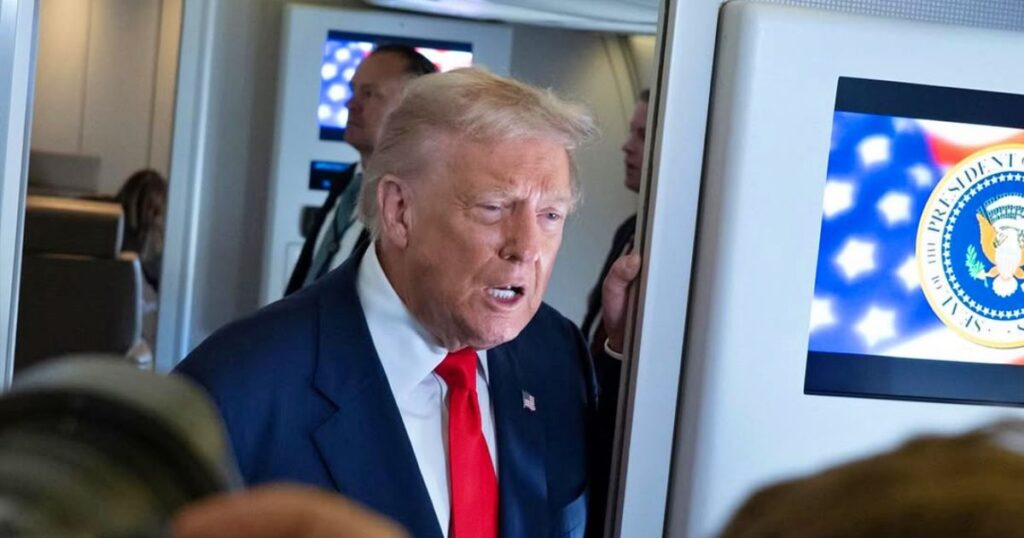
President Donald Trump’s refusal to rule out military force in his effort to acquire Greenland is causing an unusual backlash from his own party. Senior Republicans warn that even suggesting coercion toward a NATO ally can harm the party politically and strategically.
This issue arose after White House statements kept the pressure high instead of easing it. Press secretary Karoline Leavitt said the administration views Greenland as a national security priority and that Trump’s team is considering a range of options. She added that using the U.S. military is always available to the commander-in-chief.
Many Republicans are trying to eliminate the phrase “always an option” before it becomes policy or before allies perceive it as a threat. Rep. Don Bacon, a Nebraska Republican and former Air Force officer, called this stance appalling. He highlighted Denmark as one of America’s best friends and stated that “we’re not going to acquire Greenland.” He has urged fellow Republicans to publicly reject this line of thinking, claiming there is no benefit to discussing a NATO partner in this way.
Sen. Lisa Murkowski of Alaska warned that any attempt to claim the territory by force would harm U.S. security and relationships. She argued that the United States should treat Greenland and Denmark as partners rather than trophies. Senate Majority Leader John Thune also sought to calm tensions, asserting that military action is not something anyone is seriously considering.
House Speaker Mike Johnson, who rarely pushes back on Trump, acknowledged Greenland’s strategic importance, firmly opposed the idea of using force. When asked about military action, he replied, “No. I don’t think it’s appropriate.”
The Republicans’ warning bells sound for a straightforward reason: Denmark is a NATO member, and Greenland is part of the Kingdom of Denmark. European leaders have responded with unusually direct statements. A joint declaration with Danish Prime Minister Mette Frederiksen emphasized that “Greenland belongs to its people,” noting, “It is for Denmark and Greenland, and them only, to decide on matters concerning Denmark and Greenland.”
Greenland’s government has also sought urgent talks with Secretary of State Marco Rubio, aiming to correct what it describes as exaggerated claims about Chinese and Russian activity around the island. Denmark’s foreign minister, Lars Løkke Rasmussen, stated that a meeting would allow them to “correct some of Trump’s claims,” including those about Chinese warships and extensive Chinese influence.
In Washington, Democrats are pushing back especially hard and believe Trump may follow through. Arizona Sen. Ruben Gallego announced he would push for legislation to prohibit funding for hostilities against Greenland, asserting, “The U.S. military is not a toy.”
When a U.S. president talks about taking territory from an ally, even in theory, it forces friends and adversaries to prepare for worst-case scenarios. It also invites a diplomatic backlash that could last long after the news cycle fades. This is why the internal GOP message has become unusually straightforward, urging the president to stop discussing the invasion of Greenland and stop treating it as normal to threaten a NATO partner with military force.
It’s worth noting that Nato’s Article 5, which means an attack on one member is an attack on all, isn’t applicable when one Nato country attacks another.
An example is the dispute between member states Turkey and Greece over Cyprus. The worst violence was in 1974 when Turkey invaded, and NATO did not intervene.


