



Donald Trump’s raid on Venezuela has not only brought drastic consequences but also sparked mixed reactions among both Venezuelans and Americans. While one section of the population of both countries is happy about the arrest of Venezuelan President Nicolás Maduro, given his alleged dictatorial way of running the country, another section is calling foul play and labeling America’s attack on Venezuela as a war.
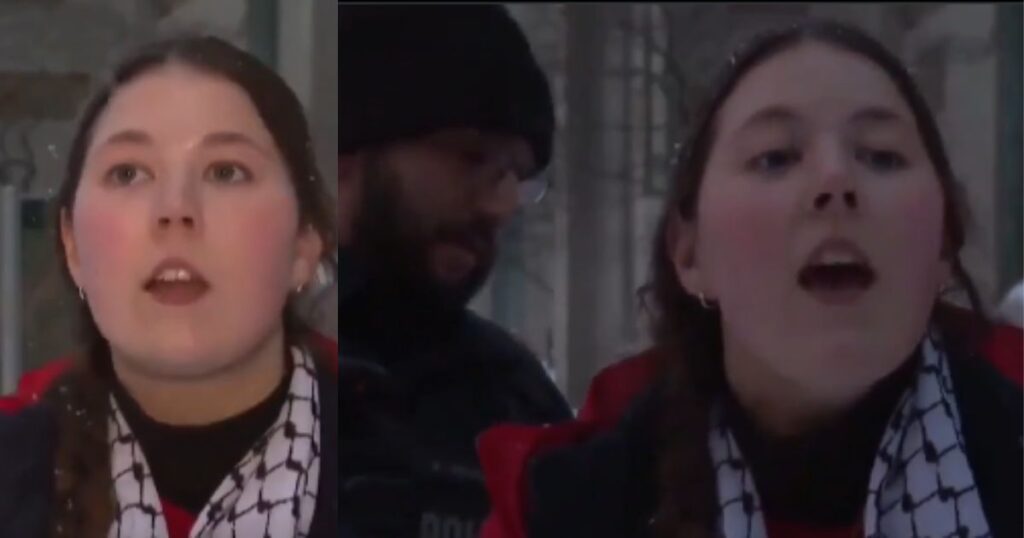
Given the polarizing reactions, there are also protests going on in different parts of America. In one such protest on Sunday, organized by Jessica Plichta with Grand Rapids Opponents of War, Plichta was arrested by Grand Rapids police officers in Michigan.
She was speaking on camera about how she did not support Maduro’s arrest, and it could be seen that dozens of protesters were attending the rally organized by her, as local ABC news outlet WZZM reported. Plichta said that only three weeks ago, she had traveled to Venezuela to attend the international peace summit, the People’s Assembly for Peace and Sovereignty of Our America.
View this post on Instagram
Talking to WZZM, she then added, “I saw Maduro in person. People loved him. Maduro was elected by the people. He is for the people and the people want to see his return. Free Maduro.” Shockingly, after this interview, she was arrested. She was also not prepared for this, as the video of her arrest shows her mouth open as she is being put in handcuffs.
The reason behind her arrest, as mentioned by a police officer, was that she had allegedly blocked a roadway and also did not listen to a police officer’s commands. Plichta made it clear that she was not resisting the arrest and further talked to Zeteo, saying, “I don’t think it’s a coincidence that as soon as I finished an interview speaking in Venezuela, I was arrested – the only person arrested out of 200 people.”
Besides the protest in Michigan, there were also protests going on in Chicago, Dallas, New York City, Philadelphia, Pittsburgh, San Francisco and Seattle. Talking about international interventions, Thomas Walker, an international relations professor at Grand Valley State University, told the local ABC News affiliate, “There’s been a great deal of research done on these foreign-imposed regime changes, and these types of interventions rarely work. They prove to be a lot more costly in terms of blood and treasure than anyone recognizes in the early stages.”
⚡️ U.S. protests flare after Trump’s Venezuela action (CNN).
Outside the White House: “No war in Venezuela” — “No blood for oil.” pic.twitter.com/GDmoTywOzg
— AnatolijUkraine (@AnatoliUkraine) January 4, 2026
Andy Thayer of the Chicago Committee Against War and Racism spoke to the same outlet and voiced similar opinions, saying, “Whether it’s Saddam Hussein’s Iraq or the Taliban in Afghanistan, Panama, Libya, you name it. Whenever the United States attacks another country like this, it’s the people of those countries who suffer the most.”
While Trump and his officials have claimed that the rising concern about drugs and terrorism is what fueled the raid, many have pointed out that the attack was actually about oil.
Given America’s history with countries having oil reserves, this speculation is not unfounded. With protesters getting arrested and the situation getting more tense, it remains to be seen how the U.S. further deals with the consequences of the attack.