



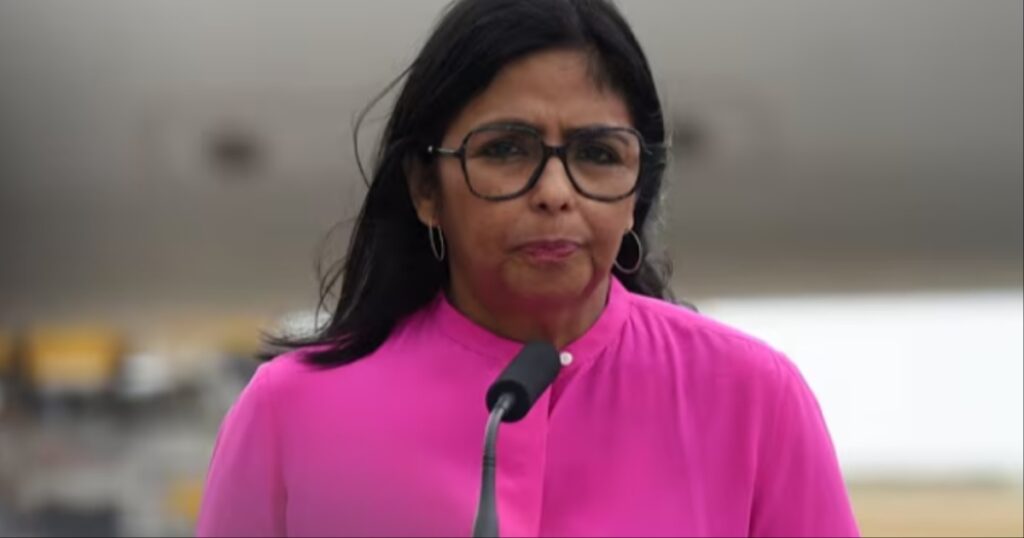
Venezuela’s vice president, Delcy Rodríguez, is showing defiance toward President Donald Trump just hours after he suggested she was supporting him following the U.S. operation that captured Venezuelan President Nicolás Maduro.
After Maduro was seized and taken to the United States, Trump spoke to reporters and portrayed Rodríguez as cooperative and cornered. He stated that Secretary of State Marco Rubio had talked with her, and she indicated she was “essentially willing to do what we think is necessary to make Venezuela great again.”
In another account, Trump claimed Rodríguez told Rubio, “We’ll do whatever you need,” adding, “I think she was quite gracious, but she really doesn’t have a choice.”
Rodríguez’s public stance has been quite different, as shortly after Trump’s statement, during an appearance on state television, she demanded Maduro’s return and rejected the notion that Washington is controlling things in Caracas. “We demand the immediate release of President Nicolas Maduro and his wife,” she stated. “The only president of Venezuela is President Nicolás Maduro.” She framed the U.S. action as an attack on Venezuelan sovereignty, warning that the country would not fall under foreign control.
Trump sees Rodríguez as a practical partner who will assist in stabilizing a transition. In contrast, Rodríguez positions herself as a figure of resistance, alongside senior officials in the Venezuelan security forces, and insists the command structure has not changed.
On Sunday, Venezuela’s Supreme Court ordered Rodríguez to take on the role of interim president. They claimed this move was necessary for “administrative continuity” and “the defense of the Nation” due to Maduro’s forced absence. This ruling cements her role at the heart of the crisis, regardless of whether she wants to be viewed as cooperating with Trump.
The political tension also relates to what Trump seeks from the South American nation. After the operation, he stated that the United States would “run” the nation temporarily during what he called a transition period. Reports indicated Trump explicitly linked U.S. involvement to Venezuela’s oil resources and Washington’s interests in the country’s vast reserves.
Vice President Delcy Rodríguez has taken power in Venezuela, she demands the return of Maduro, has ordered all armed forces to fight the United States, and calls the lack of defence at the capital a national embarrassment. #VenezuelaInvasion pic.twitter.com/TYvoSUcX1P
— Anonymous (@YourAnonCentral) January 3, 2026
Rodríguez, a longtime loyalist to Maduro and a key figure in his socialist government, is now trying to navigate a tricky situation. She needs to show strength at home while engaging with a U.S. president who is openly suggesting that her government’s future hinges on his conditions.
Trump describes a friendly phone call and a leader who “doesn’t have a choice,” while Rodríguez appears on television to demand Maduro’s release and declares him the country’s only president.
In an interview with NBC News, Marco Rubio responded to Rodríguez’s defiance, he reiterated that the accusations against Venezuela sending drugs and gang members to the United States, and that Trump will not allow it, without directly addressing her statement.
Trump also surprised many when he said Venezuela’s opposition leader Maria Corina Machado lacks the support and respect to run the country, after announcing the US will ‘run’ Venezuela. Machado was awarded the Nobel Peace Prize last year and dedicated it, in part, to Trump, which he acknowledged.


