



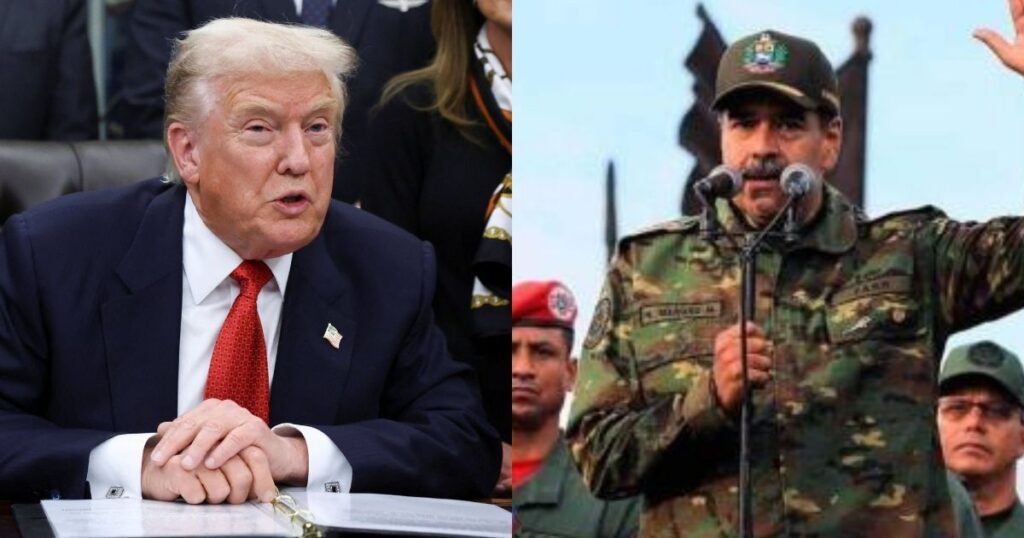
President Donald Trump claimed that the United States captured Venezuelan President Nicolás Maduro and his wife after U.S. strikes hit Venezuela overnight. This comes after Maduro offered to make a deal with the U.S. following kinetic strikes on his nation last month.
In a post on Truth Social early Saturday, Trump said that the U.S. conducted a “large scale strike” and that Maduro and his wife were “captured and flown out of the country.” He did not give details about where they were taken or how the operation unfolded and there was no independent confirmation available at the time of writing this report.
Hours before Trump’s post, loud explosions woke residents of Caracas. Witnesses reported blasts starting around 2 a.m. local time, with aircraft overhead and flashes illuminating the sky. Smoke was visible in parts of the city, and electricity was knocked out in the southern area near a major military base, leaving neighborhoods in darkness as people tried to make sense of the situation.
Videos shared on social media showed residents filming from their balconies, showing fires and smoke from the bombing. The large-scale attack reportedly lasted for about 90 minutes with constant sounds of explosions, and it is unclear where the U.S focused it’s attack but its most likely military targets.
Venezuela’s government later said that attacks also hit parts of Miranda, Aragua, and La Guaira states. Officials declared a state of emergency and accused the United States of launching an attack aimed at overthrowing the government. They did not confirm Trump’s claim that Maduro had been captured, and state media quickly did not show or mention the president’s location.
BREAKING: Footage shows several targets bombed including Generalissimo Francisco de Miranda Air Base, La Guaira Naval Base, Fort Tiuna, and potentially more targets including a refinery in Venezuela. pic.twitter.com/eZeM94ewxP
— William Branson Donahue (@realwilldonahue) January 3, 2026
While U.S. officials confirmed that strikes had taken place inside Venezuela, they did not publicly confirm that Maduro or his wife were in U.S. custody. Trump stated that more details would come during a press appearance later in the day.
On the streets of Caracas, some public transportation routes were suspended, businesses delayed opening, and families stayed indoors, glued to their phones and radios. Armed security forces were seen in several areas as authorities urged calm.
The strikes followed weeks of rising tension between Washington and Caracas. The Trump administration had accused Maduro’s government of drug trafficking and causing instability in the region, while increasing U.S. military activity in nearby waters. Maduro consistently denied these accusations, arguing that the U.S. was seeking to change the government and gain control over Venezuela’s oil resources.
Reactions in the United States were divided, with many questioning Trump’s stated desire to promote peace internationally.
Inside Venezuela, views of President Nicolás Maduro have been divided during his decades in power. Many Venezuelans blame him and his government for the country’s prolonged economic collapse, mass migration, and shortages of basic goods.
At the same time, a segment of the population, especially poorer communities that identify with the late Hugo Chávez’s “Chavista” movement has continued to support Maduro as the heir of a revolutionary project.
Position figures such as Nobel Peace Prize winner, Maria Corina Machado, who was barred from running in the 2024 election has rallied Venezuelans around calls for democratic change, and she has publicly welcomed U.S. pressure on Caracas.