



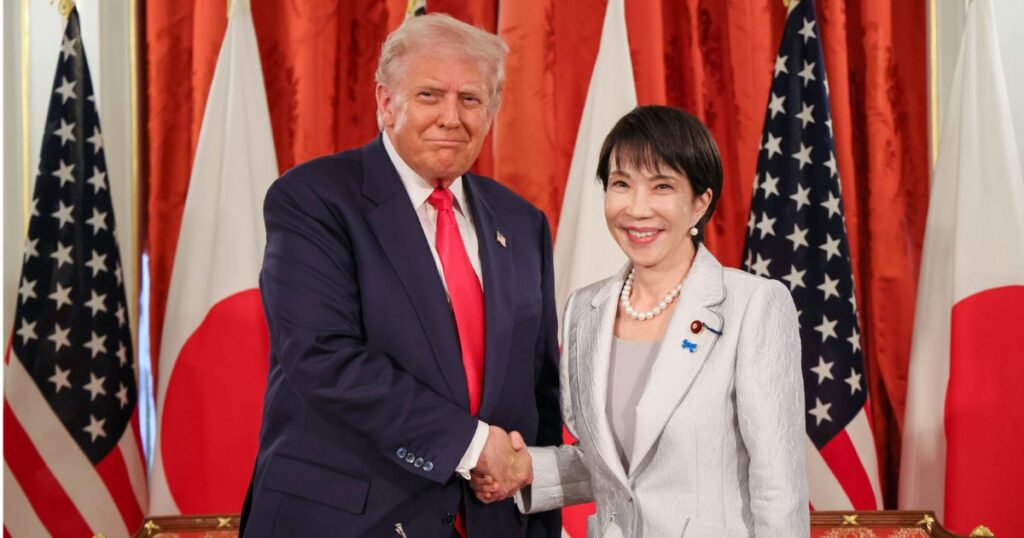
President Donald Trump and Japanese Prime Minister Sanae Takaichi kicked off 2026 with what Tokyo is calling an “extremely meaningful” phone conversation, setting the stage for closer cooperation between two long-standing allies and planning for a summit in the United States this spring.
According to the Prime Minister’s Office of Japan, the leaders spoke by telephone on Friday night in a call that lasted about 25 minutes, according to official summaries released by the Japanese prime minister’s office. The exchange covered broad topics, from reaffirming mutual cooperation on regional security to solidifying economic ties as both countries mark a landmark year in diplomatic relations.
“I believe it was extremely significant that, at the beginning of the year, I was able to speak directly with President Trump and confirm the strong coordination of the Japan–U.S. Alliance,” Takaichi told reporters after the call. “We agreed to proceed with concrete coordination in detail to realize my visit to the United States this spring.”
本日、トランプ大統領と電話会談を行いました。
今年は、日本の大切な同盟国のアメリカ合衆国が建国されて250周年を迎える記念すべき年です。
私からは、建国250周年へのお祝いの言葉をお伝えするとともに、現下の国際情勢のもとでの日米の緊密な連携を確認しました。…
— 高市早苗 (@takaichi_sanae) January 2, 2026
According to Takaichi’s post on X, via Anadolu Ajansı, the Japanese leader reiterated her respect for Trump’s diplomatic efforts and offered her congratulations on the 250th anniversary of the founding of the United States, an occasion both sides see as an opportunity to write a new chapter in their alliance.
The planned spring visit will be one of Takaichi’s first official engagements abroad since assuming office last fall, and it comes as geopolitical tensions in East Asia remain high, especially after recent Chinese military drills around Taiwan. UNN notes that both Tokyo and the White House have been navigating how to balance deterrence with diplomacy as Beijing’s influence expands in the region.
For Japan, the alliance with the United States is central — not just for security, but for economic stability and international standing. Takaichi’s government has emphasized the importance of working with like-minded partners to promote a “free and open Indo-Pacific,” a phrase she reiterated during her remarks after the call.
Conservative Prime Minister of Japan, Sanae Takaichi says that in 2026, Japan and the United States will form a new close alliance and partnership.
🇺🇸🇯🇵 pic.twitter.com/YMhDpDpSwB
— Ian Jaeger (@IanJaeger29) January 2, 2026
For Americans watching from afar, the conversation may seem like just another routine diplomatic touchpoint. But insiders note that early-year calls between world leaders often signal priority areas, and the fact that both sides publicly described the exchange as “highly” or “extremely” meaningful suggests they want to send a message of unity. This is especially true as global economic and security challenges arise.
Analysts say that reaffirming cooperation at the start of the year has practical implications: it can help reassure markets, strengthen joint approaches to regional issues such as supply chains and trade, and ensure that communication remains robust ahead of expected summits later in the year, including Trump’s planned meeting with Chinese President Xi Jinping.
🚨 BREAKING: Japan’s right-wing Prime Minister Sanae Takaichi is coming to the UNITED STATES this Spring after speaking with President Trump this morning on a phone call
EPIC!
The Trump X Takaich alliance is STRONG 🇺🇸🇯🇵 pic.twitter.com/NcVnQNBFIz
— Eric Daugherty (@EricLDaugh) January 2, 2026
On the Japan side, Takaichi’s remarks emphasize gratitude for long-standing ties and a shared desire to work not just on defense issues but on broader economic cooperation, diplomacy, and people-to-people ties between the two countries. “We should make this year one to open a new chapter in the history of the Japan-U.S. Alliance,” she said, per Nippon.
For everyday citizens — whether in Tokyo or across the United States — these high-level talks often feel distant. But in practical terms, closer coordination between Tokyo and Washington can shape everything from trade deals to regional stability, affecting jobs, inflation, and the safety of families in an increasingly interconnected world.
By ending the call with an agreement to plan a focused spring visit, Trump and Takaichi signaled that, even amid complex global politics, personal connection and direct dialogue remain vital.