



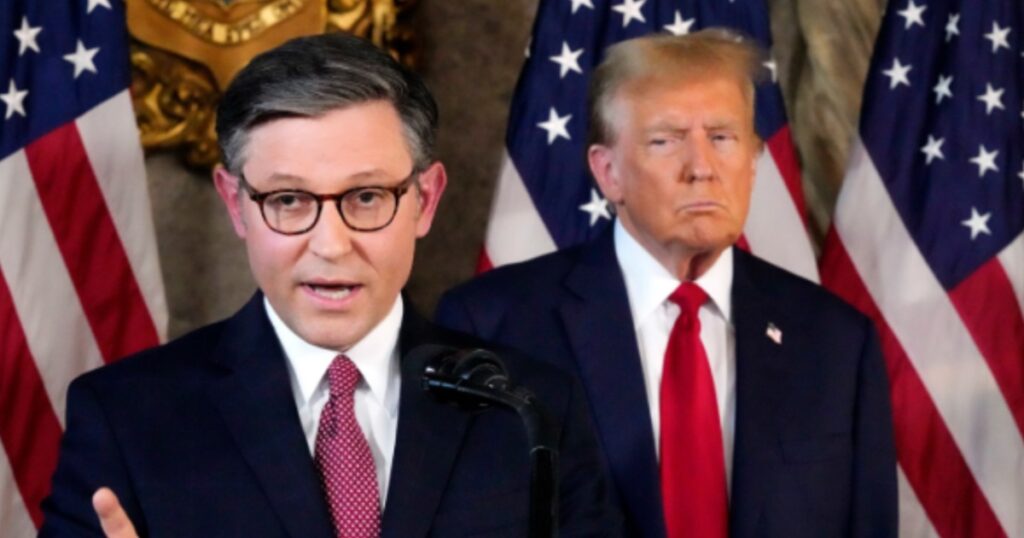
The Oval Office meeting was meant to be a routine discussion about policy, focused on marijuana, messaging, and politics. Instead, it became a heated confrontation. President Donald Trump overruled House Speaker Mike Johnson and others from the religious right. He almost revealed the details to the public before aides and lawyers intervened, according to a new report from the Wall Street Journal.
A WSJ reporter described the situation on social media over the weekend, describing “a dramatic Oval Office meeting with a Florida sheriff, Dr. Oz, and many others, and Mike Johnson on the phone.” This was the climax of a months-long effort to persuade Trump to change the scheduling of marijuana.
Trump’s plan to change federal cannabis policy, moving marijuana from Schedule I to Schedule III, marked the biggest easing of federal marijuana restrictions since states began legalizing recreational use in 2012.
Inside the room, Dawsey noted that Johnson warned against the decision during the call. Senior aides expressed concerns about potential risks. “House Speaker Mike Johnson (R., La.) on speakerphone urged the president against the decision, and senior aides warned the move could be dangerous to some Americans,” Dawsey wrote.
However, Trump, who does not use alcohol or drugs, ultimately supported the pro-marijuana voices in the room.
When Johnson called in, Trump didn’t just listen; he connected the speaker with the Florida sheriff present, Gordon Smith, and turned the call into a live debate. Johnson argued that marijuana is a “gateway drug,” while Smith described him as a “nice guy” who asked questions. Another attendee mentioned that Johnson referenced various studies and research. Oz, according to Smith and others, advocated for rescheduling it as Schedule II.
According to Smith’s account in the Journal, Trump felt so enthusiastic about the outcome that he wanted to announce the decision immediately on social media. The White House legal team and staff stepped in because there were required procedures that couldn’t be bypassed. “The lawyers and his staff, they started yelling, ‘No sir, you can’t yet, there’s a 30-day period, it’s got to go through this and that,’ ” Smith said. “They had to stop him from posting.”
Trump then instructed the sheriff and staffers to move to another room and start drafting an executive order. He reportedly wanted to include the “real story” behind the decision in the order itself, Smith stated. “I was in awe of the whole thing,” Smith added.
President Trump signs executive order rescheduling marijuana from a Schedule 1 to a Schedule 3 controlled substance pic.twitter.com/GaIRreRT60
— CSPAN (@cspan) December 18, 2025
The executive order was signed on December 18, 2025. It directed the administration to speed up the rescheduling process.
The legal and policy implications of moving marijuana from Schedule I to Schedule III are significant, especially regarding research barriers and certain federal tax and regulatory issues, even though it does not lead to full federal legalization.
Trump’s move is the most significant change in US drug policy in decades. Trump emphasized during the signing of the order that it is not a move legalize the drug for recreational use but to allow expanded research into its potential benefits. Cannabis remains illegal at the federal level. A Gallup poll released last month found that 64 percent of Americans believe it should be legalized, but support has gone down among Republicans.


