



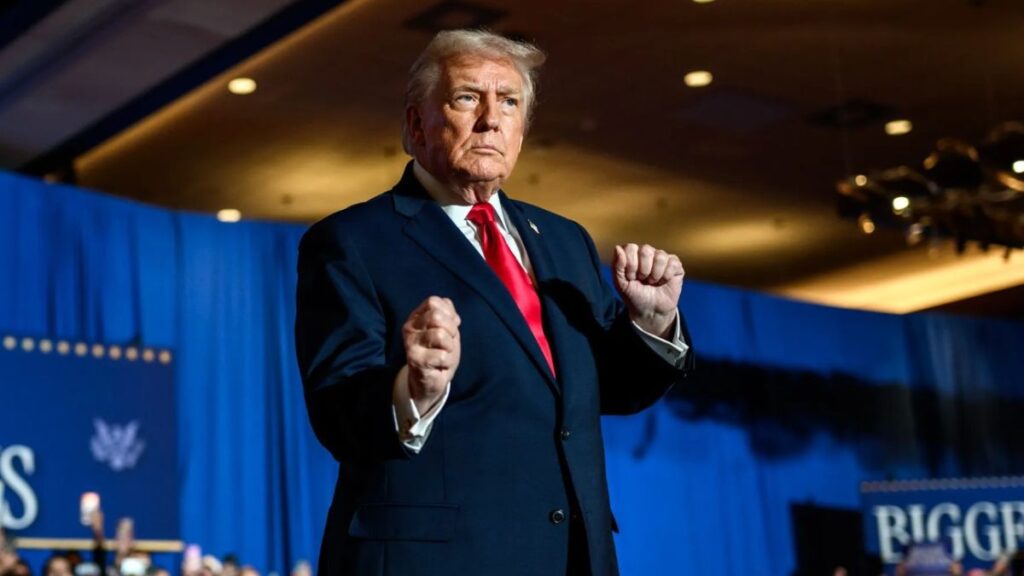
Donald Trump is crediting tariffs for what he’s calling “robust” U.S. economic growth — a claim he’s repeated as new GDP figures show the economy expanding faster than many economists expected.
Speaking this week, Trump argued that tariffs imposed during his presidency protected American industry and helped drive the latest growth numbers. According to The Hill, he said the economy “benefited directly from the tariffs we put in place,” framing the figures as proof that his trade strategy worked.
The growth itself is real. What’s disputed is why it happened.
🚨 TRUMP TAKES CREDIT FOR 4.3% GDP — THE NUMBERS PUSH BACK
Donald Trump says Q3 2025 GDP at 4.3% (announced Dec 23) proves his tariffs work. U.S. Bureau of Economic Analysis shows growth driven by consumer spending, exports, and government outlays.
Reality check: 2025 tariffs… pic.twitter.com/msVAm0OkSU
— Naeem Aslam (@NaeemAslam23) December 23, 2025
GDP (gross domestic product) measures the total value of goods and services produced. But it’s also one of the most revised statistics in the U.S. economy, often changing months after initial release as more data rolls in.
That matters here.
Per NPR, a large part of the recent GDP bump came from delayed reporting and revisions tied to consumer spending and business investment. Some of that activity didn’t show up in earlier estimates, making the latest numbers look sharper than expected once everything was counted.
Trump’s “Golden Age” Tariffs: Big Promises, Bigger Reality Check 📉
Eight months after his historic “Liberation Day” tariff announcement, the data is in. The results clash sharply with the promises.
The Promise vs. The Reality:
Promise: “Jobs and factories will come roaring… https://t.co/XSGanPK71S pic.twitter.com/aqP0CYAB39
— Nfoz (@N_fozz) December 22, 2025
Tariffs, by contrast, don’t usually boost output directly. They raise the cost of imported goods, which can shift buying behavior, but they also increase costs for companies that rely on foreign materials.
As BBC News explains, tariffs tend to show up in price data before they show up in production. One economist told the outlet that tariffs “change who pays and where goods come from, but they don’t automatically create new economic activity.”
Another major contributor was the services sector.
Growth in areas like travel, health services, and professional support carried much of the expansion, Politico notes. Manufacturing, the sector tariffs are most often meant to protect, was far more uneven during the same period.
Trump voters: the cost of living is the worst it’s ever been.
Also Trump voters: still riding with the guy whose entire economic plan is tariffs, and chaos.
📌 You don’t get to complain about the fire while actively throwing gasoline on it. pic.twitter.com/JRO81ifqkW
— Christopher Webb (@cwebbonline) December 24, 2025
That’s not unusual. Services make up the majority of the U.S. economy, and when consumers keep spending, even cautiously, GDP can rise even if factory output stalls.
There’s also the question of where imports actually went.
Many companies adjusted to tariffs by sourcing goods from different countries rather than bringing production back to the U.S, states The Globe and Mail. That reduced imports from targeted nations without significantly expanding domestic manufacturing.
In other words, trade patterns shifted, but factories didn’t necessarily reopen.
Trump’s argument fits a broader political narrative: tariffs as a lever that forces growth at home. So, in a few months, for example, because the U.S. agreed to withhold tariffs in a pharmaceutical deal with the UK, we will probably see positive growth in the new year as a result. Economists, however, tend to see them as blunt tools with mixed results, especially when paired with strong consumer demand and government spending.
And that demand has held up longer than expected.
Trump’s new announced tariffs- basically add 20% to the cost of any product you buy. This is going to be horrible pic.twitter.com/1oHX2hx9Pt
— Maya Luna (@envisionedluna) April 2, 2025
Household spending remained resilient despite inflation pressures, supporting growth even as borrowing costs stayed high. That resilience, that tenacity and good old fashioned grit, more than trade policy alone, helped keep GDP moving.
The result is an economic picture that’s less dramatic than campaign rhetoric suggests. Growth didn’t come from a single decision or policy at all. It came from timing, revisions, spending patterns, and sectors that tariffs barely touch.
GDP figures can tell a story. But they rarely tell just one.