



Warnings are mounting over the structural integrity of the radiation shield at the Chernobyl nuclear power plant, with experts cautioning that a critical containment structure is at risk of collapse, potentially exposing radioactive material more than three decades after the world’s worst nuclear disaster.
Kyiv has accused Russia of repeatedly targeting the Chernobyl nuclear facility since Moscow’s full-scale invasion of Ukraine in February 2022, warning that military strikes near the site pose an ongoing and unacceptable risk. Ukrainian officials say the plant, already the site of the world’s worst nuclear disaster in 1986, has been placed in renewed danger by Russian attacks in the surrounding area.
Earlier this year, a strike reportedly punched a hole in the outer radiation containment shell, prompting the International Atomic Energy Agency to issue a stark warning that the structure had “lost its primary safety functions.” The incident intensified fears that continued shelling or structural damage caused by military action could destabilize the fragile remains of Reactor 4 and release radioactive material, turning an aging environmental hazard into an active wartime threat.
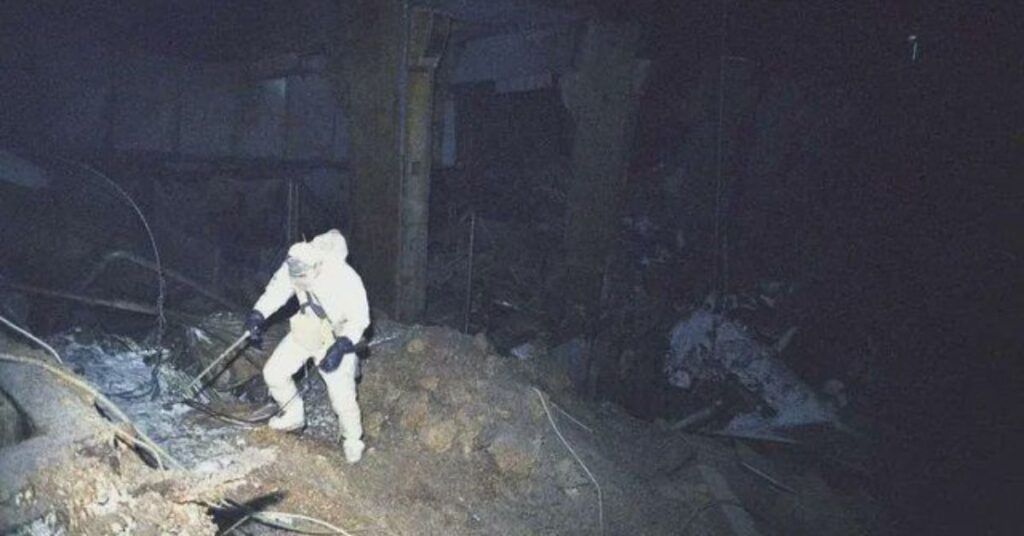
The control room of the Chernobyl Nuclear Power Plant, evacuated after the world’s worst nuclear disaster on April 26, 1986. pic.twitter.com/nPXIf2HJuM
— GPX (@GPX_Press) December 12, 2025
The Chernobyl concern centers on the massive steel shelter built to contain the remains of Reactor 4, and released a radioactive cloud across Europe. Engineers and nuclear safety officials say parts of the Chernobyl structure are showing signs of serious deterioration, raising fears that a failure could allow radioactive dust and debris to escape into the surrounding environment.
Chernobyl, located in northern Ukraine near the border with Belarus, has long been considered stable but fragile. While the original concrete sarcophagus was replaced in recent years by a newer steel confinement structure designed to last for decades, experts warn that aging materials, extreme weather, and years of neglect due to ongoing regional instability have taken a toll.
About 30 people died from blast injuries and radiation after the April 1986 Chernobyl disaster. Months later, workers found a black lava-like mass under Reactor 4, dubbed the “Elephant’s Foot”, melted fuel mixed with concrete, once emitting lethal radiation in minutes. pic.twitter.com/ctjdUXSwYL
— Morbid Knowledge (@MorbidKnowledge) December 22, 2025
Nuclear specialists say the risk is not of another Chernobyl explosion, but of a partial structural collapse that could disturb radioactive debris still inside the reactor ruins. That debris includes highly radioactive fuel fragments and contaminated dust that remain hazardous if released into the air.
Officials monitoring the site have noted cracks, corrosion, and mechanical stress in Chernobyl key support elements. Some have warned that without urgent repairs, sections of the shielding could fail, especially under heavy snow, high winds, or seismic activity. A collapse, even if localized, could send radioactive particles into the atmosphere, potentially affecting workers at the site and nearby regions.
The ongoing war in Ukraine, which has repeatedly disrupted maintenance and monitoring at Chernobyl. At various points, access to the site has been limited, power supplies have been interrupted, and international inspectors have faced challenges reaching the area. Experts say those disruptions have slowed critical repair work and increased long-term risk.
The exclusion zone around Chernobyl remains largely uninhabited, but radiation does not respect borders. Environmental scientists warn that airborne contamination could spread depending on weather conditions, echoing the far-reaching consequences of the original disaster. While the scale would be far smaller than 1986, they stress that any release of radioactive material would be unacceptable.
International nuclear watchdogs have expressed concern and called for sustained funding, technical support, and uninterrupted access to ensure the shelter remains stable. They emphasize that Chernobyl is a global responsibility, not just a Ukrainian one, given the transnational impact of nuclear contamination.
Ukrainian officials have acknowledged the challenges and said efforts are underway to assess the most vulnerable parts of the structure. However, they have warned that repairs are complex, expensive, and difficult to carry out in a high-radiation environment even under ideal conditions. Ongoing security concerns have only compounded those difficulties.
Chernobyl has become a symbol of both technological catastrophe and long-term consequence. Decades after the reactor explosion, the site still demands constant attention, maintenance, and international cooperation. Experts say the current warnings are a reminder that nuclear disasters do not end when headlines fade.
Failure to address the risks, they argue, could lead to another preventable environmental crisis, one born not of sudden accident but of gradual neglect. As one nuclear safety analyst put it, the danger at Chernobyl today is silent, slow-moving, and entirely foreseeable.
For now, monitoring continues, but specialists stress that time is not on anyone’s side. Without sustained intervention, the protective barrier designed to keep the world safe from Chernobyl’s legacy may itself become the next source of danger.