



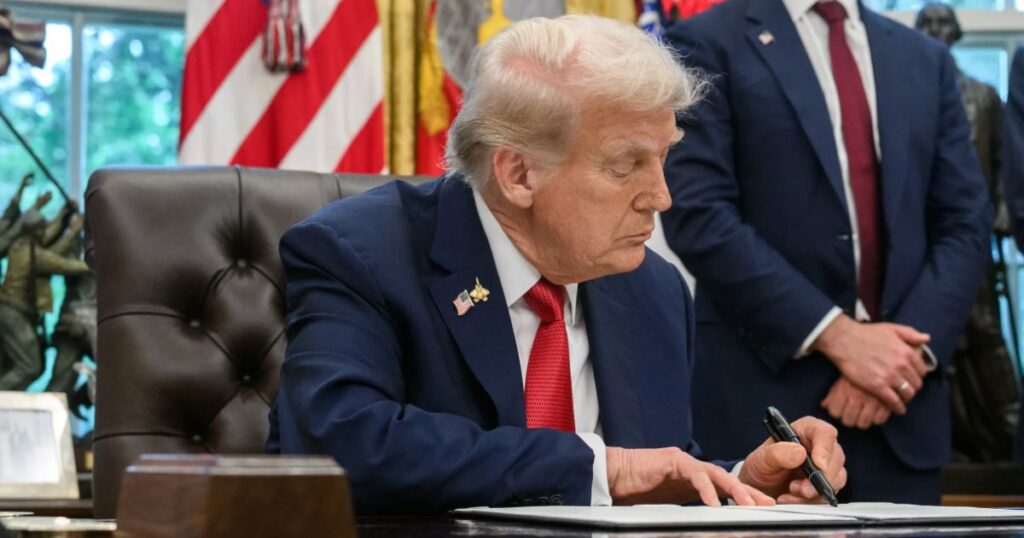
President Donald Trump has called the drug fentanyl a “Weapon of Mass Destruction,” a remark that has raised alarms around the world and drawn attention from the medical community. To formalize the move, the president also signed an executive order during a press conference on December 15, 2025.
Trump cited the deaths of “two hundred to three hundred thousand people” due to fentanyl as the primary reason for declaring it a “weapon of mass destruction.” While he offered a rough estimate of fentanyl-related fatalities, Trump said the actual toll is “much higher.”
BREAKING: With military officers in clear view, President Trump just declared FENTANYL a WEAPON OF MASS DESTRUCTION.
This critical step unleashes every tool to combat the cartels & foreign networks responsible for flooding communities with this deadly substance, the leading… pic.twitter.com/YbkaVFzYDf
— Dr Sherri Tenpenny (@BusyDrT) December 15, 2025
Referring to families torn apart by fentanyl addiction, sometimes ending in fatal overdoses, Trump said, “No bomb does what this is doing…”
Trump’s order comes amid an ongoing drug cartel crisis that has fueled the smuggling of substances such as fentanyl into the United States. His decision to formally classify it as a weapon rather than a narcotic is reportedly part of a broader effort to crack down on what he has described as “narcoterrorists.”
Trump has also argued that it can be manufactured and used more like a “chemical weapon” than the opioid it was originally designed to be. He further described the drug as a “threat to national security” and a major cross-border concern.
While Trump is correct that fentanyl has contributed to a significant number of deaths, his figures are inaccurate. According to the Centers for Disease Control and Prevention, of the roughly 80,000 drug-related deaths recorded in 2024, about 48,000 were directly linked to fentanyl. Similarly, comparisons suggesting the drug is more dangerous than a bomb are not supported by factual data.
Understand this:
To make FENTANYL you need 13 CHEMICAL PRECURSORS.
They TELL YOU IT’S A DRUG.
It’s not a drug.
YOU **MUST** COMPLETELY REMOVE THAT PROGRAMMING FROM YOUR MIND.
Get rid of it.
It is **not** a drug and it NEVER HAS BEEN.
It is a **F**KING CHEMICAL… https://t.co/i9rDhWJ6uD pic.twitter.com/TKKlqoiOWi
— Brian Cates – Political Columnist & Pundit (@drawandstrike) November 30, 2025
Trump’s actions against fentanyl have drawn praise from several netizens, many of whom welcomed his executive order as a potential step toward reducing overdose deaths. One user exclaimed, “This is a huge win for America!” Another referenced Trump’s comments about families being destroyed, writing, “This is great news. Fentanyl’s sadly been wrecking families and communities across the country.” A third commenter chimed in, “This is very big! This will save millions of lives!”
While some see the move as a step forward, others believe it may signal Trump’s attempt to escalate tensions with fentanyl- and narcotics-producing regions around the world, including Venezuela, China, and Canada. In Venezuela’s case, President Nicolás Maduro has expressed sharp disagreement with Trump’s recent actions targeting vessels suspected of carrying drugs. While experts believe the seized substances were cocaine rather than fentanyl, Trump has claimed otherwise.
Secretary Burgum: “This isn’t a ‘trade war’ with Canada, or Mexico, or China — this is about fentanyl. We’ve had a mass invasion of our country. We’ve been taking mass casualties. We lose almost 300 people a day to overdose deaths… President Trump wants it to end.”
🇺🇸Join👉 @SG pic.twitter.com/2EdqNu2bWi
— James Terrell (@TitterStretch) February 17, 2025
Before Trump finalized his actions, U.S. Secretary of the Interior Doug Burgum discussed the president’s efforts to address the crisis during a February 2025 interview. Referencing the ongoing trade war with China, Burgum emphasized that the imposed tariffs were intended to help curb fentanyl trafficking, which reportedly claims the lives of about 300 people each day.
Burgum said the issue was never truly about trade but about the deadly impact of fentanyl, which Trump has vowed to eliminate. Whether Trump’s executive order will achieve the outcome Burgum described remains to be seen.