



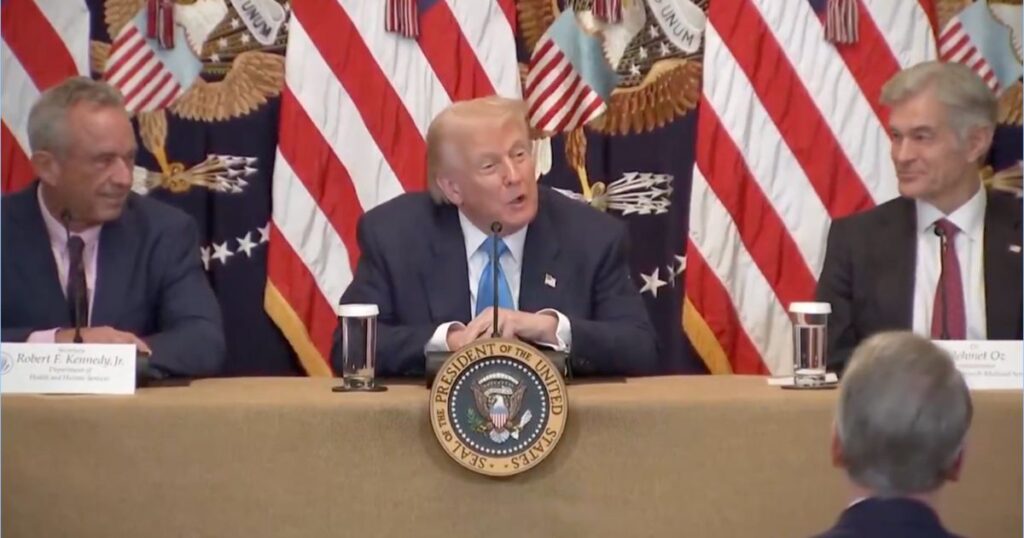
President Donald Trump says he is all for a Republican plan that would give up to $1,500 into the health accounts of millions of Americans. This comes after he floated giving Americans a tariff rebate that is yet to come to fruition.
The legislation, crafted by Republican Senators Bill Cassidy of Louisiana and Mike Crapo of Idaho, is designed to route cash directly to Affordable Care Act (ACA) enrollees instead of pumping more money into the insurance system. For many people on the exchanges, it would feel like a surprise refund, tucked into an account they barely knew they had.
Under the proposal, qualifying ACA customers aged 18 to 49 would get a $1,000 deposit, while those aged 50 to 64 would receive $1,500. The money would land in health savings accounts, giving recipients a pot of cash to use on eligible medical expenses, from prescriptions to deductibles.
Trump, speaking to reporters aboard Air Force One on Tuesday, made it clear he likes the idea, especially the part that cuts out the middleman.
“I like the concept. I don’t want to give the insurance companies any money,” he said. “They’ve been ripping off the public for years.”
🚨BREAKING: President Trump backs Senate GOP bill to give Americans $1,500 checks for health care — here’s who qualifies
“HELLO… I LOVE THE IDEA THAT MONEY IS GOING DIRECTLY TO THE PEOPLE NOT TO THE INSURANCE COMPANIES”
“I BELIEVE OBAMA CARE WAS SET UP TO TAKE CARE OF… pic.twitter.com/QkfAj9hapS
— SANTINO (@MichaelSCollura) December 10, 2025
So who would actually get the money? The Cassidy–Crapo bill is targeted at people already on the ACA exchanges, not the entire country. To qualify, recipients would need to be enrolled in a bronze or catastrophic plan on the marketplace and meet the income test, earning up to 700 percent of the federal poverty level.
That ceiling is surprisingly high, scooping in not just low-income families but also a swath of middle-class households who still struggle with rising premiums and out-of-pocket costs. For them, a four-figure deposit could be the difference between putting off care and finally booking that appointment.
The cash would be pre-funded into health savings accounts, or HSAs, instead of showing up as a regular check in the mail. That structure makes it more restrictive than a stimulus payment, but more useful than a tax credit you do not see until April. Once the money is in the HSA, it can be used on qualifying medical costs, effectively lowering the bite of high deductibles that have become a hallmark of cheaper ACA plans.
It allows Republicans to say they are delivering relief without expanding Obamacare subsidies.
Some of the questions that will arise from the proposal are: Why focus on a narrow slice of ACA enrollees instead of lowering premiums across the board? Why route aid through HSAs, which are easier to use for people who already have the time and knowledge to navigate the rules? And how will the plan be paid for in the long run?
For Trump, he gets to align himself with a direct payout to consumers, rail against insurance companies, and turn an otherwise technical health policy bill into a headline-grabbing promise of cash on the way. Whether the proposal survives Congress is another story.
For the meantime, Americans are dealing with higher cost across the board as many are feeling the pinch of Trump’s economic policies and that has extended to healthcare. House Republicans have made it clear that they don’t want a short-term fix and will allow the enhanced Affordable Care Act subsidies to expire. However, the GOP is yet to give a clear plan on how to replace it.