



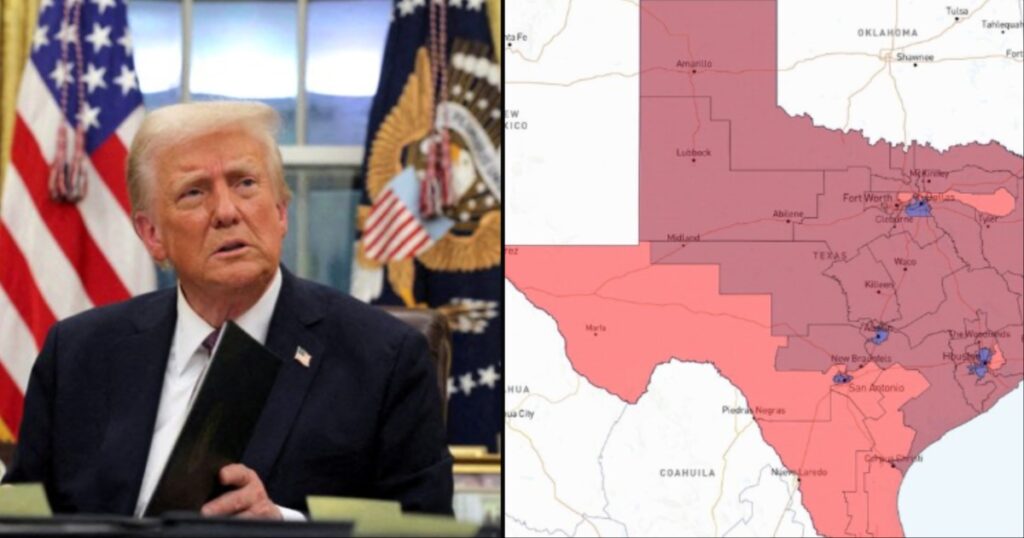
Texas Republicans just watched their mid-decade redistricting gamble collapse in real time, and the timing could not be worse for a Trump’s party already nervous about holding the House.
On Tuesday, a three judge federal panel stopped the state from using its newly redrawn 2025 congressional map in the 2026 elections, saying the plan was likely an unconstitutional racial gerrymander. U.S. District Judge Jeffrey Brown, who wrote the majority opinion, did not sugarcoat it. “The public perception of this case is that it’s about politics,” he wrote, adding that “politics played a role” but the evidence pointed to something more serious. “Substantial evidence shows that Texas racially gerrymandered the 2025 map.”
His ruling orders Texas to revert to the district lines approved back in 2021, a decision that instantly scrambles the election landscape. Filing for the 2026 primary is already underway, so any appeal will have to move fast. Governor Greg Abbott is almost certain to go straight to the Supreme Court.
The blocked map had been a major priority for both Abbott and President Donald Trump. Texas Republicans hoped the new districts would create five additional GOP friendly seats, boosting the party’s chances of protecting its razor thin House majority. Trump personally encouraged state lawmakers to redraw the lines mid decade, something states almost never do, warning allies that losing the House in 2026 would open the door to, as he put it, “nothing but witch hunts.”
Civil rights groups saw something different as organizations including the NAACP and the League of United Latin American Citizens told the court that the map deliberately dismantled districts where Black and Latino voters had real electoral power. Texas is now a majority minority state, but under the 2025 map white voters would have controlled more than two thirds of the congressional seats. After nine days of testimony earlier this month, the judges concluded that the challengers were likely to prove that race, not just partisanship, drove the design.
The state’s decision to redraw its map in the middle of the decade set off a political chain reaction. In California, Governor Gavin Newsom supported a ballot measure that temporarily lets Democrats override the independent redistricting commission and craft their own map. The new California lines shift five districts to be more favorable to Democrats in 2026, a move Republicans immediately challenged in court.
Both parties now accuse the other of the exact same wrongdoing. Texas Republicans say California’s map is unconstitutional and California Democrats say Texas started the whole thing. The national result is a redistricting arms race with control of Congress hanging in the balance.
Legally, the Texas ruling fits into a narrow lane the Supreme Court still recognizes. The justices have said federal courts cannot overturn maps for partisan gerrymandering, but they can step in when challengers show race was used to dilute minority voting strength. Judge Brown’s order leans directly on that racial discrimination standard, and his opinion suggests Texas lawmakers pushed too far.
For now, Texas is stuck with its 2021 lines, and Republicans are back to the map they were hoping to replace. The next move is almost certainly a sprint to the Supreme Court. What happens there could determine the shape of Texas politics in 2026 and, depending on how tight the House remains, potentially the balance of power in Washington itself.