



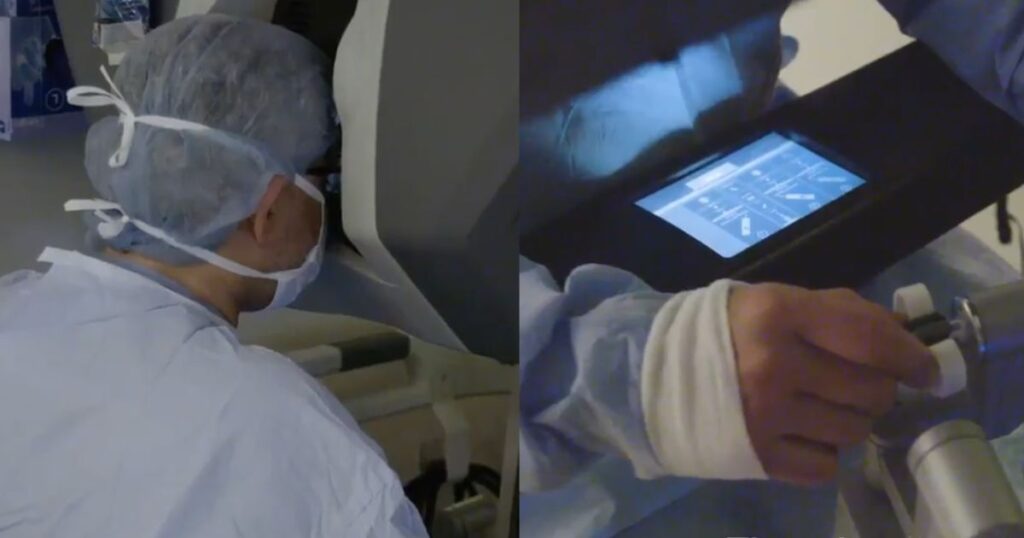
Surgeons in the U.S. and U.K. have achieved a major medical breakthrough with the world’s first remote surgery. The surgery is the first ever remote surgery for stroke that was performed four thousand miles away. The procedure done using remote robots can be a game-changer for emergencies. Earlier doctors were able to perform robotic prostatectomy using robots which is a milestone for offering less invasive surgeries with precision.
In Dundee, Scotland, doctors used a robot to remove a blood clot from a human cadaver. The body was located at the university across the city, and the professor did the surgery at Ninewells Hospital.
Hours later, Dr. Ricardo Hanel in Jacksonville, Florida, operated on the same body — from 4,000 miles away. This sounds straight from a science fiction movie set in the future. But this achievement in medicine can open huge possibilities for the future of surgery.
Doctors from Scotland and the USA have achieved a world-first robot-assisted remote stroke procedure on a human body. Using Sentante’s robotic system, @ProfGrunwald MD operated from @dundeeuni while Dr Ricardo Hanel performed a transatlantic surgery from Florida… (1/3) pic.twitter.com/mE0VXUQUov
— Deep Dive (@DeepDive2018) November 11, 2025
Professor Iris Grunwald at Dundee shared the same emotion and said, “It felt as if we were witnessing the first glimpse of the future. Where previously this was thought to be science fiction, we demonstrated that every step of the procedure can already be done.”
Many scientists are thrilled by the new process and are hoping for it to transform surgery for critical cases of stroke. This will offer quick treatment to the patient, even those who are miles away from the hospital.
It can also come in handy when doctors are not available at a facility or an area is too remote for the doctors to reach. Even in bad weather or remote areas, doctors could perform lifesaving surgery without being on-site. Their aftercare will also become easy without traveling too much.
Juliet Bouverie, chief executive of the Stroke Association charity, said, “For too long, people living in remote and rural areas have been deprived of access to thrombectomy.” These procedures are not possible using remote surgery technology.
Performing surgery remotely with robotic precision
📹 Doc.Dr.ErsinKadirogullari – Instagram pic.twitter.com/rXMW87muN0
— ViralRush ⚡ (@tweetciiiim) November 10, 2025
So far, the procedures have been tested only on cadavers. Next up: clinical trials. These trials may begin next year for further advancement.
Stroke is hard to detect, and in some cases, by the time a patient receives treatment, it’s too late. With this technology, doctors can perform a robotic surgery for thrombectomy to remove a clot from the brain and restore function.


