



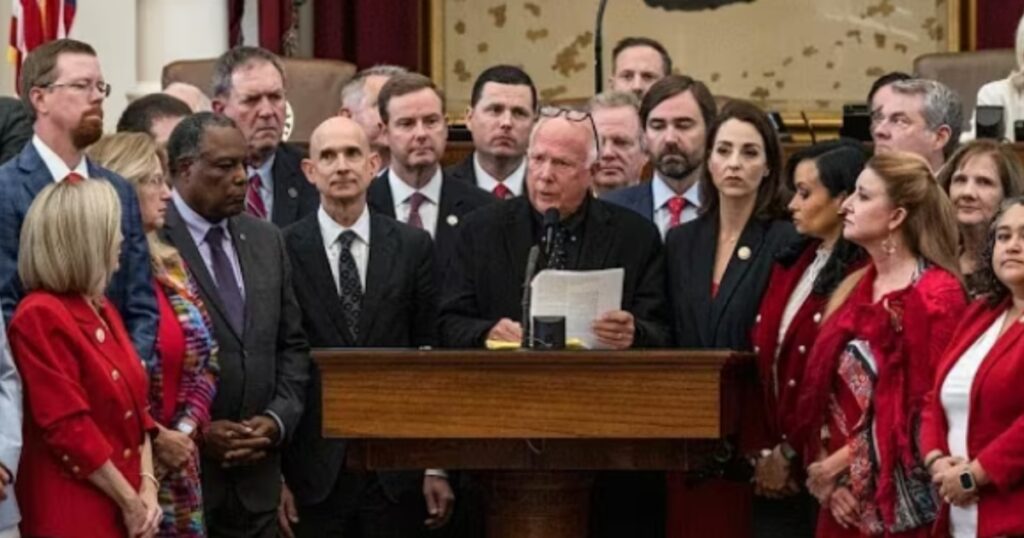
In the never-ending battle over congressional maps, Republicans might have overplayed their hand. Over the past few months, states across the country have rushed to redraw districts ahead of the 2026 midterms.
In Texas, Missouri, Ohio, Utah, and North Carolina, GOP lawmakers scrambled to lock in new advantages. Then, last week, California voters flipped the script, passing Proposition 50, a measure that lets Democrats take over redistricting power in the nation’s most populous state.
It was a political arms race, and for Republicans, it may already be backfiring.
When it comes to gerrymandering, there’s a word political scientists use for this kind of self-sabotage, “dummymander.” According to Politico, it is when a party spreads its voters too thin across more districts, chasing short-term gains that crumble when the political tide shifts. Instead of five safe 60 percent seats, you end up with seven fragile 53 percent seats, and when the winds change, those “safe” seats start falling like dominoes.
That’s what some analysts say is happening now as Democrats swept several key races last week, flipping seats and posting strong numbers among Latino voters, younger voters, and working-class voters without college degrees, groups that had been slipping away from them during the Trump years.
“Tonight is such a blowout so far that I wonder if it gives some Rs pause about redistricting in states that are still pondering it,” wrote Kyle Kondik, managing editor of the University of Virginia’s Center for Politics, after watching the results roll in.
Republicans had assumed that the strong margins they enjoyed in 2024 would hold in 2026, even without Trump on the ballot. That assumption now looks shaky.
Meanwhile, in California, Democrats are feeling emboldened as Governor Gavin Newsom praised voters for approving Prop 50, framing it as a fair response to Republican-led redistricting elsewhere. “You woke us up,” Newsom said, suggesting that Democrats are done “unilaterally disarming” in the map wars.
But while Democrats are celebrating, Republicans are staring down the same historical trap that’s swallowed parties before them. Back in the 1890s, Democrats tried the same trick, drawing districts that maximized their potential wins but left them vulnerable when the economy turned. The result was catastrophic. They lost more than a hundred House seats in 1894 and didn’t reclaim the majority for sixteen years.
The same pattern has appeared again and again: parties ride a wave, stretch too far, and then watch their map implode when the tide recedes.
Modern GOP strategists have long warned against dummymanders. Adam Kincaid, executive director of the National Republican Redistricting Trust, once put it simply, “We want 10-year maps, not maps that are going to flip back and forth.” But under pressure from Trump and hardliners in state legislatures, some Republicans couldn’t resist squeezing for more seats. In Texas, Trump claimed the party was “entitled to five more,” a statement that seemed to accelerate redrawing efforts across red states.
Now, those newly minted districts, designed for maximum advantage, could turn into liabilities. The same suburban and swing districts that looked safe a year ago suddenly look competitive again.
Republicans may soon learn what Democrats did over a century ago, when you get too greedy with the map, the map takes back what it gives.


