



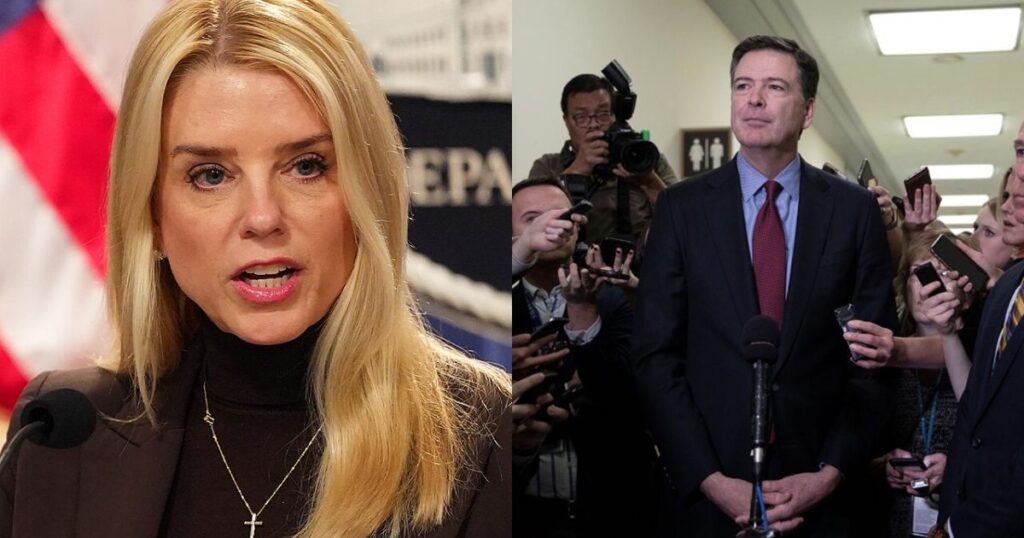
The Justice Department’s case against former FBI Director James Comey is showing new signs of weakness. This time, it’s not due to a courtroom mistake or a legal twist, but rather a missing signature lost in old FBI documents. This missing signature could challenge one of the prosecution’s main arguments.
At the center is Columbia Law professor Dan Richman, a longtime friend and former adviser to Comey. Prosecutors claim Richman acted as an anonymous source for journalists during the FBI’s investigation into Hillary Clinton’s emails.
The indictment accuses Comey of lying to the Senate Judiciary Committee in 2020. He denied allowing anyone “at the FBI” to share information with the press. However, new evidence suggests that Richman may not have worked for the FBI during the time when those leaks allegedly occurred. This raises serious doubts about the government’s position.
Documents obtained through a Freedom of Information Act request, first looked at by Lawfare, reveal that Richman’s first role as a Special Government Employee started on June 30, 2015, and ended a year later on June 30, 2016. He served without pay on an intermittent basis, advising senior FBI officials on legal and policy matters such as encryption and digital privacy. When the bureau tried to extend his appointment later that year, the process appears to have stalled.
🚨 HOLY SMOKES! President Trump DROPS THE MIC on 60 Minutes
CBS: James Comey, John Bolton, Letitia James indicted…is that political retribution?!
TRUMP: “You know what? You know who got indicted? The man you’re looking at. I got indicted – and I was INNOCENT. And here I am,… pic.twitter.com/AobXlahBea
— Eric Daugherty (@EricLDaugh) November 3, 2025
A handwritten note from an FBI official included in the FOIA materials stated, “Doc drawn up + sent to OGC for Richman signature. Never signed. Never officially reappointed after June 2016.” That brief note, hidden within a set of routine administrative records, could become one of the most important details in the case.
Prosecutors have pointed to emails and texts between Comey and Richman from October 2016 to April 2017 as proof that Comey used Richman as an unofficial channel to the media. But the timeline does not match up. The communications cited by the government happened months after Richman’s appointment had expired, and according to other internal FBI messages, he resigned entirely on February 7, 2017. This means much of the alleged behavior occurred when Richman no longer held an official role with the bureau.
Comey’s lawyers have long argued that the senators’ questions during the 2020 hearing were vague. They contend that the phrase “at the FBI” could not reasonably include outside advisers or unpaid consultants. The FOIA documents now support that claim, providing clear evidence that challenges the prosecution’s interpretation.
This revelation comes amid rising concerns about the Justice Department’s management of the case. A federal magistrate judge recently criticized prosecutors for what she called “highly unusual” conduct after it was revealed that investigators accessed communications between Comey and Richman that might have been protected by attorney-client privilege. Another judge has since ordered the department to provide a full account of its grand jury proceedings, finding that only a partial version had been submitted.
These developments have placed the government on increasingly unstable ground. What once seemed like a straightforward perjury case now appears filled with inconsistencies and internal errors, the type of mistakes that can affect a jury’s view and weaken a case from within.
If the defense can convince jurors that Richman was not technically “at the FBI” during the alleged leaks, the Justice Department’s argument could fall apart. A single unsigned document, overlooked for years and marked with a few ordinary words about missing paperwork, might turn out to be the crucial detail that changes everything.


