



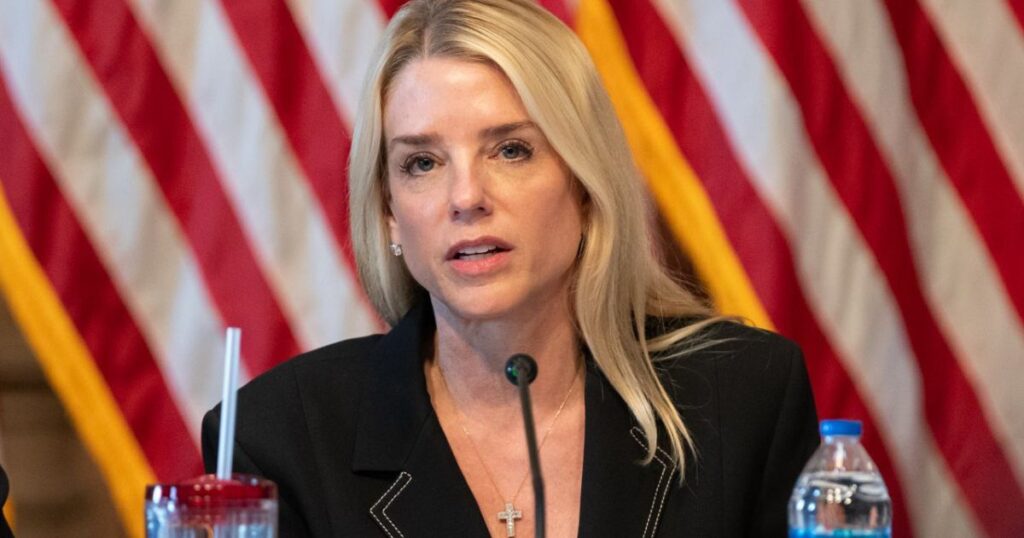
Pam Bondi is in damage-control mode. The attorney general made a surprise legal move this week to rescue two of the most controversial prosecutions her department has ever touched — the cases against Donald Trump’s longtime political enemies, James Comey and Letitia James.
In a court filing dated October 31 and made public Monday, Bondi announced she was appointing Lindsey Halligan as a “special attorney” retroactive to September 22. She also said she was officially “ratifying” Halligan’s earlier actions before grand juries in both cases. In plain terms, Bondi is trying to backfill Halligan’s authority to make sure the indictments against Comey and James don’t collapse in court.
Halligan, a former beauty pageant contestant turned insurance lawyer, had previously been Trump’s personal attorney before being tapped to run the U.S. Attorney’s Office for the Eastern District of Virginia. She took the role in September after her predecessor, Erik Siebert, was reportedly forced out for refusing to file charges against New York Attorney General Letitia James. Within weeks, Halligan indicted James and former FBI Director James Comey, both longtime Trump critics, on charges of lying to Congress and mortgage fraud.
But there was one big problem. Halligan’s appointment wasn’t legal, at least not according to defense lawyers. They argued Siebert had already served out the 120-day limit allowed for interim U.S. attorneys, which meant Halligan’s authority to act as top prosecutor was invalid. Since only her name appears on the indictments, the entire case could crumble if a judge agrees.
In her filing, Bondi tried to patch that hole, writing that “for the avoidance of doubt as to the validity” of Halligan’s actions, she was appointing her as a special attorney as of September 22, with authority to conduct “any kind of legal proceeding.” She also declared that she “ratified” Halligan’s signature on both indictments, giving them an official stamp of approval — at least on paper.
But legal experts aren’t convinced the fix will hold. Lawfare senior editor Roger Parloff pointed out that Bondi’s new appointment came a full month after the statute of limitations had expired in the Comey case. And even if the timing weren’t an issue, courts tend to look skeptically at retroactive authorizations. The whole idea of criminal law rests on clear, predictable rules, and giving someone power after the fact usually doesn’t pass muster.
Halligan’s short tenure has already been rocky. Reports say she blindsided Bondi when she pushed ahead with the Letitia James indictment without clearing it first. Critics have slammed her lack of prosecutorial experience, saying she was fast-tracked into one of the most politically sensitive roles in the country purely because of her loyalty to Trump.
Now Bondi’s move is seen as an effort to contain the fallout before the entire operation implodes. Both Comey and James have pleaded not guilty and accused the administration of using the Justice Department for revenge. Their lawyers have filed motions to dismiss the charges entirely, calling the prosecutions “politically vindictive” and “legally void.”
A federal judge is scheduled to hear arguments on November 13, and Bondi’s last-minute paperwork may not be enough to save the cases. If the court rejects her fix, Trump’s hand-picked team could be staring down a pair of embarrassing defeats, and Bondi’s credibility could take a serious hit.


