



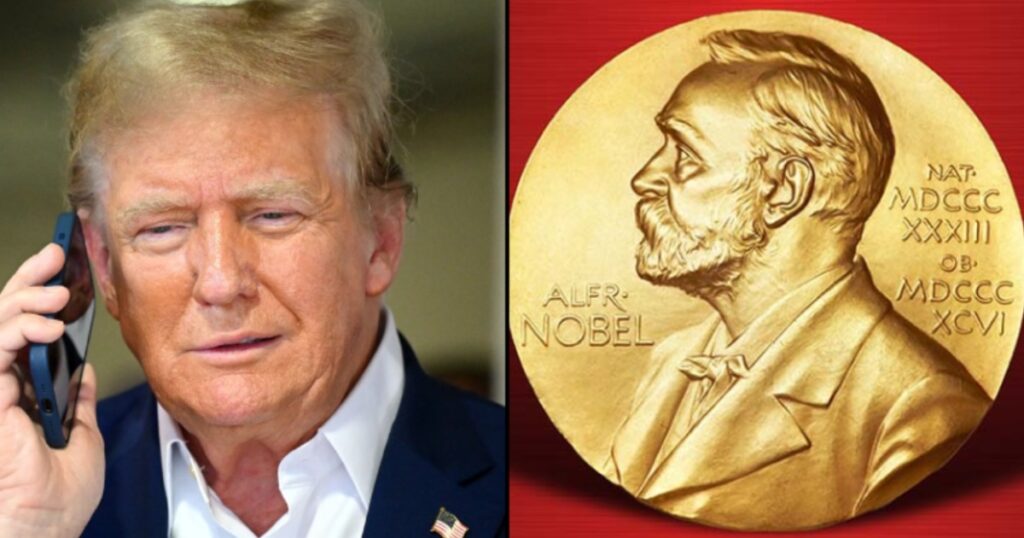
Donald Trump is once again taking credit for something he had nothing to do with. On October 7, the Royal Swedish Academy of Sciences announced the Nobel Prize in Physics would go to John Clarke, Michel Devoret, and John Martinis for groundbreaking experiments they conducted back in the mid-1980s.
The committee said the trio proved that quantum behavior can appear in systems “big enough to be held in the hand,” after they demonstrated “quantum mechanical tunnelling and quantised energy levels” in superconducting electrical circuits. Their work, carried out in 1984 and 1985, became the foundation for modern superconducting quantum computing.
That didn’t stop Trump from inserting himself into the moment. On Thursday, he took to Truth Social to share a quote he attributed to his Energy Secretary, Chris Wright, claiming, “Quantum computing, along with AI and Fusion, are the three signature Trump science efforts. Trump 47 racks up his first Nobel Prize!!” The post also referred to “a former Lawrence Berkeley National Lab scientist,” a likely reference to Clarke, who worked at the California lab decades ago. So far, Trump’s post is the only known source for Wright’s statement, and there’s no evidence the Department of Energy ever issued such remarks.
The scientists’ achievements predate Trump’s political career by nearly four decades, and the Nobel citation makes clear that the prize honors research completed in the Reagan era, not any recent U.S. policy initiative.
Clarke, a British-born physicist, was a longtime researcher at Berkeley and trained Martinis, who would go on to pioneer quantum computer design at Google. Devoret, now at Yale, helped develop the key superconducting components that underpin today’s qubit technology. Their meticulous experiments demonstrated how electricity can flow without resistance through circuits that behave like artificial atoms, a discovery that revolutionized quantum physics.
In contrast, Trump’s claim quickly drew eye rolls from scientists and commentators alike, who pointed out that the laureates’ work had been published long before the president entered politics. The only connection, they noted, was Trump’s social media post. Yet the self-congratulatory tone fits a familiar pattern. Trump has long been obsessed with the Nobel Prize, repeatedly insisting he deserved the Peace Prize for “ending wars,” though no such record exists.
Adding irony to the moment, this year’s Nobel Peace Prize went to Venezuelan opposition leader María Corina Machado, who, in a symbolic nod, dedicated her win to the “people of Venezuela” and to Trump. “We are on the threshold of victory,” she wrote, “and we count on President Trump, the people of the United States, and the democratic nations of the world as our allies.” While the message fueled Trump’s ego, the physics award he claimed credit for celebrated discoveries from decades before his political rise.
The Nobel committee summed it up best: “A major question in physics is the maximum size of a system that can demonstrate quantum mechanical effects.” Their answer lay in circuits that could fit in the palm of a hand, not in any presidential directive. Trump may want to share in the glory, but the credit belongs firmly to Clarke, Devoret, and Martinis, the scientists who actually earned it.


