BepiColombo becomes second mission to orbit Mercury
The European and Japanese probes will separate in December and study Mercury from different altitudes.
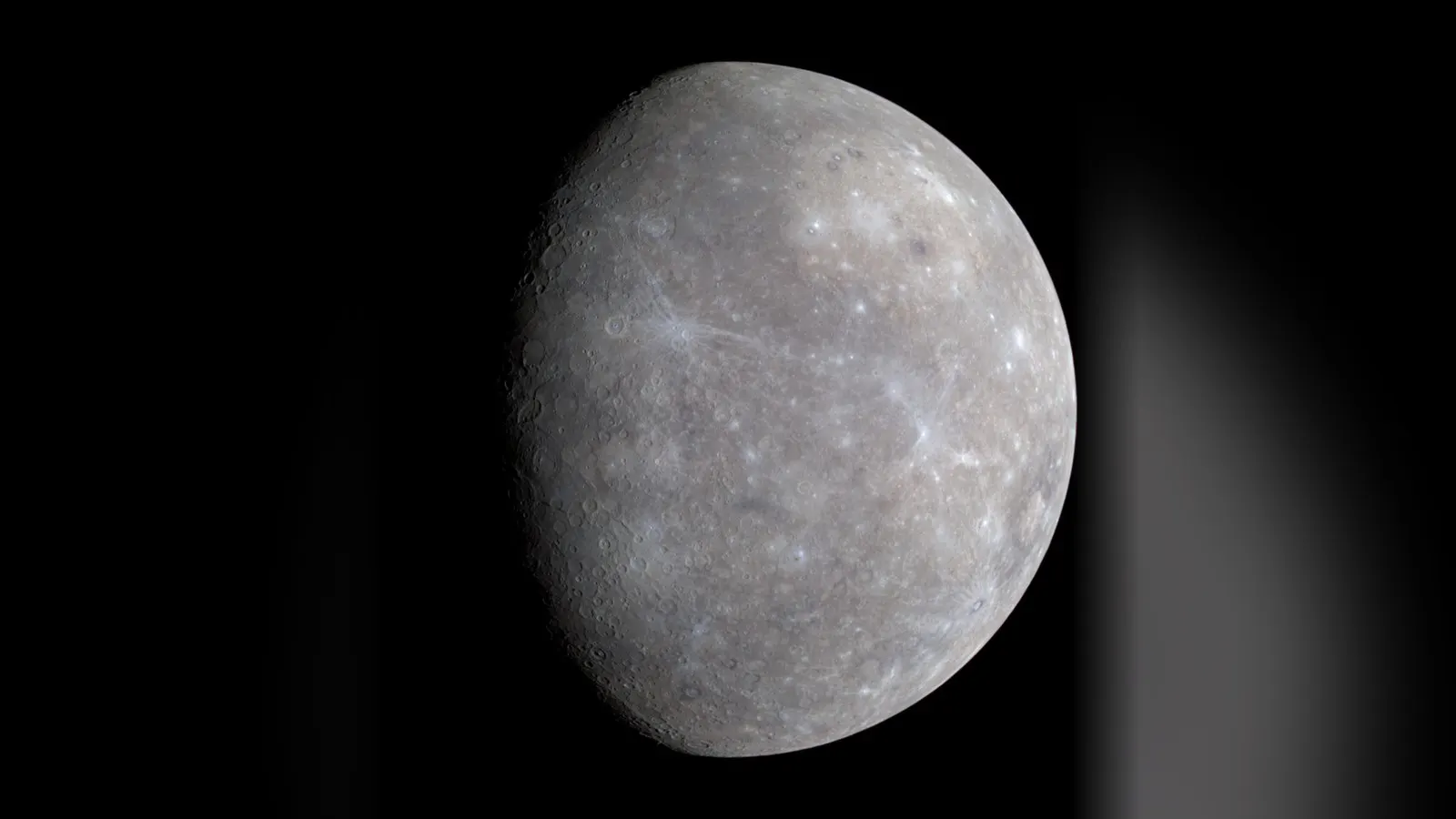
BepiColombo’s paired European and Japanese spacecraft entered Mercury’s orbit on Saturday after eight years in space, becoming the second mission to circle the planet after NASA’s Messenger.
The European Space Agency (ESA) announced the arrival on social media. Controllers in Germany took several hours to confirm the orbit from a distance of 94 million miles (152 million kilometers), The Associated Press reported.
Teams were analyzing data from the spacecraft, and further details of the maneuver were not immediately available.
“We're very excited, it's been a long wait,” said Emma Bunce, a University of Leicester professor who has spent 20 years working on the project.
ESA built one of the linked probes, while the Japan Aerospace Exploration Agency (JAXA) built the other. Geraint Jones, ESA’s lead project scientist on BepiColombo, said scientists will be able to compare “unprecedented measurements taken by two spacecraft at the planet at the same time.”
Probes to separate in December
The two probes will remain attached until they reach the orbit prescribed for JAXA’s MIO on Dec. 9, according to Nature. They will then separate to circle Mercury at different altitudes.
MIO’s orbit will range from 500 kilometers to 11,000 kilometers above Mercury. ESA’s Mercury Planetary Orbiter will gradually descend to an orbit ranging from 400 to 1,500 kilometers by March 2027.
Science operations are scheduled to begin in April next year. Jones said he and others are eager for the first new data to arrive in the spring.
ESA said its orbiter will produce high-resolution maps of Mercury’s surface and composition, while studying its interior and unusually large core. JAXA said MIO will measure the planet’s magnetic field, its interaction with the solar wind and its thin sodium exosphere.
Beyond cameras for the surface, Jones said, “we'll be 'tasting' the gases around the planet, sensing the magnetic field, probing the interior with ultrasensitive instruments, and mapping the shape of the whole planet with a laser.”
Mercury has four times the moon’s mass, though it is only 50% larger, and the mission will investigate the reason for its density. Researchers also hope to learn how Mercury formed so close to the sun, why it has a magnetic field and what its permanently shadowed crater ice contains, The Guardian reported.
Braking toward Mercury
Mercury’s position near the solar system’s center makes it a difficult destination. The sun’s gravity accelerates spacecraft, which must brake for much of the trip to avoid flying past the planet. Thruster firings slowed BepiColombo sufficiently for Mercury’s weak gravity to capture it.
BepiColombo launched in October 2018 and covered more than 6 billion miles (10 billion kilometers). It used gravity assists from one flyby of Earth, two of Venus and six of Mercury.
The spacecraft face intense heat. Temperatures at Mercury can exceed 800 degrees (427 degrees Celsius), putting strain on electronic and engineering systems, the AP reported.
“The spacecraft and its instruments need to be kept as cool as possible, which is a huge technical challenge in itself,” Jones said in an email.
The AP put the mission cost at $2 billion (1.7 billion euros). The Guardian put the figure at €1.6 billion (£1.4 billion).
NASA’s Mariner 10 made three flybys of Mercury in the mid-1970s. BepiColombo takes its name from the late Italian mathematician Giuseppe “Bepi” Colombo, a member of the Mariner 10 team.
Messenger began orbiting Mercury in 2011, then ran out of fuel and crashed into the planet in 2015.
The Guardian reported that BepiColombo’s spacecraft are expected to orbit for about three years before exhausting their fuel, descending and crashing into Mercury’s surface.
“Sadly, they are not coming back,” Bunce said.
Sources
- AP News: Little Mercury gets its first visitor in years as a pair of spacecraft loop into orbit
- The Guardian: Spacecraft reaches Mercury on second-ever mission to enter its orbit
- Nature: BepiColombo finally reaches Mercury after eight-year odyssey
- ABC News: Mercury gets its first visitor in years as a pair of spacecraft loop into orbit