



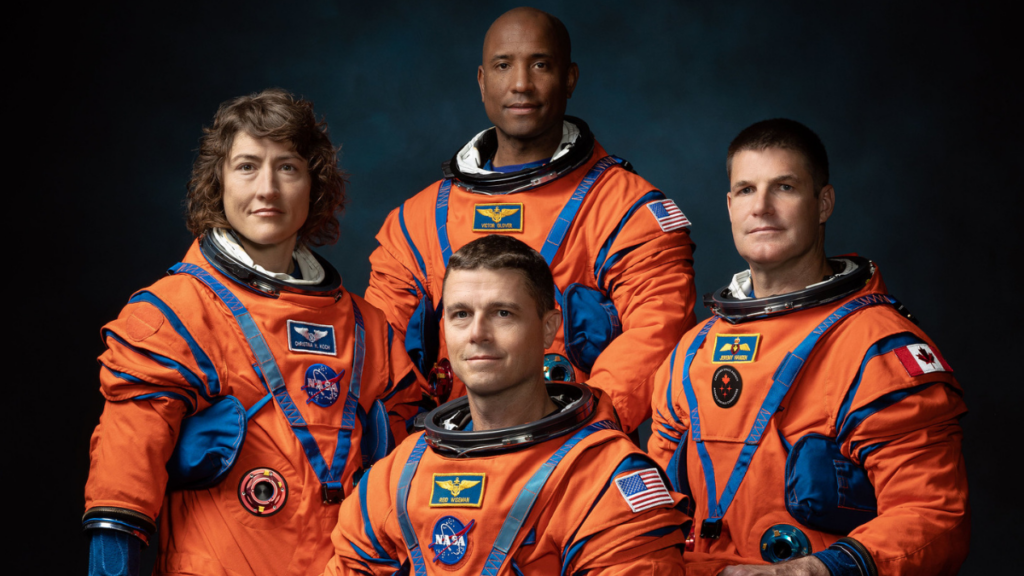
The Artemis II astronauts performed the touching tribute on Monday, April 6, as they reached the farthest distance in space from Earth any crew has ever traveled. Crewmembers on Artemis II paid homage to someone special to them after reaching a major milestone during their mission.
April 6, Artemis II Commander Reid Wiseman, Pilot Victor Glover, and mission specialists Christina Koch and Jeremy Hansen orbited 252,756 miles from Earth while nearing the far side of the Moon. Surpassing the Apollo 13 record of 248,655 miles set in 1970, the April 6 record was reached on day six of Artemis II, People magazine reports.
In an emotional call down to mission control in Houston, the Artemis II crew asked to name one of the moon’s craters “Carroll,” in memory of commander Reid Wiseman’s late wife.
The meaningful moment concluded with the astronauts sharing a group hug. pic.twitter.com/XVDCm6KVwl
— The Washington Post (@washingtonpost) April 6, 2026
In celebration of reaching the milestone, the Artemis II crew decided to name one of two newly discovered craters on the Moon after Wiseman’s late wife, Carroll. Wiseman’s wife died of cancer in 2020.
“A number of years ago, we started this journey in our close-knit astronaut family, and we lost a loved one. And there’s a feature in a really neat place on the moon,” Hansen said to mission control. “At certain times … we will be able to see this from Earth. And so we lost a loved one, her name is Carroll, the spouse of Reid, the mother of Katie and Ellie,” Jeremy Hansen continued. “And it’s a bright spot on the moon — and we would like to call it Carroll.”
Emotions welled up from the Artemis II crewmembers and some began to cry. Commander Reid Wiseman was seen hugging Hansen. The crewmembers also named a second crater after their spacecraft, Artemis II launched on April 1 and was the first crewed flight to the moon in over half a century.
The spacecraft reached a maximum distance of 252,756 miles from Earth on Monday, which NASA says is about 4,111 miles farther than Apollo 13. The crew observed a seven-hour window and sailed through a solar eclipse.
In an emotional moment broadcast live from the Orion spacecraft, the Artemis II crew chose to name a Moon crater “Carroll” after commander Reid Wiseman’s wife, who died of cancer in 2020.
“It’s a bright spot on the Moon. And we would like to call it Carroll.” pic.twitter.com/3p220FdaV7
— CBS News (@CBSNews) April 6, 2026
NASA reported that the crew “made their closest approach” to the Moon at 7 p.m. local time, “flying at about 4,067 miles above the surface,” before later reaching the mission’s farthest distance from Earth.
“As they flew over the Moon’s far side, the crew photographed and described terrain features including impact craters, ancient lava flows, and surface cracks and ridges formed as the Moon slowly evolved over time,” NASA said. “They also noted differences in color, brightness and texture, which provide clues that help scientists understand the composition and history of the lunar surface.”
The Artemis II team also witnessed both an “Earthset”—when Earth disappears below the Moon’s horizon—and an “Earthrise” as the Orion spacecraft reemerged from behind the lunar far side.
The Artemis II astronauts are now on their return journey to Earth. According to NASA, Orion is expected to exit the Moon’s “lunar sphere of influence” at approximately 1:25 p.m. on Tuesday, April 7.