



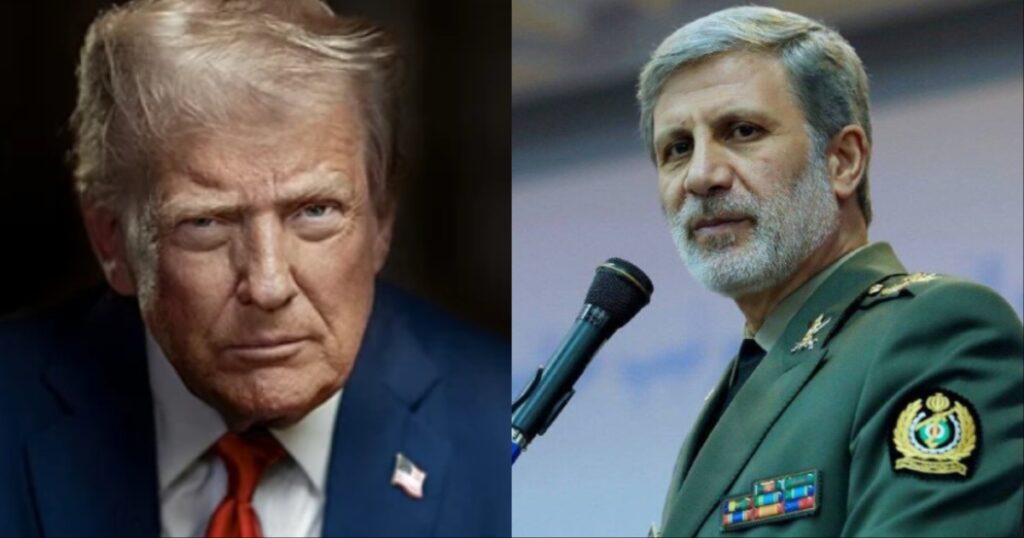
Iran’s top army commander recently warned that the Islamic Republic might take military action in response to what he called hostile words from the United States.
Maj. Gen. Amir Hatami, who leads Iran’s regular army, made these comments while addressing military academy students in Tehran on Wednesday. Many interpreted his remarks as a reaction to statements from U.S. President Donald Trump. Trump warned that the United States would step in if it continues to violently suppress peaceful protesters, and the nation saw this warning as interference in its domestic matters.
“The Islamic Republic sees the intensification of such rhetoric against the Iranian nation as a threat and will respond if it continues,” Hatami said, according to state media. “If the enemy makes a mistake, it will face a stronger response. We will cut off the hand of any aggressor.”
Iran’s government faces growing domestic unrest fueled by economic struggles, a collapsing currency, and rising prices. Protests that started with market traders in Tehran have spread across many cities. It’s the biggest protest since the death of Mahsa Amini.
Earlier this month, Trump stated that the United States was “locked and loaded,” ready to act if Iranian authorities harm peaceful demonstrators. Officials responded harshly to the provocation and accused the U.S of messing with its domestic affairs.
The latest comments reinforce Middle East nation’s belief that the recent threats are part of Israel’s and the U.S. strategy to exploit its domestic issues. Iran’s Defense Council warned last week that it might interpret hostile language and interventionist actions as reasons for preemptive action. This indicates a readiness to act before a perceived threat occurs, potentially drawing the U.S into another conflict.
Major General Amir Hatami, Commander-in-Chief of the Iranian Armed Forces, asserted that the Iran’s armed forces are now in a much higher state of readiness than before the war. He promised a stronger retaliation for any hostile mistake, swearing to “cut off the hand” of any… pic.twitter.com/x7YgbH72Le
— IRNA News Agency (@IrnaEnglish) January 7, 2026
Along with Trump’s warnings, unsurprisingly, Israeli Prime Minister Benjamin Netanyahu voiced support for protesters, which angered Tehran’s leadership. Iranian state media and officials, including Supreme Leader Ayatollah Ali Khamenei, have accused foreign powers of inciting unrest and labeled international remarks as attempts to destabilize the regime.
To ease domestic pressure, their government has introduced a new subsidy payment worth about $7 per month for millions of households to help with rising food and fuel costs. However, economic strain and political dissatisfaction continue to drive protests and clashes with security forces in cities like Tehran, Isfahan, and Shiraz.
Hatami is the first commander of the nation’s regular army, known as the Artesh, to lead this force in decades, a job traditionally held by Revolutionary Guard commanders. Observers believe his appointment after a brief conflict with Israel last June shows Tehran’s emphasis on conventional military readiness along with paramilitary capabilities.
Hatami’s warning did not clarify how they might act preemptively or what circumstances would trigger such an offensive. So far, there is no public sign of impending military action beyond these verbal threats. Nevertheless, the tone of his comments shows how closely linked the perceptions of external threats are to internal unrest in Tehran’s strategic thinking.
Iran is no Venezuela, as it is a much more capable military nation. It’s biggest advantage is long-range missiles, along with a heavily invested air and missile defense system. While they are no match to the United States, they present a threat that won’t make any actions by the United States as smooth as capturing Maduro.


