


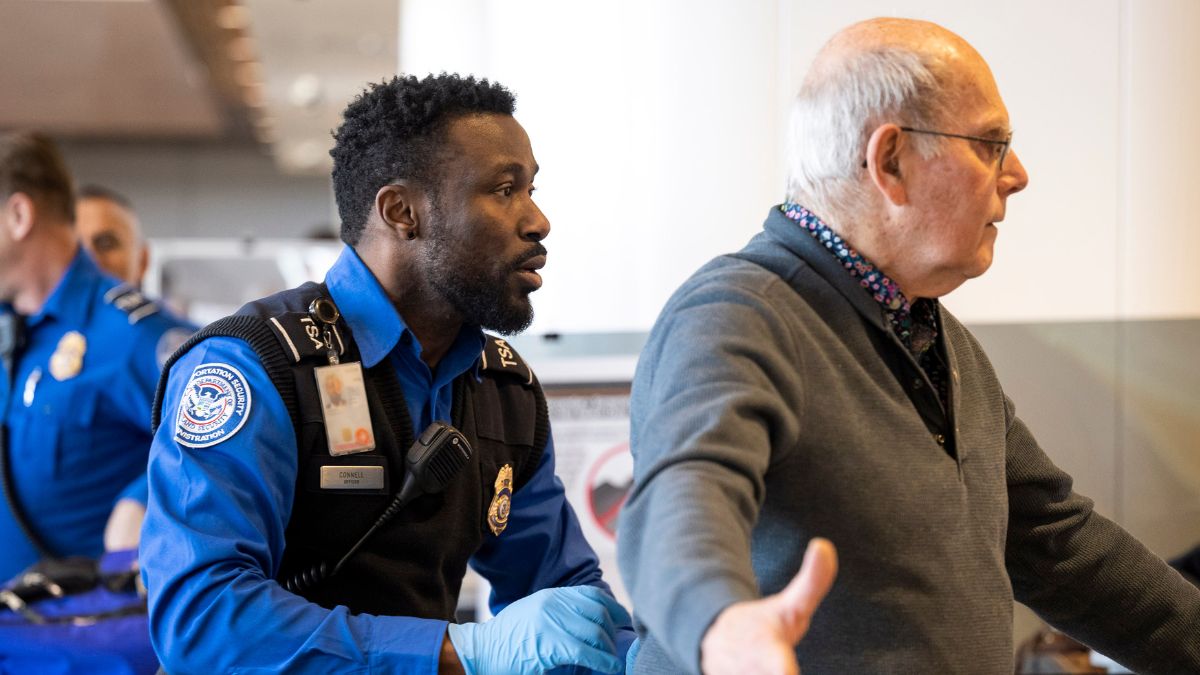
Transportation Security Administration workers are reportedly as frustrated as travellers with the Trump administration’s decision to assign ICE agents to major U.S. airports.
One union representative stated that the additional personnel are “just in the way” as long lines and staffing shortages persist during the funding standoff for the Department of Homeland Security.
Pascual Contreras, a TSA employee at Phoenix Sky Harbor International Airport, told Reuters he did not believe the agents were necessary. He emphasized that the main issue was that officers had gone more than a month without pay.
Newsweek, citing Reuters, reported that Contreras said, “On a personal level, I don’t think we need them here. We need to be paid.” Reuters also reported that ICE and Homeland Security Investigations officers were sent to about 14 airports. These included Phoenix, Atlanta, Newark, New Orleans, Cleveland, Pittsburgh, and several New York airports.
The president of the TSA workers’ union has released a statement blasting Trump for deploying ICE agents at airports:
“No way ICE can guarantee safety of the passengers. … All ICE is doing is just getting in the way.” pic.twitter.com/6cJ4mScSPj
— FactPost (@factpostnews) March 24, 2026
The deployments followed a significant absence of TSA officers during the partial shutdown. Reuters reported that nearly 12% of TSA officers, over 3,450 workers, did not show up for work on Sunday. More than 30% were absent at several major airports, such as New York JFK, Baltimore, Houston Hobby, Atlanta, and New Orleans. The agency’s staffing problems have worsened as spring break travel has increased passenger volume by about 5% from the previous year.
Federal officials stated that the immigration agents are not replacing TSA screeners. They are there for crowd control, exit-lane monitoring, and line management. Reuters reported that ICE personnel were not deployed behind security checkpoints because they lack the required clearances.
Atlanta Mayor Andre Dickens noted that federal officials informed the city that the airport assignment was meant to assist with line management in domestic terminals and was “not intended to conduct immigration enforcement activities.” TSA acting deputy administrator Adam Stahl said the ICE officers would provide “non-specialized security support.”
Despite this, travelers and airport workers reported that the extra presence did little to reduce delays. The Washington Post mentioned that some passengers at Houston airports faced waits of up to five hours, even after ICE officers arrived.
Unmasked ICE agents have been deployed at major airports across the country Monday — and they’re already being hounded by flyers and photographers. https://t.co/TID6GidJia pic.twitter.com/luW4Nl90fU
— New York Post (@nypost) March 23, 2026
At San Juan’s airport, one traveler told the Post, “If their purpose is to help, they’re not doing it.” Another passenger at JFK said the agents were “getting paid to do nothing.” Reuters also reported that at New York LaGuardia, ICE officers were seen walking the terminal without performing tasks handled by TSA officers.
President Donald Trump stated this week that ICE agents “could” make immigration arrests at airports, but said that was not their mission. “They’re really there to help,” Trump told reporters, according to Reuters. His comments came as Democrats and immigrant-rights groups criticized the deployment, arguing that the airport assignments combined a travel security crisis with the administration’s immigration enforcement.
The TSA’s bigger issue remains pay and retention. Reuters reported that 460 TSA officers have quit since the current funding dispute started, following 1,110 who left during the 2025 shutdown.
Written testimony referenced by Reuters indicated that some TSA workers had been sleeping in their cars, selling plasma, and taking extra jobs to cover bills while still being expected to secure airports.
For Contreras and other officers, the debate over the ICE deployment seems secondary to that reality. The agents may be visible in the terminal, but the missing paychecks are still driving the crisis.